
Design and Development
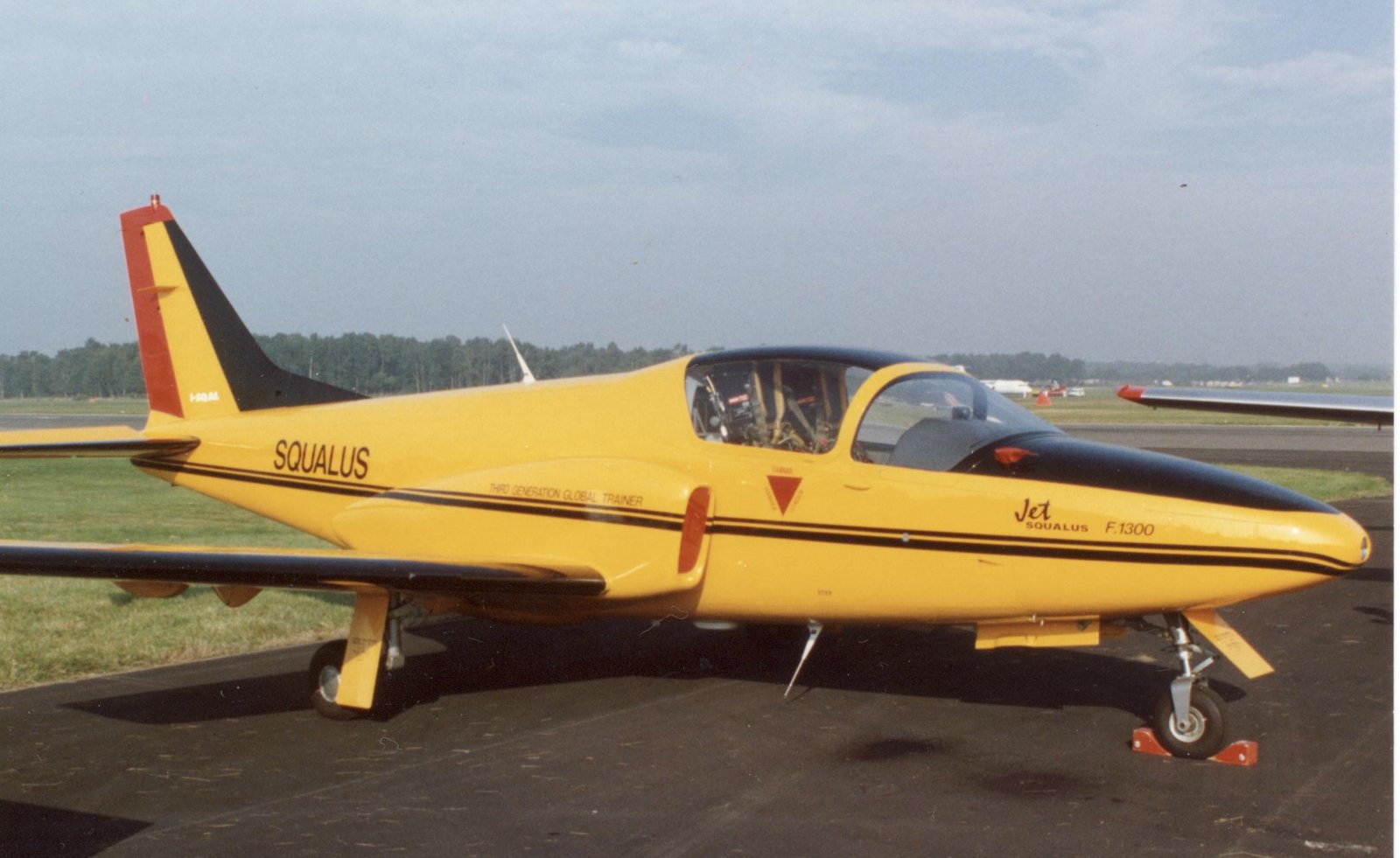
The Promavia F-1300 Jet Squalus was designed by Stelio Frati as a compact, next-generation light jet trainer intended to serve both military and civilian markets. The aircraft was conceived as a versatile platform capable of performing a wide array of roles, including pilot training, navigation and weapons training, reconnaissance, maritime surveillance, border patrol, target towing, and light attack.
While the program was associated with the Belgian company Promavia, the initial prototype was constructed by General Avia in Pioltello, Italy. The first prototype, registered as I-SQAL, made its maiden flight on April 30, 1987, piloted by Jack Zanasso from Orio al Serio Airport in Bergamo, Milan. The aircraft featured a twin-seat configuration and was engineered for high performance in a small airframe, with a length of 30.9 feet, a wingspan of 29.8 feet, and a height of 11.10 feet.
Technical Specifications and Powerplant
Originally, the Jet Squalus was powered by a single Garrett TFE109-1 turbofan engine, which provided 1,330 lbf (603 kgf) of thrust. In a later effort to improve performance, the prototype was re-engined with a Williams FJ44 turbofan, which increased the thrust to 1,800 lbf (816 kgf). The aircraft's technical specifications included a wing area of 146.2 square feet, an empty weight of 2,866 lb, and a maximum takeoff weight of 5,291 lb. It carried a fuel capacity of 190 US gallons, enabling a ferry range of 1,150 miles at an altitude of 20,000 feet. The Jet Squalus reached a maximum speed of 322 mph and a cruise speed of 300 mph, with a service ceiling of 36,991 feet.
Production and Operational History
Despite extensive promotion and flight demonstrations, the F-1300 never entered series production. Only two airframes are firmly documented: the flying prototype and a second airframe, registered as OO-JET, which was built but never flown. While some reports suggest other incomplete airframes may have existed, these remain unverified. The Belgian Air Force reportedly declined to place an order for the aircraft, and no other military or commercial operators ever put the type into active service, although records associate Sabena with the OO-JET airframe.
Legacy
The failure to commercialize the Jet Squalus eventually contributed to the downfall of the program's Belgian backers, as Promavia went bankrupt in 1998. The aircraft serves as a historical example of the difficulties inherent in the 1980s trainer market. The original prototype survived and was later registered in the United States as N112SQ.