
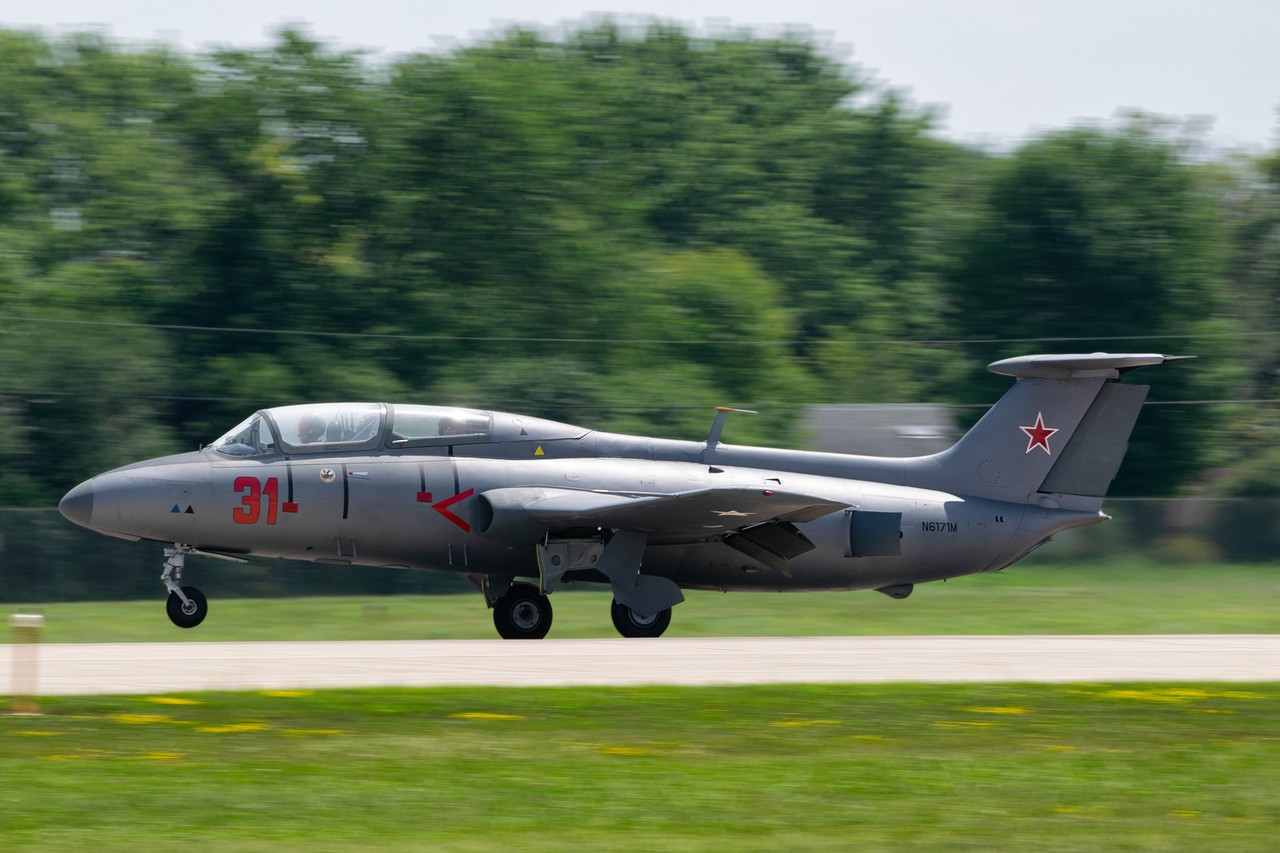
Dominance in Eastern Bloc Training
The L-29 Delfín achieved remarkable success within the Soviet sphere of influence, with approximately 3,600 aircraft produced between 1963 and 1974. The Soviet Air Force alone operated around 2,000 examples, while more than 30 nations eventually flew the type. This widespread adoption stemmed from a 1961 Warsaw Pact evaluation where the L-29 outperformed its competitors, the Yakovlev Yak-30 and PZL TS-11 Iskra, completing 15 test rounds compared to just 10 for the rival designs.
Design Philosophy and Innovation
The design team led by Jan Vlček, Z. Rublič, and K. Tomáš created the L-29 with specific objectives: replace aging piston-engine trainers throughout the Eastern Bloc and provide a rugged platform capable of operating from unprepared airfields. The aircraft's straight-wing configuration and robust landing gear enabled operations from grass, sand, and concrete surfaces alike. This versatility proved essential for Warsaw Pact training programs, where airfield infrastructure varied dramatically across member nations.
The prototype XL-29 initially flew with a British Bristol Siddeley Viper turbojet, but production aircraft featured the domestically-produced Motorlet M-701 engine. This powerplant change reflected Czechoslovakia's commitment to technological independence and provided a reliable foundation for the training mission.
Aero Vodochody's Achievement
Aero Vodochody, established in Czechoslovakia during the interwar period, achieved its greatest international success with the L-29 program. The company continues operations today as Aero Vodochody Aerospace in the Czech Republic, having survived the political transformation following the 1993 division of Czechoslovakia. For the L-29 program, Vodochody coordinated with Motorlet, which produced approximately 9,250 M-701 engines between 1961 and 1968, with at least 5,000 designated for L-29 installations.
Engine and Technical Specifications
The Motorlet M-701C turbojet represented a significant achievement in Czech aviation technology. Producing 1,960 pounds of thrust, the engine provided adequate power for training missions while maintaining excellent reliability. The aircraft's dimensions—10.29-meter wingspan, 3.13-meter height, and 19.8 square meters of wing area—created stable flight characteristics ideal for student pilots transitioning from propeller aircraft to jets.
The tandem cockpit arrangement placed the instructor in the rear seat with full flight controls and superior visibility. This configuration became the standard for subsequent trainer designs and facilitated effective instruction during all phases of flight training.
Operational Variants and Combat Capability
While primarily designed for training, the L-29 spawned several specialized variants. The L-29A Akrobat featured single-seat configuration for aerobatic training, while the L-29R incorporated nose-mounted cameras for reconnaissance training. The basic trainer could carry up to 200 kilograms of external stores, providing light attack capability for advanced weapons training.
Major operators included the air forces of Bulgaria, Czechoslovakia (approximately 400 aircraft), East Germany, Hungary, Romania, Egypt, Syria, Indonesia, Nigeria, and Uganda. The aircraft earned the NATO reporting name "Maya" and served as the backbone of jet training programs throughout the 1960s and early 1970s.
Pilot Experience and Performance
Pilots praised the L-29's forgiving flight characteristics and robust construction. The aircraft's straightforward systems and predictable handling made it ideal for introducing pilots to jet operations. Unlike more complex fighters, the Delfín focused on fundamental jet flying skills without overwhelming students with advanced avionics or complex systems.
The straight-wing design provided excellent low-speed handling characteristics, crucial for pattern work and landing practice. This configuration, while limiting high-speed performance, proved perfect for the training role where predictability outweighed maximum performance.
Production Legacy and Current Status
Production concluded in 1974 after 11 years, with the L-29 succeeded by the more advanced L-39 Albatros. The Slovak Air Force operated 16 L-29s until 2003, representing some of the last military service for the type. Today, approximately 50 aircraft remain airworthy, primarily in civilian hands as warbirds.
The type enjoys popularity among collectors and airshow performers, particularly in the United States, England, Italy, and South Africa. Several flight training organizations, including operations in Santa Fe, New Mexico, utilize L-29s for civilian jet training. Museums worldwide preserve examples, including the MAPS Air Museum in the United States and the Estonian Aviation Museum.
The L-29 Delfín's significance extends beyond its production numbers, representing Czechoslovakia's successful entry into jet aircraft manufacturing and establishing design principles that influenced trainer development throughout the Warsaw Pact nations.