
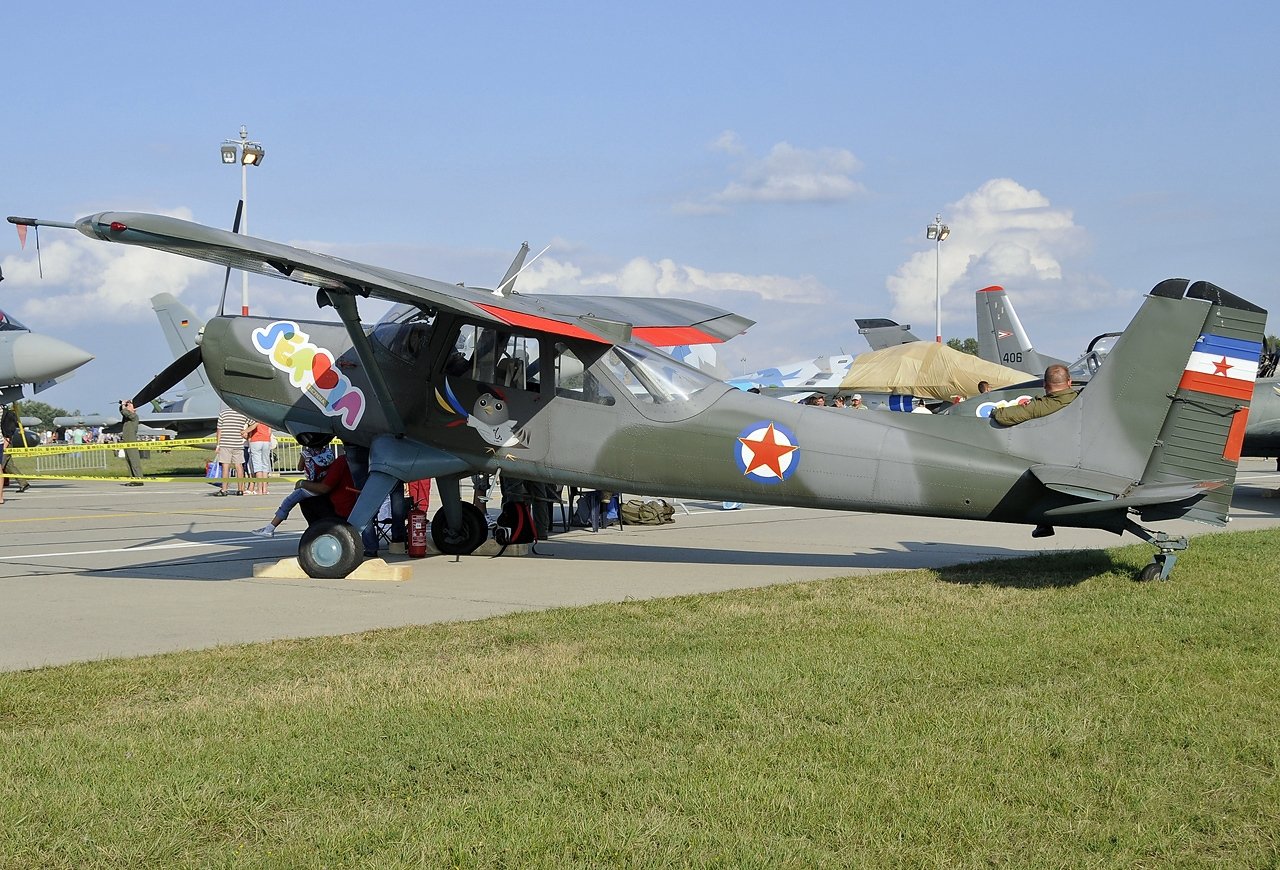
Service History
The UTVA-66 dominated Yugoslav military utility operations throughout the 1970s and 1980s, with the Yugoslav Air Force operating 117 aircraft designated with serial numbers 51001 through 51004 for prototypes and 51101 through 51185 for production models. The type served as the backbone of liaison duties, personnel transport, and glider towing operations across Yugoslavia's diverse and challenging terrain. Its exceptional STOL capabilities made it invaluable for reaching remote mountain airstrips and improvised landing sites that conventional aircraft could not access.
Wartime History
During the Yugoslav Wars of the 1990s, UTVA-66 aircraft found themselves scattered among the emerging successor states. Some examples fell into service with Slovenian and Croatian forces after the breakup, though their role remained limited to utility and liaison missions rather than combat operations. The type's military service officially ended in 1999 when the last examples were withdrawn from active duty. Following demilitarization, surplus aircraft were exported to civilian operators in Canada, the United States, France, and Ireland.
The Manufacturer
UTVA emerged from Yugoslavia's ambitious post-World War II aviation industry expansion, established alongside other manufacturers like SOKO, Ikarus, and Zmaj. Based in Pančevo near Belgrade, the company specialized in light utility and training aircraft throughout the Cold War era. The UTVA-66 represented the culmination of the company's evolutionary design process, building upon lessons learned from the earlier UTVA-56 and UTVA-60 models. The Yugoslav aerospace sector's collapse during the 1990s wars devastated UTVA, with successor entities operating under various names including Erebus before evolving into current Serbian aviation companies with limited continuity to the original manufacturer.
Engine & Technical Innovation
The heart of the UTVA-66's performance lay in its Lycoming GSO-480-B1J6 air-cooled flat-six engine, producing 200 kilowatts (270 horsepower). This powerplant, manufactured by Lycoming Engines (a division of Avco Corporation, later Textron), provided the thrust necessary for the aircraft's impressive short-field capabilities. The design team incorporated fixed leading-edge slats, full-span flaps, and drooping ailerons to maximize lift at low speeds—innovations that distinguished it from conventional utility aircraft of the era.
The aircraft's wing design utilized a modified NACA 4412 airfoil across 18.08 square meters (194.6 square feet) of wing area, optimized for maximum lift generation during critical takeoff and landing phases. With an empty weight of 1,250 kilograms (2,756 pounds) and maximum takeoff weight of 1,814 kilograms (3,999 pounds), the UTVA-66 could carry substantial loads while maintaining its short-field performance characteristics.
Operational Versatility
Pilots praised the UTVA-66 for its forgiving handling characteristics and remarkable adaptability to harsh operating conditions. The aircraft's dual flight controls made it suitable for training missions, while removable seats allowed rapid reconfiguration for medical evacuation with two stretchers. The 66H variant demonstrated the design's flexibility with interchangeable pontoon floats for water operations or skis for winter conditions, expanding its operational envelope beyond conventional airstrips.
With a fuel capacity of 250 liters (66 US gallons), the aircraft provided adequate range for its intended liaison and utility missions while maintaining the weight distribution necessary for optimal short-field performance. The rugged landing gear and reinforced structure enabled operations from rough, unprepared surfaces that would challenge more conventional designs.
Production Legacy
UTVA manufactured more than 130 UTVA-66 aircraft during the late 1960s production run, making it one of Yugoslavia's most successful indigenous aircraft designs. The type represented the pinnacle of the country's light aircraft manufacturing capability before the industry's decline and eventual collapse in the 1990s. Today, several examples remain airworthy in civilian hands across North America and Europe, where they have found new life as rugged backcountry aircraft prized for their exceptional short-field capabilities.
The UTVA-66 stands as a testament to Yugoslavia's post-war aviation ambitions and engineering competence, bridging the gap between military utility requirements and civilian recreational flying. Its survival in small numbers continues to demonstrate the soundness of its original design philosophy, nearly six decades after its maiden flight.