
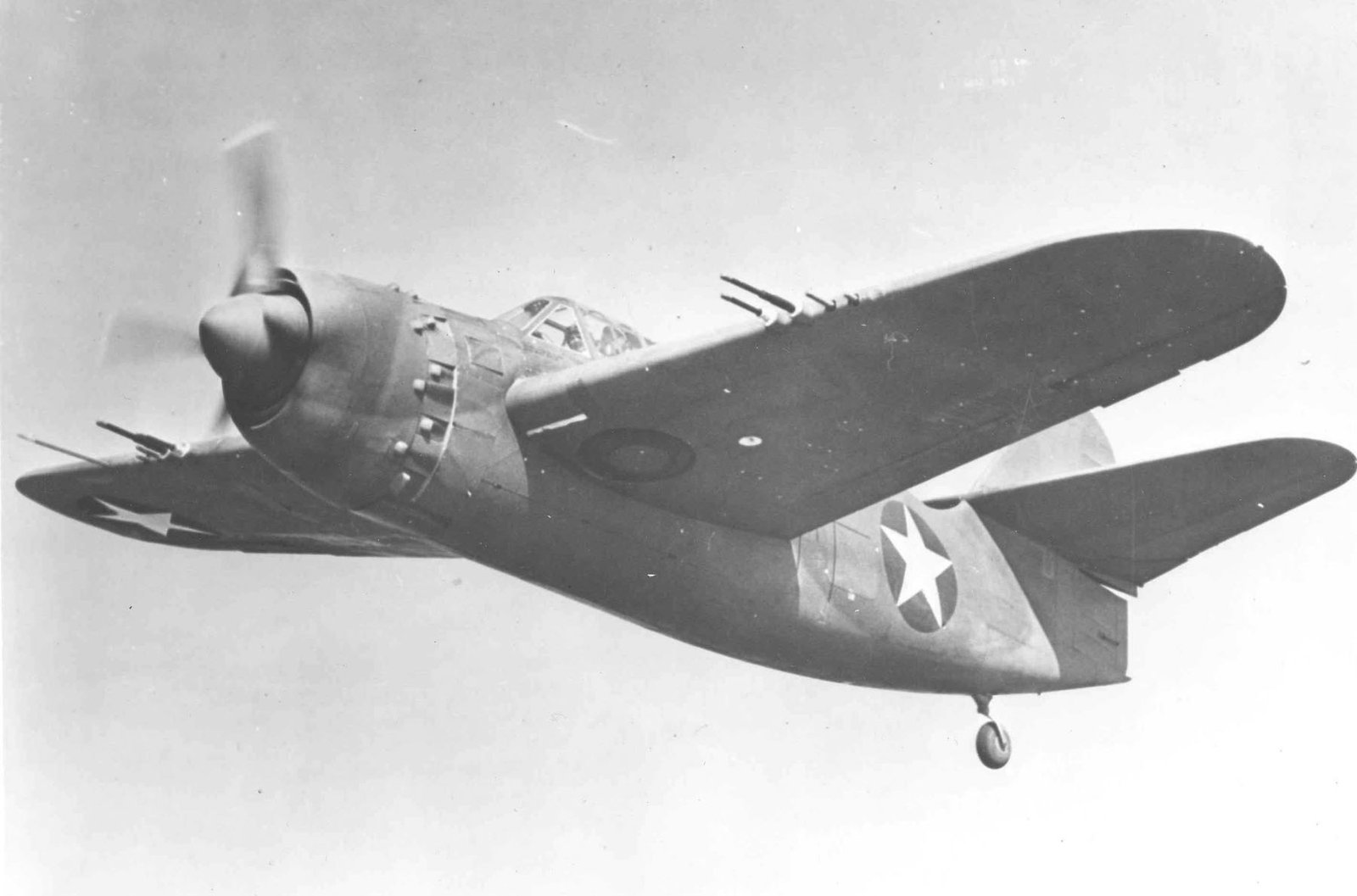
The Brewster XA-32 was conceived as a specialized "Close Support Army Cooperation Airplane," a role inspired by the U.S. Army's analysis of the German Junkers Ju 87 "Stuka" in 1940. Following a 1941 requirement, the Brewster Aeronautical Corporation developed the XA-32 as a single-seat dive bomber intended to combine the heavy ordnance capacity of a bomber with the strafing power of a heavy fighter. The first prototype took flight on May 22, 1943.
Technically, the XA-32 was powered by a Pratt & Whitney R-2800 two-row 18-cylinder radial piston engine, rated at approximately 2,100 horsepower. To fulfill its dive-bombing role, the aircraft featured split dive-flaps and an internal bomb bay capable of housing a 1,000-lb bomb. Additional underwing racks could carry two more 1,000-lb bombs, bringing the total payload to 3,000 lb. For offensive fire, the design proposed either eight 0.50-inch machine guns or four 20 mm cannons in the wings. To protect the pilot during low-level attacks, the airframe incorporated heavy internal armor.
Despite these capabilities, the aircraft suffered from severe performance deficits. In a light test configuration without armament or ballast, the prototype reached a maximum speed of only 311 mph at 10,000 feet, falling short of the expected 330+ mph. When fully equipped for combat, the cruise speed dropped below 200 mph, and the aircraft experienced significant vibration and handling difficulties. Other reported performance figures included a service ceiling of 26,000 feet, a rate of climb of 1,754 ft/min, and a maximum ferry range of 960 miles.
Only two prototypes were completed: the XA-32 and the refined XA-32A. The program was cancelled in 1944 as the U.S. Army Air Forces shifted their preference toward versatile fighter-bombers, such as the Republic P-47 Thunderbolt. The failure of the XA-32 contributed to the downfall of the Brewster Aeronautical Corporation, which had been plagued by mismanagement and inefficiency. After the U.S. Navy cancelled all remaining contracts on July 1, 1944, the company folded by 1945–1946. No XA-32 airframes survived the program's cancellation.