
Service History
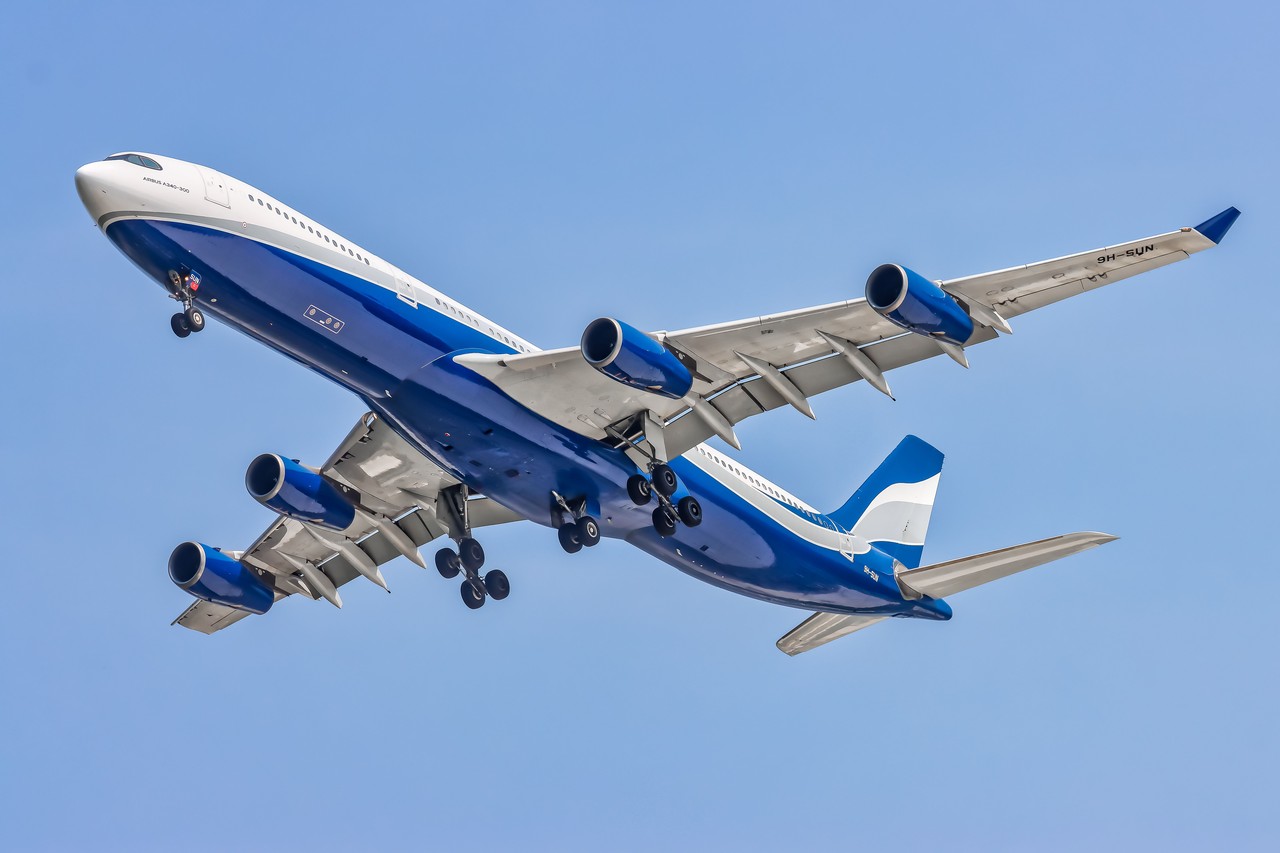
The A340-300 achieved remarkable success in commercial aviation, with 218 aircraft delivered between 1991 and 2013, making it the most popular variant of the entire A340 family. Following certification on December 22, 1992, the aircraft entered service in March 1993 with launch customers Lufthansa and Air France, establishing itself as a dominant force on intercontinental routes between Europe and Asia. Air France operated the largest fleet with 28 aircraft, followed by Iberia with 21, while other major operators included Cathay Pacific, South African Airways, and Philippine Airlines.
The aircraft's four-engine configuration provided airlines with enhanced reliability over remote oceanic routes, particularly before extended-range twin-engine operations (ETOPS) regulations allowed twin-jets to fly similar distances. This capability made the A340-300 particularly attractive to carriers operating transpacific and transatlantic services where engine redundancy was valued over fuel efficiency.
The Manufacturer
Airbus Industrie, established as a European consortium in the 1970s to compete with American manufacturers Boeing and McDonnell Douglas, launched the A340 program in June 1987 alongside the twin-engine A330. The company began conceptual work on the A340 family in the 1970s as part of their strategy to offer a comprehensive range of wide-body aircraft. Today operating as Airbus SE, the company remains a leading global aerospace manufacturer, having successfully challenged Boeing's dominance in commercial aviation.
The A340 represented Airbus's ambitious entry into the long-range, high-capacity market segment previously dominated by the Boeing 707-300 and Douglas DC-8. By developing the A340-300 with a longer fuselage than the initial A340-200, Airbus created an aircraft that could carry more passengers while maintaining similar range capabilities, effectively targeting airlines seeking maximum efficiency on high-density long-haul routes.
Engine & Technical Details
The A340-300's four CFM International CFM56-5C turbofan engines, manufactured by the joint venture between General Electric and Safran Aircraft Engines, represented proven technology adapted for long-range operations. These engines, part of the highly successful CFM56 family that became one of the world's most widely used commercial powerplants, provided the reliability and fuel efficiency necessary for extended over-water flights.
Later production A340-300s incorporated improved avionics and fly-by-wire flight control systems, reflecting Airbus's commitment to advanced technology integration. The aircraft typically required a crew of two pilots, benefiting from Airbus's common cockpit philosophy that allowed pilots to transition easily between different Airbus aircraft types with minimal additional training.
Performance & Operational Characteristics
The A340-300's extended range of up to 9,000 nautical miles enabled non-stop flights between virtually any two points on Earth, making it particularly valuable for airlines serving thin long-haul routes where smaller aircraft would be more economical than larger twin-jets. This capability allowed carriers to open new route possibilities and provide passengers with convenient direct services to previously difficult-to-reach destinations.
Pilots appreciated the A340-300's stable handling characteristics and the confidence inspired by its four-engine configuration during challenging weather conditions or when operating from high-altitude airports. The aircraft's performance made it especially suitable for routes to destinations with challenging approach conditions or limited diversion airports.
Production & Legacy
Production of the A340-300 ceased in 2013, though Airbus had officially terminated the entire A340 program on November 10, 2011, due to declining orders and intense competition from more fuel-efficient twin-engine aircraft like the Boeing 777. The aviation industry's shift toward twin-engine operations, driven by improved engine reliability and rising fuel costs, ultimately sealed the fate of four-engine aircraft in the commercial market.
As of March 2024, 61 A340-300s remained in active airline service from the original 218 delivered, with many finding second careers in the charter market where their spacious cabins and long range continue to provide value. The aircraft has proven particularly popular for high-end charter operations, with business-class configured versions featuring lie-flat beds serving sports teams, entertainment industry clients, and luxury travel markets.
The A340-300 was succeeded by the A350-900, which offers similar passenger capacity and range with significantly improved fuel efficiency through modern twin-engine design and advanced materials. Despite its commercial obsolescence, the A340-300 remains an important milestone in aviation history, representing the final generation of successful four-engine commercial aircraft and demonstrating Airbus's ability to compete effectively in the long-range airliner market during the transition from tri-jets and quad-jets to modern twin-engine designs.