
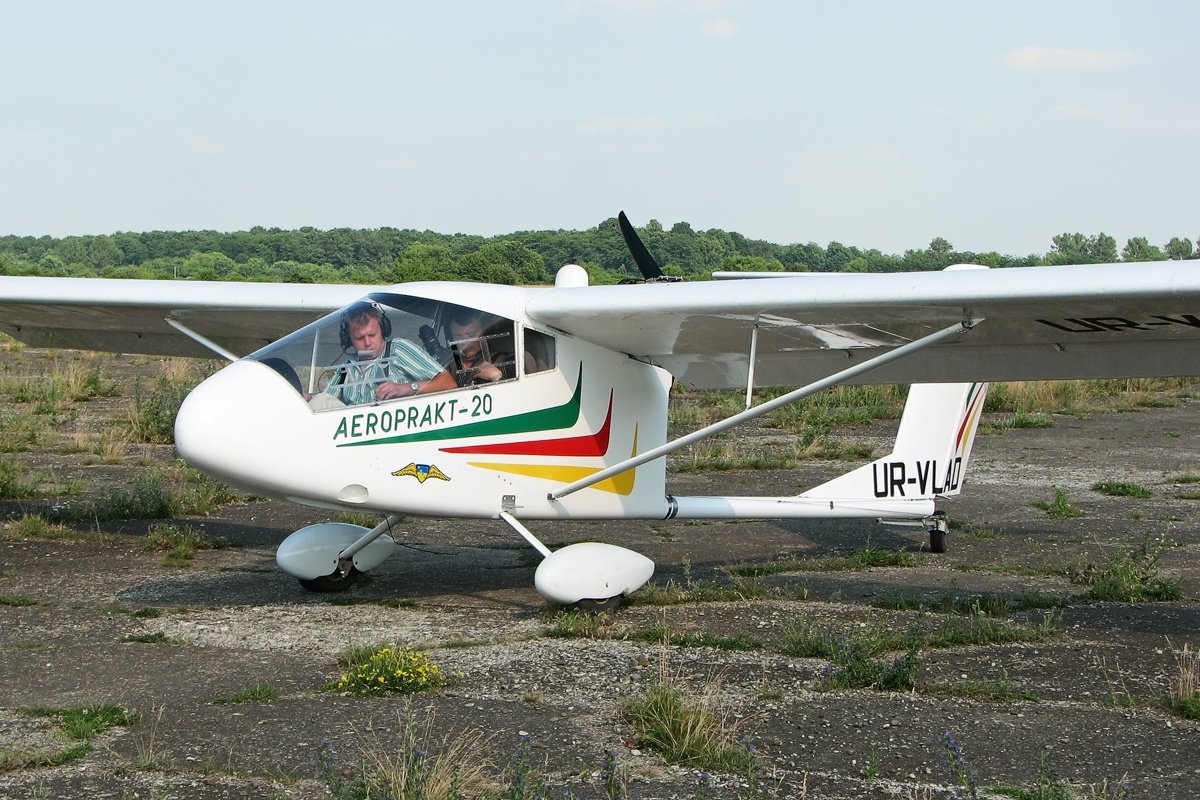
Design Genesis and Development
Yuri Yakovlev initiated the A-20 Vista project in September 1990 as Ukraine transitioned toward independence, drawing upon his experience at the renowned Antonov Aircraft Design Bureau. Working alongside Oleg Litovchenko and fellow engineers from the Aeroprakt Aero Club in Kiev, Yakovlev envisioned an ultralight aircraft that would democratize aviation access while delivering professional-grade performance. Construction of the prototype commenced in November 1990, culminating in the maiden flight on August 5, 1991—just three weeks before Ukraine declared independence from the Soviet Union.
Technical Innovation
The A-20's design broke new ground in affordable aviation through its innovative material combination and aerodynamic configuration. Yakovlev specified a low-drag fiberglass forward fuselage and cockpit section, seamlessly integrated with aluminum wings featuring highly effective flaps. This hybrid construction approach reduced manufacturing costs while maintaining structural integrity and performance. The pusher engine configuration, mounted behind the cockpit, provided unobstructed forward visibility crucial for training operations and enhanced the aircraft's short-field capabilities.
The wings incorporated the TsAGI P-IIIA-15 airfoil section, developed by Russia's Central Aerohydrodynamic Institute, which contributed significantly to the aircraft's remarkable low-speed handling characteristics. With flaps deployed, the A-20 achieved a stall speed of just 30 mph, enabling operations from fields as short as 200 feet. The high-wing, strut-braced configuration provided inherent stability that made the aircraft particularly suitable for pilot training.
Production and Manufacturing
Financial backing from Finnish investors enabled Aeroprakt to begin production in 1993, with the first production aircraft taking flight on August 15, 1993. Manufacturing took place at the company's facility in western Kiev, where skilled workers assembled approximately 70 A-20s over the subsequent decade. Each aircraft required roughly 484 pounds of empty weight to support a maximum gross weight of 990 pounds, demonstrating exceptional structural efficiency.
Three primary variants emerged during production: the base Vista model with the 50-horsepower Rotax 503 engine, the STOL/SS variant featuring the more powerful 64-horsepower Rotax 582, and the Cruiser series equipped with the 100-horsepower four-stroke Rotax 912ULS. The Cruiser variants incorporated reduced wingspan configurations—33.4 feet for the SS model and 31.0 feet for the Cruiser-S—optimizing performance for higher-powered applications.
International Recognition
The A-20 gained significant international attention following its North American debut at EAA AirVenture 1999 in Oshkosh, Wisconsin. The aircraft's combination of affordability, performance, and docile handling characteristics attracted considerable interest from sport aviation enthusiasts and flight training organizations. This exposure led to export opportunities that helped establish Aeroprakt's reputation beyond Eastern Europe.
Competitive validation came in 2002 when an A-20 captured victory at the European Microlight Championship, demonstrating that the Ukrainian design could compete successfully against established European manufacturers. This achievement highlighted the aircraft's exceptional rate of climb—990 feet per minute—and its impressive power-to-weight ratio despite utilizing relatively modest engine specifications.
Operational Characteristics
Pilots praised the A-20's forgiving flight characteristics and practical design features. The tandem seating arrangement, with the instructor positioned in the rear seat, provided optimal visibility and control for training operations. The pusher configuration eliminated propwash over the wings and fuselage, contributing to more predictable stall characteristics and improved pilot comfort.
With a fuel capacity of 9.5 US gallons, the A-20 offered reasonable endurance for local training flights and recreational flying. The aircraft's cruise speed of 70 mph balanced efficiency with the ability to operate safely in varying wind conditions. Structural limits of +4/-2 g provided adequate margins for normal aerobatic training maneuvers while maintaining certification within ultralight categories.
Company Legacy
The A-20 Vista established Aeroprakt as a serious aircraft manufacturer, paving the way for the company's subsequent success with over 1,250 total aircraft produced by the 2020s. Yuri Yakovlev's leadership as CEO and chief designer continued the tradition of innovation that began with the company's origins in 1986. The experience gained through A-20 production enabled Aeroprakt to develop more sophisticated designs while maintaining its reputation for rugged, reliable ultralights.
Today, surviving A-20s remain active in private hands across Europe and North America, testament to the aircraft's durable construction and enduring appeal. While exact airworthiness numbers are undocumented, the type's simple systems and readily available Rotax engine support contribute to continued operational viability decades after production ended.