
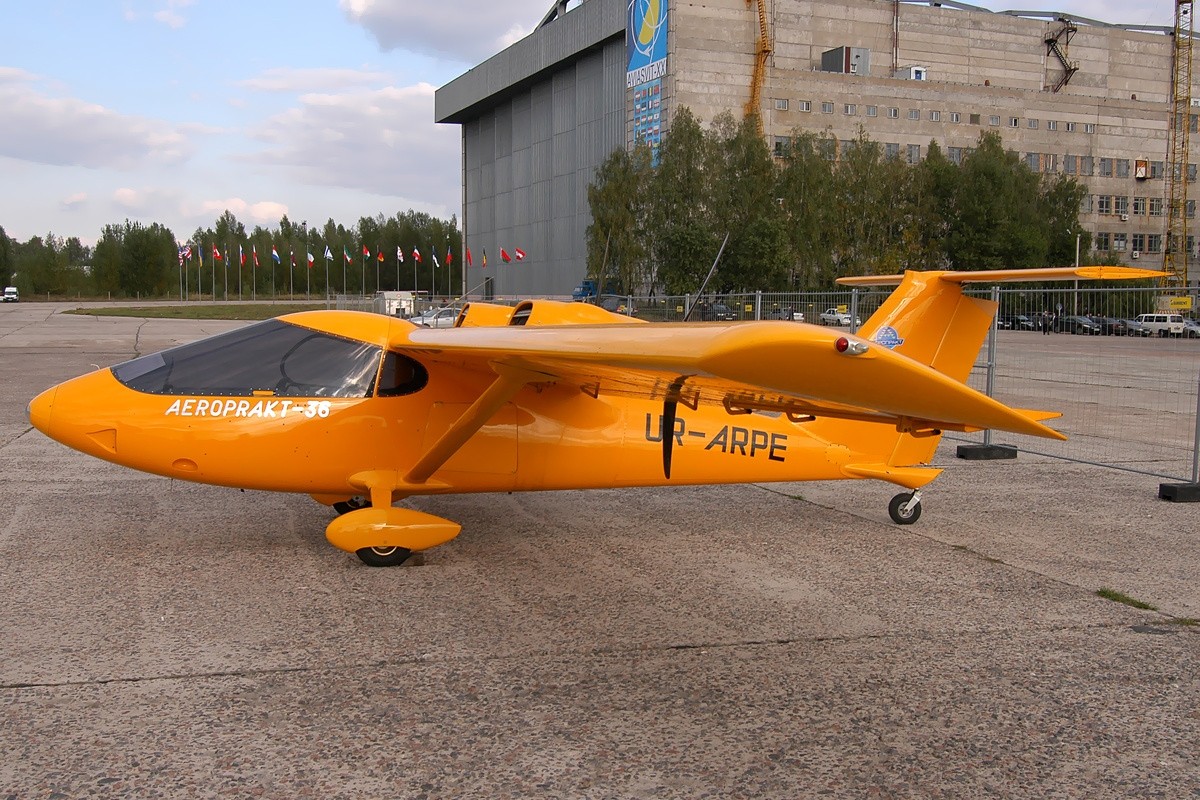
Development and Design Philosophy
The A-36 Vulcan emerged from Aeroprakt's commitment to creating aircraft capable of operating in Ukraine's diverse geographical conditions. Chief Designer Yuri Yakovlev's team engineered the aircraft with three critical objectives: safe operations over hostile terrain, single-engine takeoff and landing capability, and short runway performance. These requirements shaped every aspect of the design, from the high-mounted wing configuration to the twin-engine pusher layout.
The aircraft's mixed construction reflects practical engineering decisions. The forward fuselage utilizes fiberglass construction for strength and weight savings, while the aluminum tail cone provides structural integrity. Wings and empennage employ traditional aluminum construction, with fiberglass components limited to non-structural elements like engine cowlings and fairings. This approach balances manufacturing costs with performance requirements.
The Manufacturer's Journey
Aeroprakt's origins trace to 1974 when the design bureau was established as a public organization. Yuri Yakovlev founded the company as an amateur aircraft design club in 1986 after graduating from the Kuybyshev Aviation Institute and joining Antonov in Kyiv. Ukrainian independence in 1991 provided the opportunity for formal establishment as an independent entity.
By 1990, Aeroprakt had gained international recognition, registering in Samara's Industrial District and beginning overseas aircraft demonstrations. The company's evolution culminated in 1998 with registration as a Limited Liability Company. Under Yakovlev's leadership and Oleg Litovchenko's direction, Aeroprakt developed more than 20 aircraft types, establishing itself as a significant player in light aircraft manufacturing.
The company's product line demonstrates consistent design philosophy. The A-20 Vista debuted in August 1991, followed by the A-22 Foxbat and original A-26 Vulcan in November 1996. The A-36 represents the culmination of lessons learned from these earlier designs, particularly the A-26 Vulcan's operational experience.
Technical Innovation and Performance
The A-36's twin Rotax 912S powerplants represent a deliberate choice for reliability and maintenance simplicity. Each four-cylinder, liquid and air-cooled engine produces 75 kilowatts, providing 202 total horsepower for the 1,653-pound gross weight aircraft. This power-to-weight ratio enables the impressive 11 meters per second climb rate, crucial for the aircraft's intended terrain-following missions.
The T-tail configuration serves multiple purposes beyond aesthetic appeal. Positioned above the propeller wash, the horizontal stabilizer operates in clean air, improving control authority at low speeds. The 70 kilometer per hour stall speed demonstrates the high-wing design's effectiveness, while the 47.8 kilograms per square meter wing loading provides gentle handling characteristics.
Fuel capacity of 120 liters supports extended range operations, essential for the aircraft's design mission of operating over challenging terrain where emergency landing sites may be scarce. The pusher configuration protects the propellers from debris during rough-field operations while improving forward visibility for the crew.
Operational Experience
By 2011, the A-36 remained in active production, indicating sustained market demand. International recognition came through the aircraft's appearance at the April 2009 Sun 'n Fun gathering in Lakeland, Florida, exposing the design to the American light aircraft market. One example achieved U.S. Federal Aviation Administration registration by December 2012, demonstrating the aircraft's ability to meet international certification standards.
The aircraft's two-seat tandem configuration optimizes the fuselage for aerodynamic efficiency while maintaining communication between pilot and passenger. Unlike side-by-side seating arrangements, the tandem layout reduces frontal area and improves the aircraft's penetration through turbulent conditions common in mountainous terrain.
Legacy and Market Position
The A-36 Vulcan represents Ukrainian aerospace engineering's adaptation to post-Soviet market realities. Rather than competing with established manufacturers in saturated markets, Aeroprakt identified a niche for aircraft optimized for challenging operational environments. The design's emphasis on short-field performance and single-engine safety reflects operational requirements common in developing regions and areas with limited infrastructure.
Serial number 001, registered as UR-PAPE, continued flying operations as late as 2017, demonstrating the design's durability and operational viability. The aircraft's survival through Ukraine's political and economic challenges of the 2010s testifies to its practical value for operators requiring reliable, economical twin-engine performance.
Aeroprakt's commitment to delivering complete, ready-to-fly aircraft distinguished the A-36 from kit-built competitors. This approach appeals to commercial operators and flight training organizations requiring certified aircraft with established support networks. The design's conservative engineering choices prioritize reliability over cutting-edge performance, reflecting the practical requirements of operators in challenging environments.