
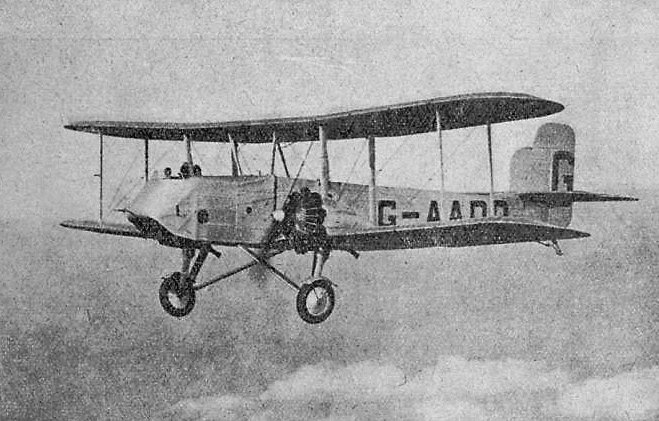
The Gloster A.S.31 Survey was a specialized British twin-engine biplane developed to facilitate long-range aerial mapping and photo-survey work. The aircraft was designed as a replacement for the single-engine de Havilland DH.9 in imperial survey roles. Gloster developed the A.S.31 by taking over a design project originally initiated by de Havilland (the DH.67). The aircraft first flew in 1929 and was manufactured by the Gloster Aircraft Company at their works in Hucclecote, Gloucestershire.
Only two examples of the A.S.31 were produced. The first aircraft, registered as G-AADO, was a civil aircraft known simply as the Survey. The second was built for the British Air Ministry and designated as K2602. The design featured a two-seat configuration for a pilot and an observer, with a fuselage and cabin specifically arranged to house heavy survey cameras and equipment. Structurally, it was a single-bay biplane with fixed landing gear and a tailwheel configuration. The aircraft proved to be exceptionally durable; records indicate that one airframe completed 500 flying hours of survey work without requiring the replacement of any major components.
Power was provided by two Bristol Jupiter XI F air-cooled, nine-cylinder radial piston engines, each producing approximately 460 hp (340 kW). These engines drove tractor propellers mounted on the lower wing roots. Technically, the A.S.31 featured a wingspan of 67 feet and a length of 42 feet. It had a maximum speed of 131 mph and a cruise speed of 110 mph, with a service ceiling of 21,900 feet. Its endurance ranged between 4.5 and 5.75 hours, providing a total range of 495 miles.
In civil service, G-AADO was operated by the Aircraft Operating Company (AOC), conducting extensive mapping flights across Africa, including operations based out of Cape Town. In March 1935, the South African Air Force (SAAF) purchased G-AADO for aerial photography work at Waterkloof, where it served until it was broken up in December 1942. The second aircraft, K2602, was delivered to the Royal Aircraft Establishment (RAE) at Farnborough in November 1931, where it was utilized for radio experiments until 1936. While the A.S.31 existed during the early years of the Second World War, it performed no combat role. No examples of the A.S.31 Survey survive today.