
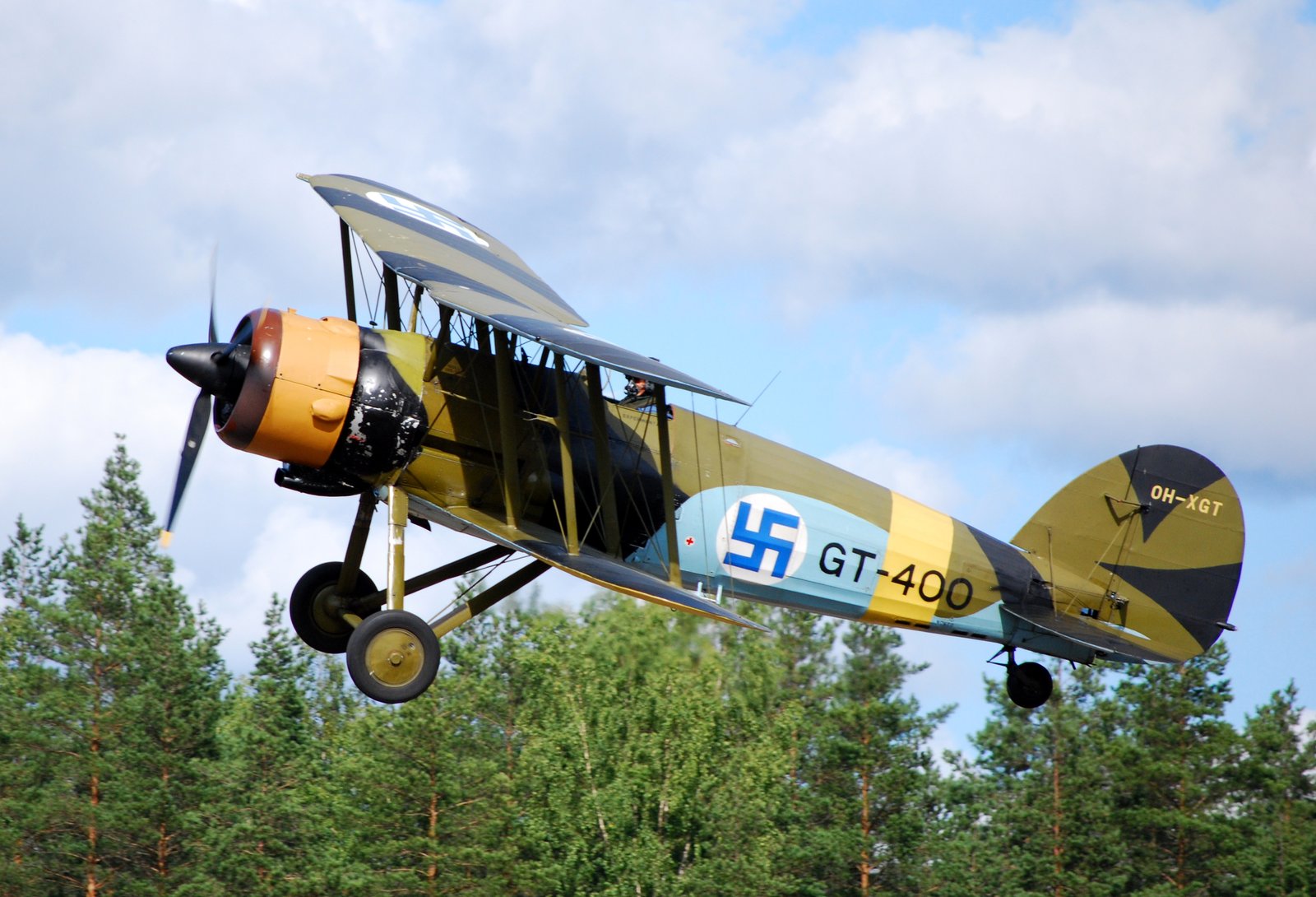
Designed by Henry Philip Folland and his team, the Gloster Gauntlet was developed to meet Air Ministry Specification F.20/27. The prototype, initially designated as the Gloster SS.18, first flew in January 1933, followed by an improved SS.19B prototype later that year. The resulting production aircraft featured a metal monocoque fuselage with fabric covering and single-bay staggered biplane wings. To enhance aerodynamic efficiency, the design incorporated a Townend ring around the radial engine and a retractable radiator located under the nose.
Production began in 1933 at the Gloster Aircraft Company's facility in Brockworth, Gloucestershire. A total of 204 Gauntlet Mk I and Mk II aircraft were built for the Royal Air Force (RAF), while 17 Gauntlet I aircraft were license-built in Copenhagen by the Orlogsværftet (Royal Danish Naval Dockyard). In total, 246 aircraft were produced. The Gloster Aircraft Company, which had been founded in 1917 as the Gloucestershire Aircraft Company, joined the Hawker Siddeley Group in 1934 and eventually ceased major aircraft production in 1956 before being absorbed into Hawker Siddeley Aviation in 1963.
Technically, the Gauntlet was powered by Bristol air-cooled radial piston engines. The Mk I utilized the 9-cylinder supercharged Bristol Mercury VI S, producing approximately 645 hp at take-off. The Mk II employed the Mercury VIS.2 or VIIIA, providing between 645 and 705 hp. These engines drove a two-blade fixed-pitch wooden propeller, allowing the Mk II to reach maximum speeds between 230 and 242 mph with a service ceiling of roughly 33,500 feet. Standard armament consisted of two synchronized .303 in Vickers machine guns, though some configurations allowed for under-wing Lewis guns.
Operational service began with No. 19 Squadron at Duxford in May 1935. Other RAF units, including Nos. 23, 32, 46, 56, 65, 73, 74, and 80 Squadrons, also operated the type. By early 1938, the Gauntlet was being replaced in first-line units by the Gloster Gladiator and Hawker Hurricane. During the Second World War, the aircraft served in training and auxiliary roles, including use by the Southern Rhodesia Air Unit. Finland acquired 25 ex-RAF Gauntlet IIs in late 1939 and early 1940, using them for advanced training during the Winter War. Denmark utilized its license-built fleet as front-line fighters until the German invasion in April 1940. Today, the Gauntlet's legacy is preserved by a single reconstructed Mk II airframe held by the Royal Air Force Museum.