
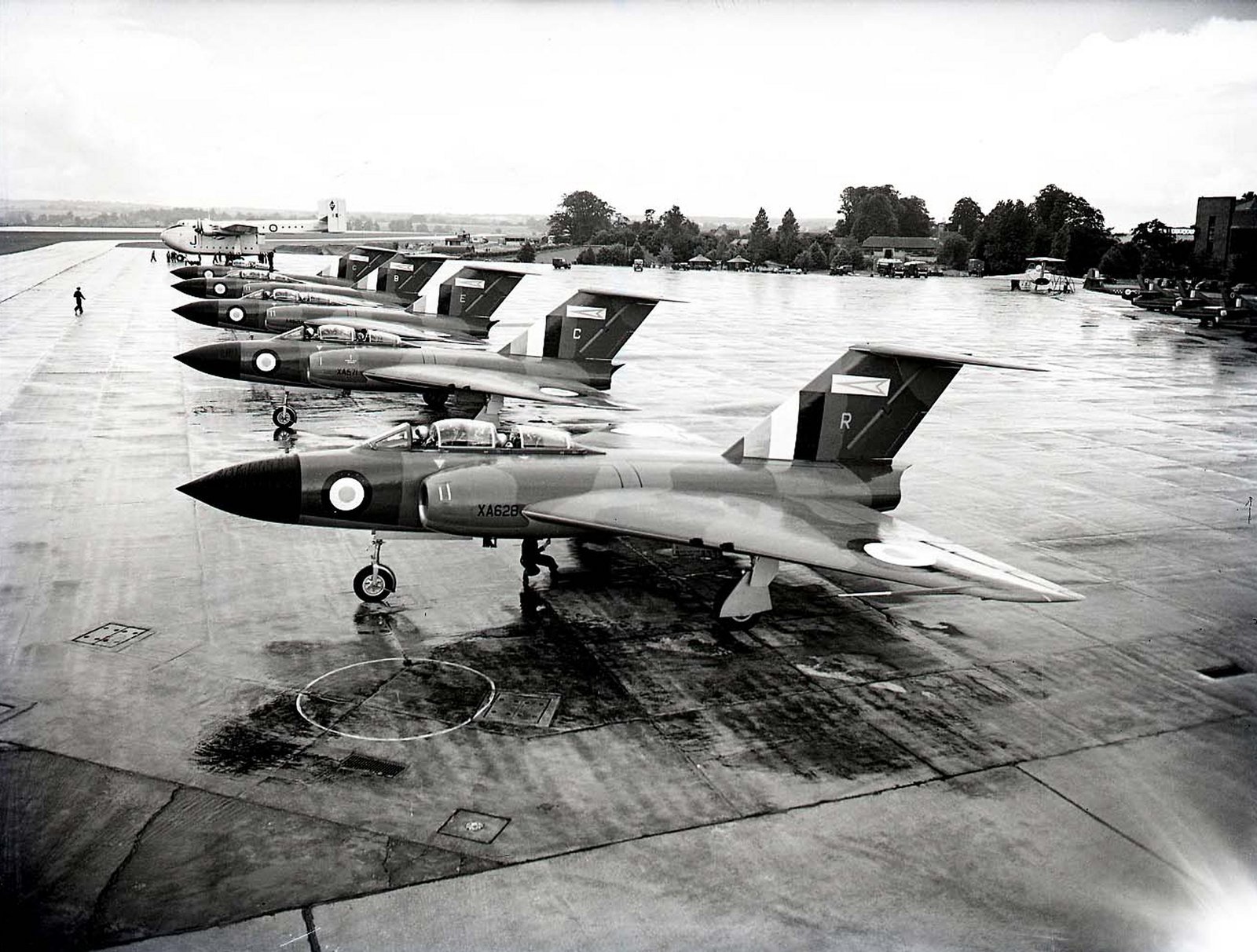
The Gloster Javelin was developed in the late 1940s and early 1950s to meet Specification F.44/46, which called for a high-performance night fighter and all-weather interceptor capable of countering high-altitude bombers. This effort resulted in a pioneering design that became the world's first twin-jet delta-wing fighter. The aircraft's configuration was characterized by its delta wing, a T-tail, and the integration of advanced radar and electronic systems essential for poor-weather operations. The first prototype, designated WD804, took to the air on November 26, 1951.
Production of the Javelin began with the first production version flying on July 22, 1954. A total of 435 aircraft were manufactured, with 302 produced by the Gloster Aircraft Company and 133 by Armstrong Whitworth. At the time of production, both companies were members of the Hawker Siddeley group. The Javelin holds a distinct place in aviation history as the final aircraft design to bear the Gloster name.
Power was provided by two Armstrong Siddeley Sapphire turbojet engines. In the FAW.1 variant, these were Sapphire SA.6 units producing 8,000 lb of thrust each, though later variants utilized Sapphire engines with significantly increased power. The aircraft's armament evolved over its service life; the FAW.1 was equipped with four 30 mm Aden cannons, while subsequent versions were upgraded with improved radar and Firestreak air-to-air missiles.
The Royal Air Force (RAF) began integrating the Javelin into squadron service in 1956, with No. 46 Squadron being the first to receive the type in February of that year. Serving in roles as a bomber destroyer and night fighter, the Javelin operated until April 1968. During its tenure, it saw service in Southeast Asia during the confrontation era, where it is claimed to have achieved a victory against an Indonesian C-130.
Performance figures for the FAW.9 variant included a service ceiling of 52,800 ft, a climb rate of 5,400 ft/min, and a range of 829 nmi, reaching speeds of approximately Mach 0.93 at altitude. Following its retirement from frontline service in 1968, some airframes remained active in test roles with the RAE until 1976. One notable preserved example, XH777, was withdrawn from RAF Tengah in 1968 and eventually transferred to the Imperial War Museum at Duxford.