
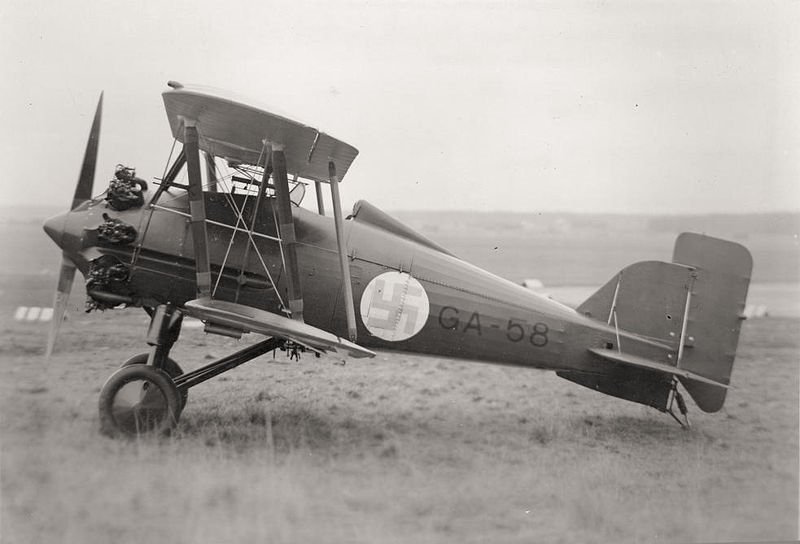
Designed by Henry Philip Folland, the Gloster Gamecock was developed as a direct improvement over the Gloster Grebe Mk III. The design aimed to resolve structural and engine reliability issues present in its predecessor. Key enhancements included the installation of a Bristol Jupiter radial engine and the introduction of metal bracing members and an aluminium fireproof bulkhead to separate the engine from the cockpit. The prototype first flew on February 22, 1925.
Production was carried out by the Gloster Aircraft Company (originally the Gloucestershire Aircraft Company Limited) at their facilities in Hucclecote and Brockworth, England. The RAF ordered three production batches of the Gamecock Mk I: 30 aircraft in September 1925 (serials J7891–J7920), 42 in July 1926 (serials J8033–J8047, J8069–J8095), and 28 in 1927 (serials J8571–J8598). While 100 Mk I aircraft were ordered, approximately 90 entered active RAF service. Additionally, Finland acquired three British-built aircraft and produced approximately 15 more under licence as the "Kukko."
Technically, the Gamecock was powered by a 9-cylinder, air-cooled Bristol Jupiter VI or VIIF radial engine producing roughly 425 hp. This powerplant enabled a maximum speed of 145 mph at 10,000 feet and a service ceiling of 22,100 feet. The aircraft was armed with two synchronized 0.303 in Vickers machine guns. Despite being praised as a stable gun platform with excellent maneuverability, the type suffered from aeroelastic flutter. This led to a high accident rate, with 22 of the 90 RAF aircraft lost due to structural failures during spins or landings.
In military service, the Gamecock entered RAF front-line duty in March 1926 with No. 43 Squadron and remained in service with units such as No. 23, No. 3, and No. 17 Squadrons until July 1931. While it saw no combat with the RAF, the Finnish Air Force utilized the "Kukko" in fighter and training roles throughout the 1930s, including combat operations during the Winter War (1939–1940). The final Finnish example was not scrapped until September 1944. No complete airframes are known to survive today.