
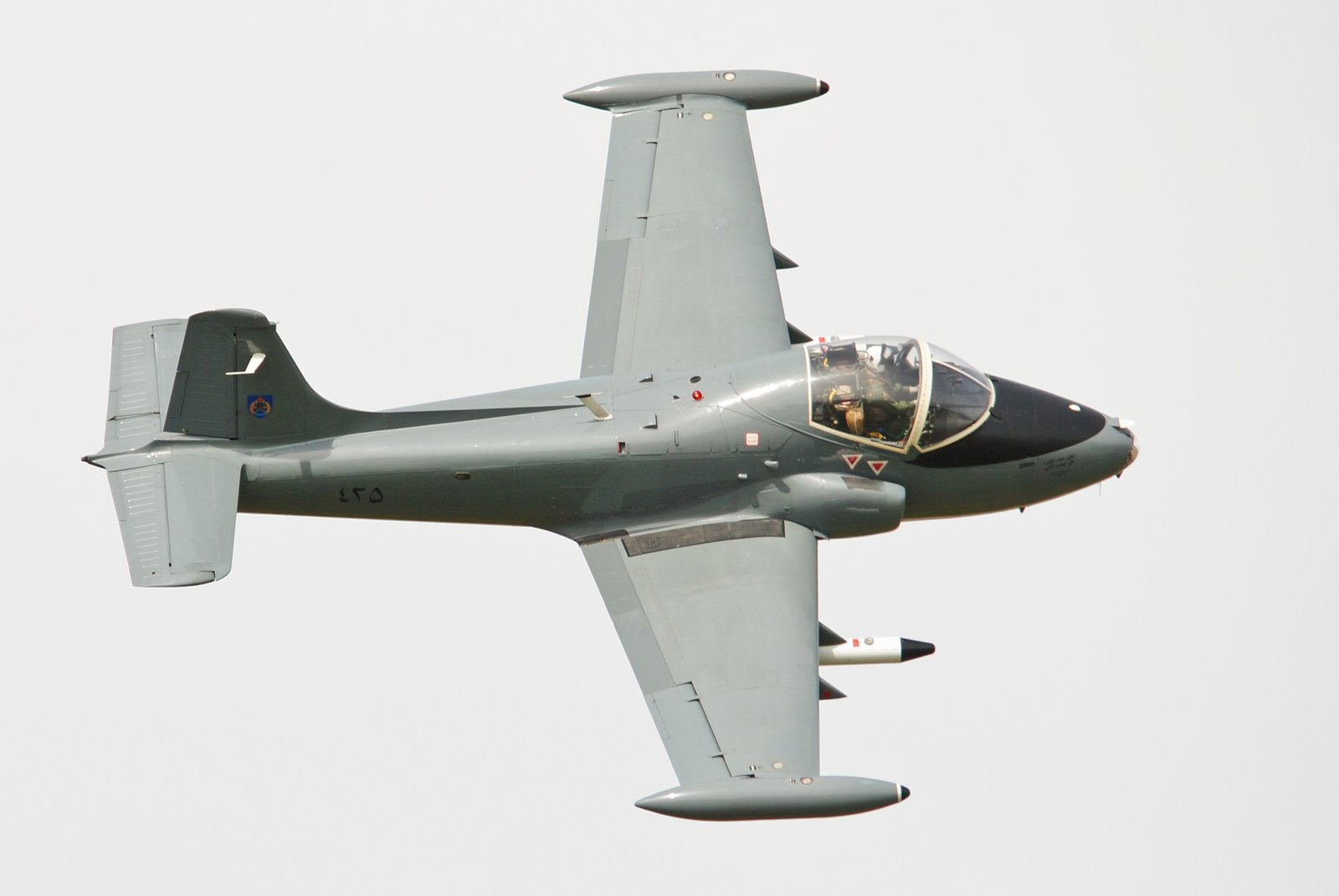
The BAC 167 Strikemaster was a British jet-powered aircraft developed as an advanced trainer and light attack platform. It evolved from the Hunting/BAC Jet Provost, which itself was a jet-powered successor to the piston-driven Percival Provost P.56 that first flew in 1950. Designed by the British Aircraft Corporation (BAC)—a company formed in 1960 through the merger of Hunting Aircraft, Bristol Aeroplane Company, Vickers-Armstrongs, and English Electric—the Strikemaster was tailored primarily for the export market. The aircraft made its first flight in 1967, and production continued from the late 1960s until 1983, with a total of 146 aircraft built.
To transition the Jet Provost from a trainer to a combat-capable aircraft, BAC implemented significant structural upgrades. The airframe and wings were strengthened to accommodate eight underwing hardpoints, allowing the aircraft to carry up to 3,000 lb of ordnance, including rockets and general-purpose bombs such as the 500 lb Mk.82. For internal firepower, the fuselage was equipped with two machine guns (either .303 or 7.62 mm) with an ammunition capacity of approximately 500 rounds per gun. The aircraft retained a tandem two-seat cockpit with ejection seats, making it suitable for both operational conversion and advanced training.
Power was provided by a single Rolls-Royce Viper turbojet, specifically the Viper Mk. 535 in common export configurations, which produced 3,410 lbf of thrust. This engine enabled a maximum speed of approximately 518 mph and a service ceiling of 40,000 ft, with an internal fuel range of roughly 1,380 miles.
Throughout its service life, the Strikemaster was utilized by several air forces for counter-insurgency (COIN) and close air support (CAS). The Royal Air Force of Oman employed the type during the Dhofar Rebellion to strike rebel supply lines. Similarly, the Ecuadorian Air Force utilized the Strikemaster for reconnaissance and ground-attack missions during the 1995 Cenepa War against Peru. Other operators included the Royal Saudi Air Force, the Republic of Singapore Air Force, the Royal New Zealand Air Force, the Botswana Defence Force Air Wing, the Kenya Air Force, and the People’s Democratic Republic of Yemen. While BAC was nationalized into British Aerospace in 1977 (now BAE Systems), the Strikemaster's legacy persists; several aircraft continue to fly in the 2020s as privately owned warbirds or within the Ecuadorian Air Force.