
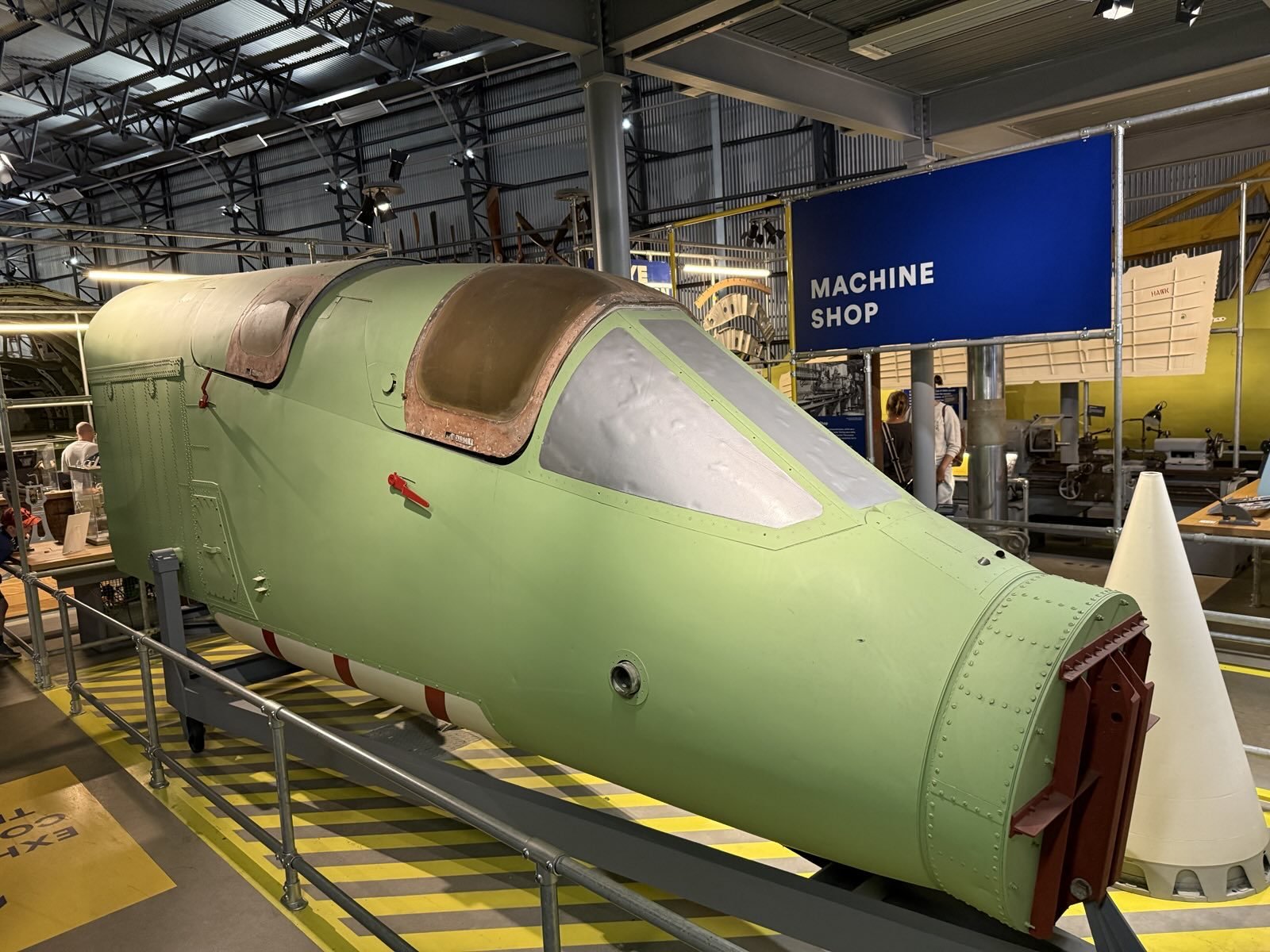
The BAC TSR-2 was conceived as a cutting-edge tactical strike and reconnaissance aircraft for the Royal Air Force, designed to perform high-speed, low-level penetration of defended airspace. The project originated from GOR.339, issued in November 1956, and the Ministry of Supply officially announced the selected design on 1 January 1959. The aircraft was developed by a joint design team at the British Aircraft Corporation (BAC), a company formed in 1960 through the merger of Vickers-Armstrongs, English Electric, Hunting Aircraft, and the Bristol Aircraft Company. Today, the corporate lineage of BAC survives through BAE Systems.
Technically, the TSR-2 was characterized by a long, slender fuselage and shoulder-mounted wings with distinctive turned-down wingtips. It was powered by two Bristol Siddeley Olympus Mk. 320 afterburning turbojets, each capable of producing approximately 22,000 lbf of dry thrust and 30,610 lbf with reheat. This propulsion system allowed the aircraft to reach a maximum speed of Mach 2.15 at 40,000 feet and Mach 1.1 at sea level. The design focused on a 'total systems' concept, integrating a crew of two and a weapons load of up to 10,000 lb, split between 6,000 lb of internal and 4,000 lb of external ordnance.
Despite its technical promise, the TSR-2 never entered series production. Only two prototypes were completed, with the first airframe, XR219, making its maiden flight from Boscombe Down on 27 September 1964. While initial flight reports described the aircraft as an outstanding technical success, the program was abruptly cancelled on 6 April 1965. Consequently, the aircraft never entered military service, though it was intended for roles including nuclear strike delivery and tactical reconnaissance.
With a maximum takeoff weight of 103,500 lb and a combat range of 860 miles, the TSR-2 remains a symbol of the tension between advanced aerospace engineering and defense procurement politics. A surviving example of the aircraft is preserved at the RAF Museum Midlands (Cosford), serving as a testament to one of the most ambitious British military aviation projects of the Cold War era.