
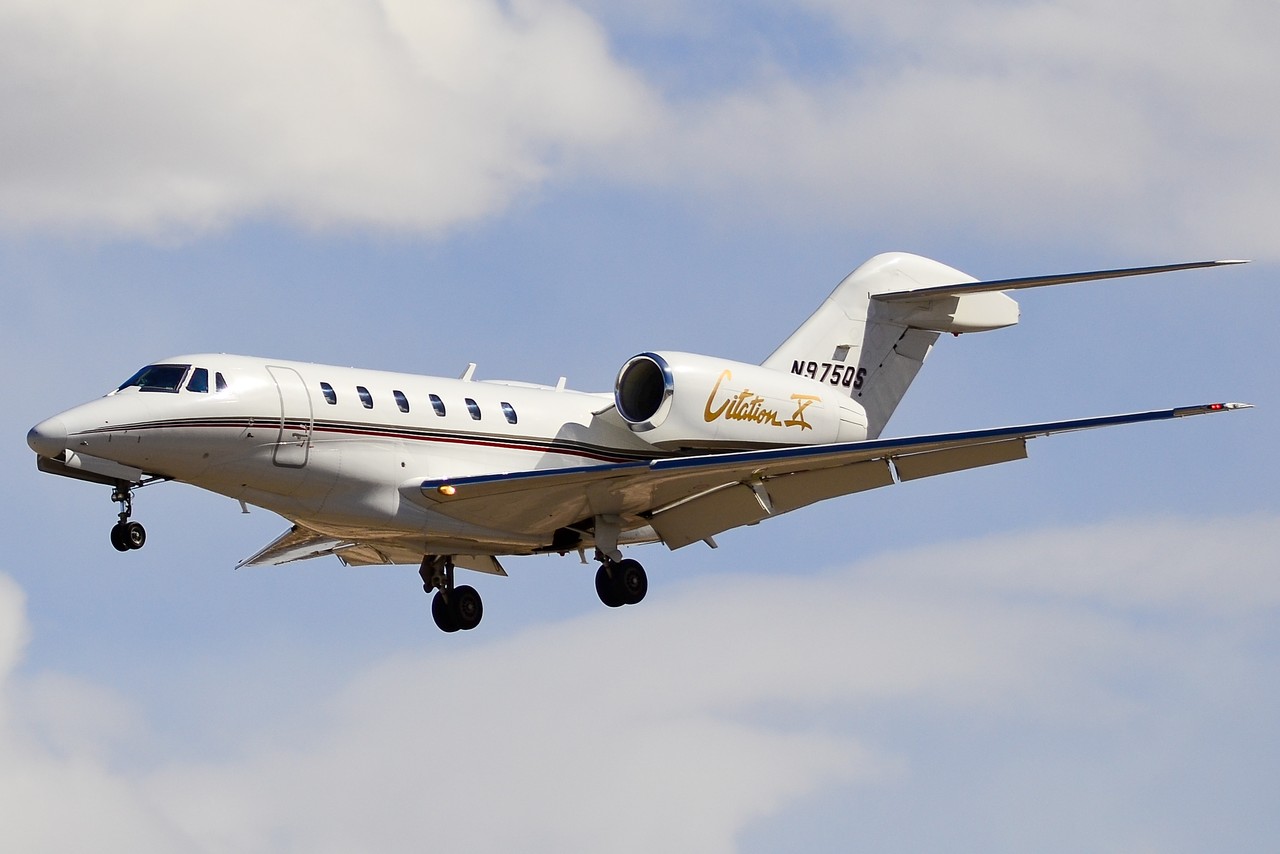
Revolutionary Speed Achievement
When Cessna announced the Citation X at the October 1990 NBAA Convention in New Orleans, the company promised to deliver something unprecedented: a midsize business jet capable of near-sonic speeds previously reserved for much larger, more expensive aircraft. The aircraft emerged from recommendations by Cessna's Customer Advisory Council, which demanded superior performance beyond the aging Citation 650 series that had dominated the company's lineup for eight years.
Development and Certification Challenges
The Citation X program faced significant technical hurdles during its development phase. Originally scheduled for certification in August 1995, the program encountered multiple delays due to airframe and engine failures that failed to meet Federal Aviation Administration standards. Engineers struggled particularly with balancing cabin noise reduction against the weight penalties of sound-dampening materials. Additional complications arose when Cessna attempted to increase maximum takeoff weight by approximately 800 pounds to achieve a full-fuel payload of 1,400 pounds with seven passengers aboard.
Despite these setbacks, Cessna achieved FAA certification on June 3, 1996, and delivered the first aircraft in July 1996 to golf legend Arnold Palmer, a devoted Cessna customer who had previously owned multiple Citation aircraft.
The Manufacturer Legacy
Cessna Aircraft Company, founded in 1927 in Wichita, Kansas, had established itself as a dominant force in general aviation by the 1990s. The Citation X marked the launch of Cessna's new 750 series, representing a complete departure from derivative designs that had characterized previous Citation models. While incorporating lessons learned from the Citations III, VI, and VII, the Citation X featured entirely new wing geometry, advanced electronic systems, and significantly more powerful propulsion.
Engineering Excellence
The Citation X's performance capabilities stem from its pair of Rolls-Royce AE3007C1 high-bypass turbofan engines, each delivering between 6,764 and 8,600 pounds of thrust. These powerplants represented cutting-edge technology for their era, featuring the highest thrust-to-weight ratio available for super-midsize business jets and the lowest specific fuel consumption in their class. The engines operate at reduced temperatures, enabling extended operational periods while consuming 325 gallons of fuel per hour.
The aircraft's aerodynamic design enables cruise speeds of Mach 0.92, making it faster than many military transport aircraft and rivaling some fighter jets of earlier generations. This performance comes with a practical range of 3,111 nautical miles under NBAA IFR conditions with four passengers, enabling nonstop coast-to-coast flights across the United States.
Cabin and Operational Characteristics
The Citation X accommodates eight passengers in comfortable seating arrangements, with maximum configurations supporting up to 12 occupants. The cabin measures 23.7 feet in length, 5.6 feet in width, and 5.7 feet in height, providing 527 cubic feet of interior volume. This space allocation prioritizes passenger comfort while maintaining the aircraft's speed-optimized exterior dimensions.
Pilots appreciate the Citation X for its exceptional climb performance and high-altitude capabilities, though the aircraft demands respect due to its high approach speeds and swept-wing characteristics that differ significantly from straight-wing Citation models. The jet typically requires a two-pilot crew, though some operators utilize single-pilot operations under specific regulatory frameworks.
Production Success and Market Impact
Between 1996 and 2012, Cessna delivered 315 original Citation X aircraft, with total production exceeding 350 units when including the upgraded Citation X+ variant introduced in 2010. The Citation X+ featured enhanced engines and advanced avionics systems, with deliveries beginning in 2013 and an additional 27 aircraft entering service.
Remarkably, 309 of the original 315 Citation X aircraft remained operational as of recent surveys, demonstrating exceptional reliability and continued market demand. This operational rate reflects both the aircraft's robust construction and the ongoing value proposition it provides to business aviation operators.
Competitive Positioning
The Citation X fundamentally altered business aviation market expectations by delivering world-class speed, transcontinental range, comfortable accommodations, and excellent runway performance at prices competitive with conventional midsize jets operating 70 knots slower. This combination forced competitors to reconsider their product strategies and established new benchmarks for the super-midsize category.
Legacy and Continued Operations
Production concluded in 2018 after more than two decades, but the Citation X's influence on business aviation continues. The aircraft demonstrated that midsize jets could achieve performance characteristics traditionally associated with heavy jets, fundamentally changing operator expectations and competitive dynamics throughout the industry. Today, Citation X aircraft remain highly sought after in the pre-owned market, commanding strong residual values that reflect their continued relevance and operational capabilities.