
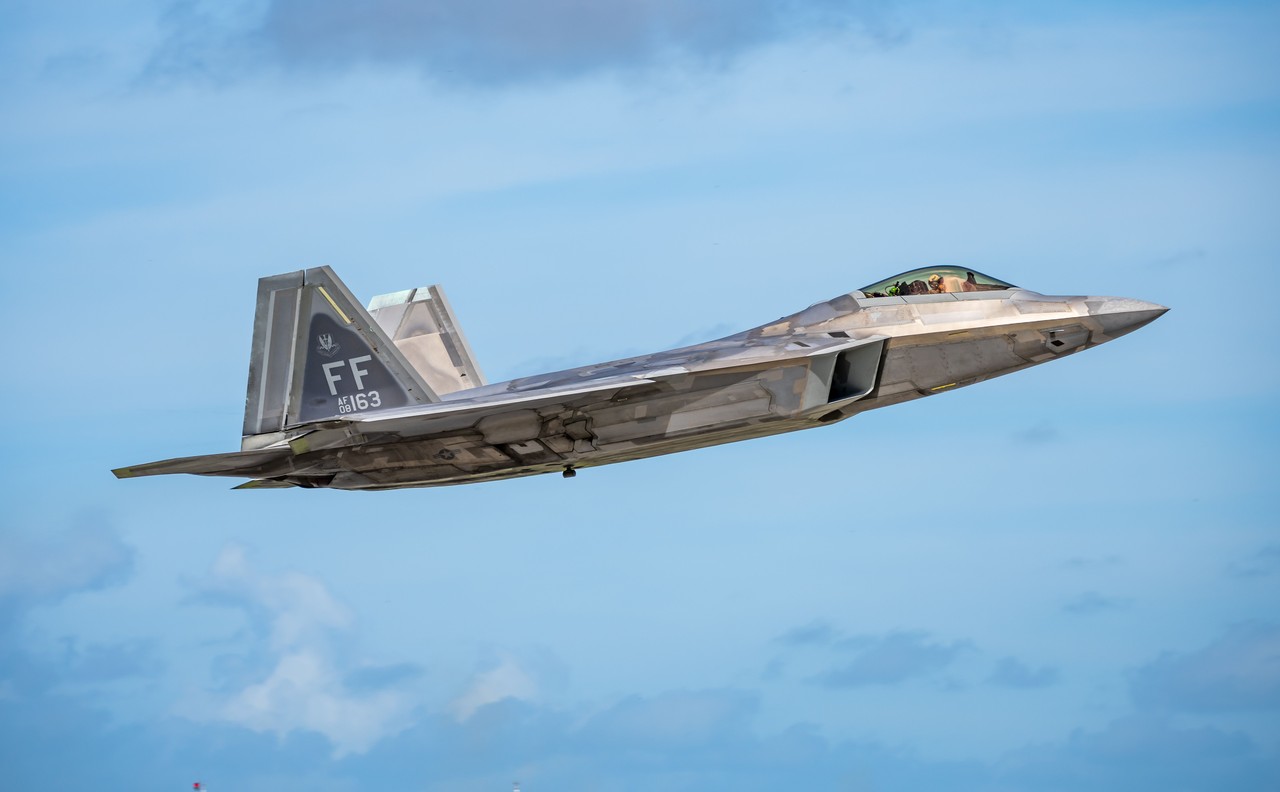
The Ultimate Air Superiority Fighter
The F-22 Raptor emerged from the most demanding fighter requirements ever established by the United States Air Force. Born from the Advanced Tactical Fighter program that began in 1986, this aircraft represents the pinnacle of air combat technology, combining stealth, speed, agility, and situational awareness in ways no previous fighter had achieved.
Development and Design Innovation
Lockheed Martin's Skunk Works division, the secretive advanced development unit responsible for the U-2 spy plane and SR-71 Blackbird, led the F-22's development in fierce competition with Northrop's team. The contest produced two remarkable prototypes: Lockheed's YF-22 and Northrop's YF-23, both first taking flight in August 1990. After extensive evaluation, the YF-22 was selected as the superior design, leading to the production contract.
The development process proved extraordinarily thorough, requiring nearly 44,000 wind tunnel test hours and 13,000 material sample tests over six years. Chief test pilot Paul Metz conducted the first production F-22's maiden flight on September 7, 1997, completing a 58-minute flight from Marietta, Georgia. The aircraft was officially unveiled and christened the "Raptor" on April 9, 1997.
Revolutionary Technology
The F-22's design centered on four critical capabilities that would define fifth-generation fighters: stealth, supercruise, advanced avionics with sensor fusion, and superior maneuverability. The stealth characteristics required extensive shaping of the airframe and careful attention to materials, with the Air Force imposing increasingly stringent low-observable requirements throughout development.
Powering this technological marvel are two Pratt & Whitney F119-PW-100 turbofan engines, specifically developed for the Advanced Tactical Fighter program. These engines incorporate thrust vectoring nozzles and enable the Raptor's signature supercruise capability—sustained supersonic flight without afterburner. The first flyable F119 prototype received Initial Flight Release on March 31, 1997, with the first flight test engine delivered to Lockheed Martin on October 8, 1997.
Manufacturing Excellence
Production of the F-22 spanned from 1996 to 2011, with Lockheed Martin's facility in Marietta, Georgia serving as the primary assembly site while Boeing Military Airplanes handled aft fuselage assembly in Seattle, Washington. The program supported over 1,000 subcontractors and suppliers across 46 states, employing up to 95,000 workers at peak production rates of approximately two aircraft per month.
A total of 195 F-22s were built, comprising 8 test and engineering/manufacturing development aircraft and 187 production aircraft. Each Raptor cost approximately $150 million in 2009 dollars, making it one of the most expensive fighter aircraft ever produced.
Service History and Capabilities
The F-22 achieved Initial Operational Capability on December 15, 2005, after extensive testing and evaluation. The first production aircraft was delivered to Edwards Air Force Base in October 2002 for Initial Operational Test and Evaluation, with the first operational squadron aircraft arriving at Nellis Air Force Base in January 2003.
As an air superiority fighter, the F-22 can engage multiple targets simultaneously while remaining virtually invisible to enemy radar. Its internal weapons bays carry AIM-120 AMRAAM and AIM-9 Sidewinder missiles, plus a 20mm M61A2 Vulcan cannon. The aircraft can also perform air-to-ground missions and reconnaissance, though its primary mission remains air dominance.
Pilot Perspective
Pilots describe the F-22 as unlike any previous fighter, with its combination of stealth, situational awareness, and raw performance creating unprecedented tactical advantages. The aircraft's thrust vectoring provides exceptional maneuverability, while its advanced avionics suite fuses data from multiple sensors to present pilots with unparalleled battlefield awareness.
The Raptor cruises supersonically without afterburner, operates at altitudes exceeding 50,000 feet, and possesses a combat range of more than 1,600 nautical miles. Its maximum speed exceeds Mach 2.25, though its true performance capabilities remain classified.
Legacy and Current Status
Despite never seeing combat, the F-22 fundamentally changed air warfare doctrine and influenced fighter development worldwide. Production ended in 2011 due to budget constraints and shifting defense priorities toward the multi-role F-35 Lightning II. Today, approximately 185 F-22s remain in the active Air Force inventory, serving as America's premier air superiority platform.
The Raptor's legacy extends beyond its tactical capabilities. It established the technological foundation for fifth-generation fighter design and proved that stealth, supercruise, and advanced avionics could be successfully integrated into an operational fighter. Examples are displayed at the National Museum of the U.S. Air Force at Wright-Patterson Air Force Base, ensuring future generations can study this remarkable achievement in aviation technology.