
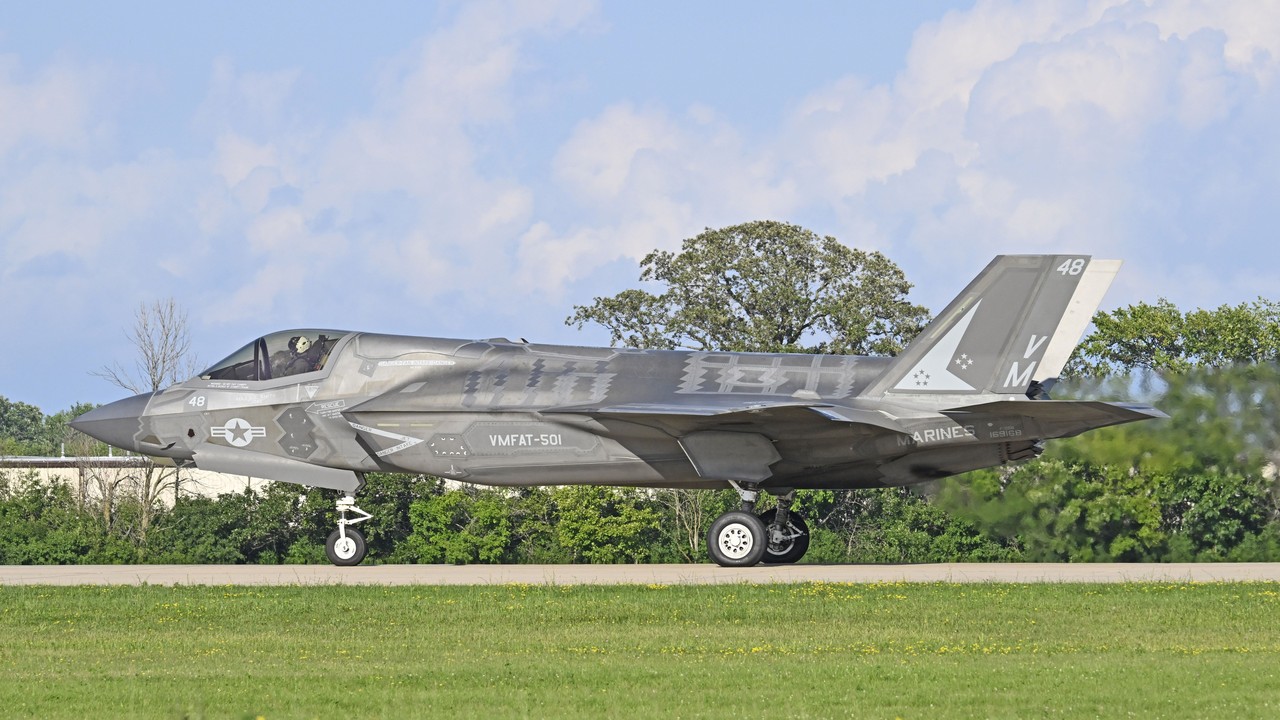
Operational Dominance
Since achieving initial operational capability with the U.S. Marine Corps in 2015, the F-35B has fundamentally transformed expeditionary warfare capabilities. The global F-35 fleet reached approximately 1,300 aircraft by early 2026, with the program logging over one million cumulative flight hours by March 2025. Marine Corps squadrons including VMFA-121 and VMFA-211 have operated the aircraft extensively, while international operators include the Royal Air Force, Royal Navy, Italian Air Force, and Japanese Air Self-Defense Force across 16 different services worldwide.
Combat Operations
The F-35B proved its combat effectiveness in multiple real-world operations throughout 2025. Notable engagements included contributions to Operation Midnight Hammer over Iran and the successful downing of Russian drones over Poland. The aircraft's multirole capabilities enable air superiority, precision strike, and reconnaissance missions, with its advanced sensor fusion providing 360-degree situational awareness through the distributed aperture system. Internal armament includes a 25mm GAU-22/A cannon with provisions for two AIM-120 AMRAAM missiles and two JDAM precision munitions, while six external hardpoints accommodate additional weapons when stealth is not critical.
Manufacturing Excellence
Lockheed Martin, formed from the 1995 merger of Lockheed Corporation and Martin Marietta, serves as prime contractor for the F-35 program. The company's aerospace heritage includes legendary aircraft such as the P-38 Lightning, SR-71 Blackbird, and F-117 Nighthawk from Lockheed, plus the Titan rocket series from Martin Marietta. Final assembly occurs at Air Force Plant 4 in Fort Worth, Texas, with additional production lines in Italy and Japan enabling a combined annual capacity of 156 aircraft. This distributed manufacturing approach produces F-35s at five times the rate of other allied fighter programs.
Revolutionary Propulsion
The F-35B's unique STOVL capability stems from its Pratt & Whitney F135-PW-600 turbofan engine, which generates up to 43,000 pounds of thrust. This powerplant incorporates an innovative lift-fan system that enables vertical landings and takeoffs from surfaces as small as amphibious assault ship decks. Each F135 engine costs $20.4 million in current Lot 18 production contracts and represents a significant advancement in adaptive cycle technology. The engine's reliability has been proven through the fleet's million-hour milestone, supporting operations across diverse global environments.
Design Innovation
The Joint Strike Fighter program, led by Lockheed Martin with key partners Northrop Grumman and BAE Systems, created three variants from a common design foundation. The F-35B specifically addresses the Marine Corps requirement for expeditionary operations from austere locations and ship-based platforms. Advanced stealth coatings and internal weapons carriage provide low observability, while the aircraft's software-defined architecture enables continuous capability upgrades through programs like Technology Refresh-3 (TR-3). The design emphasizes an 8,000-hour service life, significantly exceeding previous fighter aircraft standards.
Production Milestones
Lockheed Martin achieved record F-35 deliveries in 2025, completing 191 aircraft across all variants and surpassing the previous high of 142 delivered in 2021. This production surge cleared a backlog of over 100 stored aircraft affected by TR-3 software integration issues that had halted deliveries from July 2023 to July 2024. Production Lots 18 and 19, finalized in September 2025, encompass up to 296 F-35s valued at $24.3 billion, with Lot 18 including 16 F-35B aircraft for the Marine Corps scheduled for delivery by June 2027.
Operational Legacy
The F-35B represents the culmination of decades of STOVL fighter development, finally providing a supersonic replacement for the subsonic AV-8B Harrier. Its ability to operate from forward bases and amphibious platforms extends air power projection capabilities far beyond traditional aircraft carrier operations. With full-rate production approval granted in March 2024 after extensive testing and development, the F-35B continues to mature as the backbone of allied fifth-generation fighter capabilities, unifying logistics and operational procedures across multiple nations while maintaining technological superiority through continuous software and hardware upgrades.