
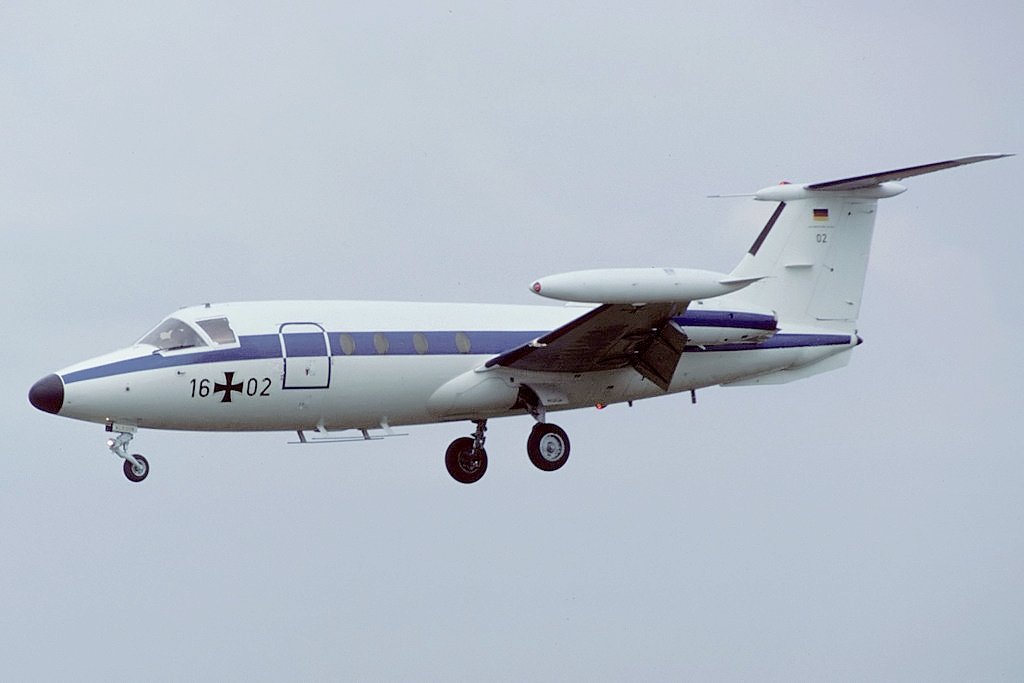
Production and Manufacturer History
The HFB-320 Hansa Jet was developed and produced in Hamburg, West Germany, between 1964 and 1973. The aircraft was originally designed and built by Hamburger Flugzeugbau (HFB), an entity closely linked to the shipbuilder Blohm & Voss. In 1969, HFB's aviation operations merged with Bölkow and Messerschmitt AG to form Messerschmitt-Bölkow-Blohm (MBB), which oversaw the program until production concluded. A total of 47 aircraft were manufactured. While MBB eventually became part of DASA and later Airbus, the HFB-320 is no longer in production.
Design and Technical Specifications
Lead engineer Hans Wocke, who previously worked on the Junkers Ju 287, designed the Hansa Jet with a distinctive 15° forward-swept wing. This aerodynamic choice was intended to provide high-speed benefits while avoiding certain control issues associated with rear-sweep wings. Additionally, the forward sweep allowed the wing spar to be positioned behind the passenger cabin, resulting in a wider interior cross-section. The aircraft is an all-metal, mid-wing monoplane featuring a T-tail and retractable tricycle landing gear. It was powered by two General Electric CJ610 turbojets, each producing 3,108 lbf of static thrust.
Development and Performance
The first prototype performed its maiden flight on April 21, 1964, followed by a second prototype later that year. The first production model flew on February 2, 1966, and the aircraft received FAA certification on April 7, 1967. Performance data indicates a top speed of 513 mph and a typical cruise speed of 420 mph, with a service ceiling of 40,000 ft and a range of 1,472 miles. However, the aircraft faced operational challenges, including a required takeoff run of approximately 5,900 ft in some scenarios, which limited its utility at smaller airports.
Service History
The West German Air Force was the HFB-320's largest customer, utilizing the jet for VIP transport and electronic countermeasures (ECM) training into the early 1990s. In the civilian sector, the aircraft was marketed as both an executive transport for 7–12 passengers and a regional feederliner capable of seating up to 15. Civilian operators included Millardair in Canada, Libyan Arab Airlines, and several U.S. carriers such as Zantop Airways and Golden West Airlines. Despite these efforts, the type was largely a commercial failure due to high operating costs and loud engines.
Safety and Legacy
The aircraft's history was marred by safety concerns, including a fatal deep-stall crash during a May 1965 certification flight that killed the chief test pilot. This accident led to the implementation of a stick-pusher system. Reports suggest as many as nine serious accidents occurred throughout the type's history. By the mid-2000s, the final active aircraft were retired, as they lacked the hush-kits required to meet modern noise regulations. Today, the HFB-320 survives primarily as a museum exhibit and remains a unique example of civilian forward-swept wing design.