
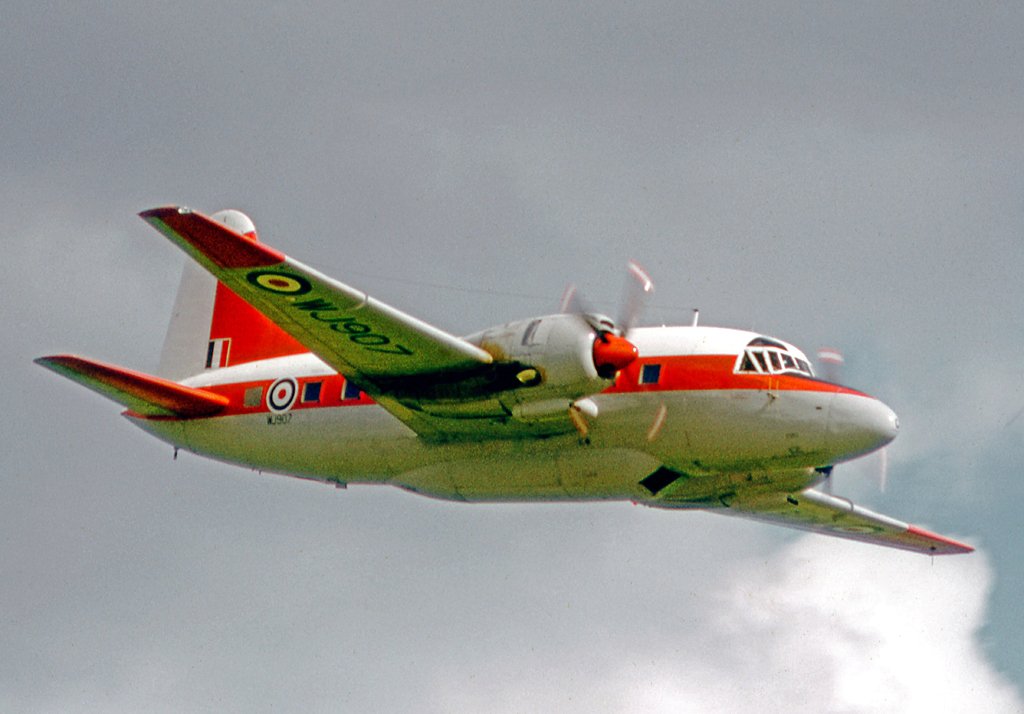
The Vickers Varsity was a British twin-engined crew trainer developed by Vickers-Armstrongs as a derivative of the Vickers Viking and Valetta aircraft family. Designed to meet a 1948 British Air Ministry specification, the aircraft was intended to serve as a comprehensive multirole trainer for various aircrew roles, including pilots, navigators, wireless operators, flight engineers, and bomb aimers. The Varsity first took to the skies on 17 July 1949.
To accommodate its training mission, the Varsity featured a longer fuselage than its Viking-derived predecessors and utilized a tricycle landing gear configuration, which was essential for training crews in contemporary multi-engine operations. A notable design feature was the inclusion of a ventral bombing position, which allowed for practical bombing instruction. Power was provided by two Bristol Hercules 264 piston engines, each capable of producing 1,950 hp (1,454 kW).
Production of the aircraft took place at two locations: Brooklands and a new Vickers-Armstrongs factory at Hurn, near Bournemouth. A total of 163 aircraft were built, with 146 of these produced at the Hurn facility. The aircraft entered operational service in 1951 and became a staple of the Royal Air Force (RAF). Within the RAF, the Varsity was utilized for multi-engine pilot training at No. 201 Advanced Flying School based at RAF Swinderby, and was later employed for Bomber Command crew training and navigation instruction. Beyond the United Kingdom, the Royal Swedish Air Force operated a single Varsity, designated as the Tp 82, which served in an electronic intelligence role from January 1953 until 1973.
Technically, the Varsity possessed a wingspan of 95 ft 7 in and a length of 67 ft 6 in. It had a maximum takeoff weight of 37,500 lb and could reach a maximum cruise speed of 250 kt. Its operational ceiling was 28,700 ft, with a range of 2,301 nmi and a rate of climb of 1,400 ft/min. The RAF eventually withdrew the type from service in 1976. The last flying example, registered as WL679, was retired into preservation in 1992 and is currently held at the Royal Air Force Museum Midlands, Cosford.