
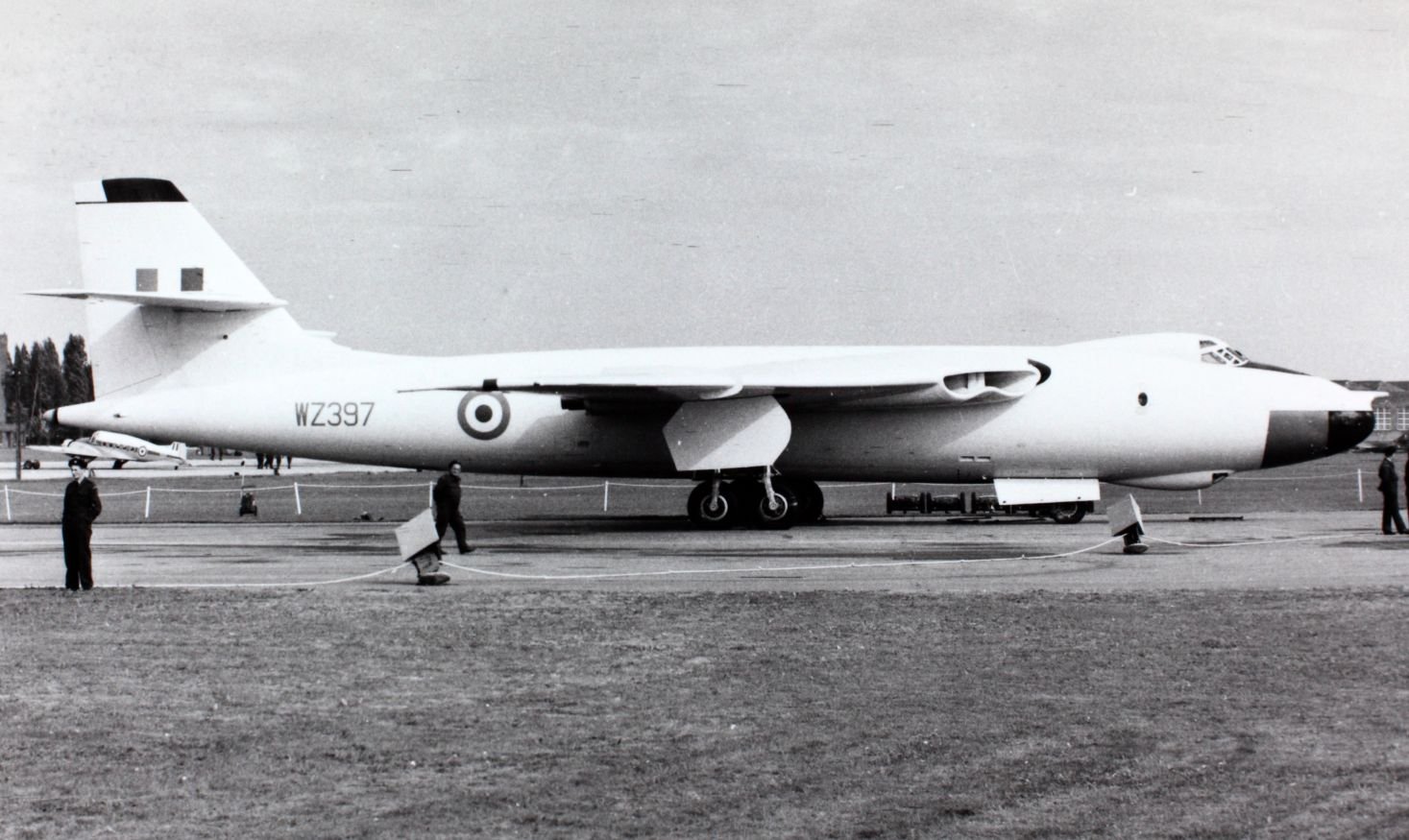
Designed by George Edwards to meet Air Ministry Specification B.35/46, the Vickers Valiant was developed as a high-speed, high-altitude strategic bomber. The prototype, a Vickers Type 660 with serial WB210, first took flight on May 18, 1951, from Wisley Aerodrome in Surrey, piloted by J. “Mutt” Summers. To ensure a rapid entry into service as a "stop-gap" measure during the early Cold War, Edwards utilized a more conservative aerodynamic approach than the subsequent Vulcan and Victor bombers. The resulting design relied on speed, altitude, and electronic countermeasures for survivability, omitting defensive gun turrets entirely.
Production took place between 1951 and 1957 at Vickers-Armstrongs' facilities in Surrey, specifically at the Brooklands/Weybridge and Wisley sites. A total of 107 aircraft were built, with the first production model delivered to the Royal Air Force (RAF) on February 8, 1955. The aircraft was powered by four Rolls-Royce Avon RA.28 (Mk 204) turbojets, each producing approximately 10,000 to 10,050 lbf of thrust. Technically, the Valiant was a mid-wing monoplane with a wingspan of 114 ft 2 in and a maximum takeoff weight of 140,000 lb. Its crew of five included a pilot, co-pilot, and three specialized navigation and electronics officers.
In military service, the Valiant is distinguished as the only V-bomber to engage in combat bombing and the only one to deliver live nuclear weapons. During the 1956 Suez Crisis (Operation Musketeer), 138 and 207 Squadrons conducted conventional raids against Egyptian airfields. In the realm of nuclear testing, No. 49 Squadron played a pivotal role. On October 11, 1956, Squadron Leader Edwin Flavell dropped the first British nuclear weapon, a “Blue Danube” Mk 1, over Maralinga during Operation Buffalo. The Valiant also delivered the first successful British hydrogen bomb during Operation Grapple X on November 8, 1957, and the largest British nuclear device (approximately 3 megatons) during Operation Grapple Y on April 28, 1958.
Beyond its bombing role, the aircraft served as a photo-reconnaissance platform and was converted into an aerial refueling tanker, pioneering in-flight refueling for the RAF. However, the shift to low-altitude penetration missions in the early 1960s to evade Soviet defenses caused severe structural fatigue in the wing spars. Consequently, the remaining fleet of approximately 70 aircraft was grounded and withdrawn from service by January 1965. Today, only one complete example survives: Valiant B.1 serial XD818, preserved at the RAF Museum Cosford, which participated in the Operation Grapple tests.