
Development and Design Philosophy
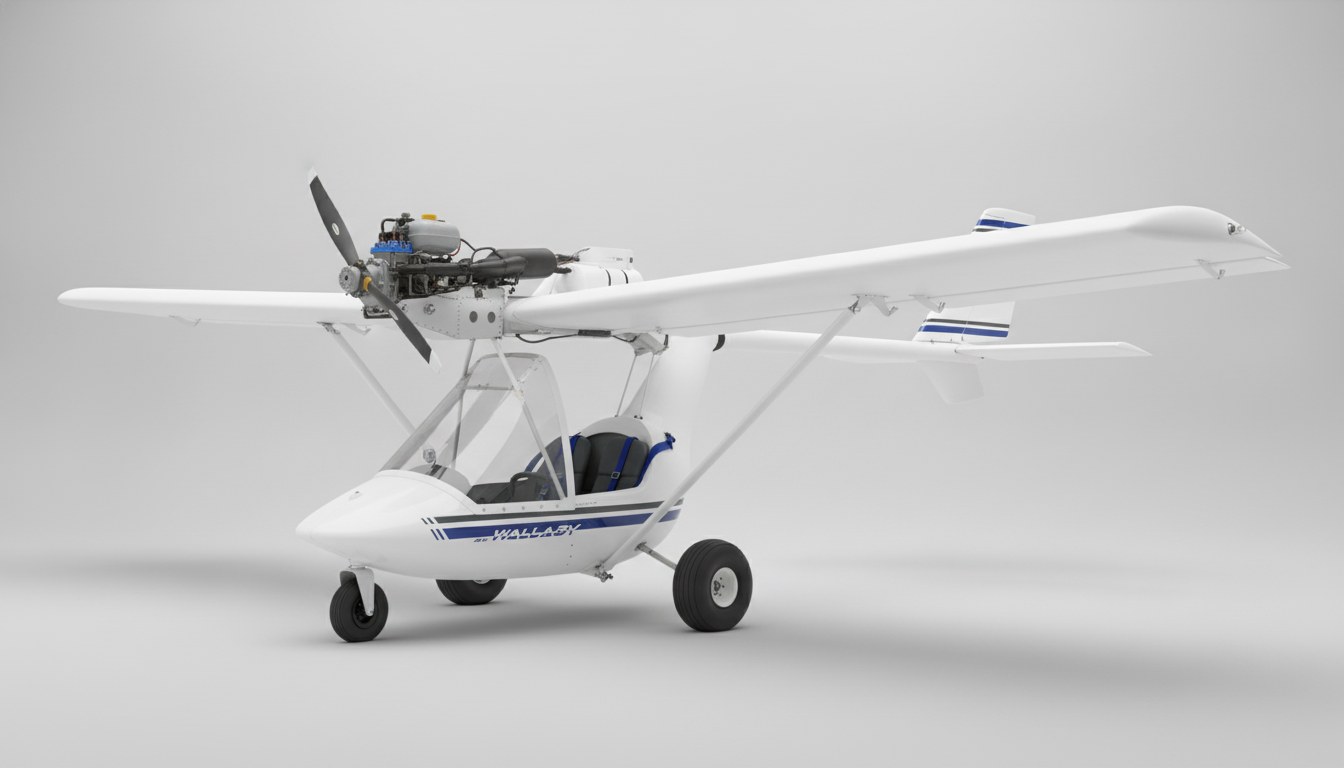
Fly Synthesis engineered the Wallaby around a specific mission: creating an economical microlight that delivered exceptional short takeoff and landing performance while maintaining good cruise efficiency at low power settings. The Italian manufacturer achieved this by marrying the laminar airfoil wing from their successful Storch CL model to a completely new high tailboom fuselage design. This hybrid approach allowed the company to leverage proven aerodynamics while optimizing the aircraft for pure flying pleasure in an open cockpit configuration.
The design incorporated several technical innovations for the microlight category. The wing featured full-span Junkers-type ailerons that provided excellent control authority at low speeds, while composite materials throughout the structure delivered the optimal balance of lightness and rigidity. The fiberglass fuselage connected to an aluminum tailboom, and fixed tricycle landing gear with a steerable nosewheel and drum brakes completed the practical configuration.
Manufacturing History
Fly Synthesis began Wallaby production in 1999 at their facility in Friuli, located in the Venezia region of northeastern Italy. The company had been founded in the late 1980s in Gonars, producing their first aircraft, the Storch, in 1990. By January 2003, at least six Wallaby aircraft had been completed, with production continuing through documented examples imported to Australia in mid-2006.
Production records show aircraft with constructor numbers including 2002-005 and 2003-002, indicating steady manufacture through the early 2000s. In 2006, Fly Synthesis relocated to a 3,000-square-meter facility in Mortegliano, positioned beside a World War II-era military base. This move coincided with new ownership, as the company had been sold in 2000. The Wallaby represented one element of Fly Synthesis's broader product line, which eventually encompassed 124 aircraft across all models.
Engine Options and Performance
Two Rotax powerplant options defined the Wallaby variants. The base Wallaby R503 utilized the 37-kilowatt Rotax 503, a two-cylinder, two-stroke, fan-cooled engine with dual electronic ignition. The enhanced Wallaby R582, also marketed as the New Wallaby, featured the liquid-cooled Rotax 582 UL producing 64 horsepower. Both Austrian-built engines provided the reliability and fuel efficiency essential for ultralight operations.
With the Rotax 503 installation, the Wallaby achieved a maximum speed of 90 miles per hour and cruise speeds between 71 and 84 miles per hour at 75 percent power. The aircraft's 50-kilometer-per-hour stall speed and 2.5-meter-per-second rate of climb delivered the promised short-field capabilities, with takeoff runs of 80 to 90 meters and landing distances of 70 to 80 meters. Fuel capacity of 60 liters provided endurance up to 460 kilometers with 30-minute reserves.
International Operations
The Wallaby found markets across multiple continents through Fly Synthesis's dealer network, which handled 80 percent of the company's worldwide exports. In the United States, the aircraft was marketed under the Lafayette Wallaby designation. The first Wallaby reached Australia in mid-2006 through Fly Synthesis Australia, with aircraft registered there including 19-7049 (constructor number 31), which operated from December 2008 through April 2010.
European registrations included aircraft in Belgium carrying marks OO-E10 and OO-E15, while Hungarian examples bore OM-M designations. New Zealand also received Wallaby aircraft through the international distribution network. The global reach demonstrated the aircraft's appeal to recreational pilots seeking an economical entry into powered flight.
Technical Specifications and Load Factors
The Wallaby's dimensions reflected its microlight classification while maximizing internal space. The 9.43-meter wingspan supported 12.6 square meters of wing area, while overall length measured 5.73 meters and height reached 2.4 meters. Empty weight of 208 kilograms allowed a maximum takeoff weight between 395 and 472.5 kilograms depending on configuration, providing useful loads up to 187 kilograms.
Structural load factors of +4/-2G exceeded typical microlight requirements, while analog instrumentation kept cockpit complexity minimal. Optional equipment included ballistic parachute systems and folding wing mechanisms for trailer transport. The open cockpit design prioritized the pure flying experience over weather protection, appealing to pilots who valued direct connection with the flying environment.
Legacy and Current Status
While exact production totals remain unconfirmed, the Wallaby represented Fly Synthesis's successful expansion beyond their original Storch design into purpose-built recreational aircraft. The model bridged the gap between the company's 1999 Texan introduction and later designs including the Syncro in 2009 and Catalina in 2010. Examples continued appearing in active registrations through the 2010s across multiple countries, indicating sustained operational utility. Today, the Wallaby stands as a representative example of early 2000s European microlight development, emphasizing composite construction and optimized aerodynamics for the recreational flying market.