
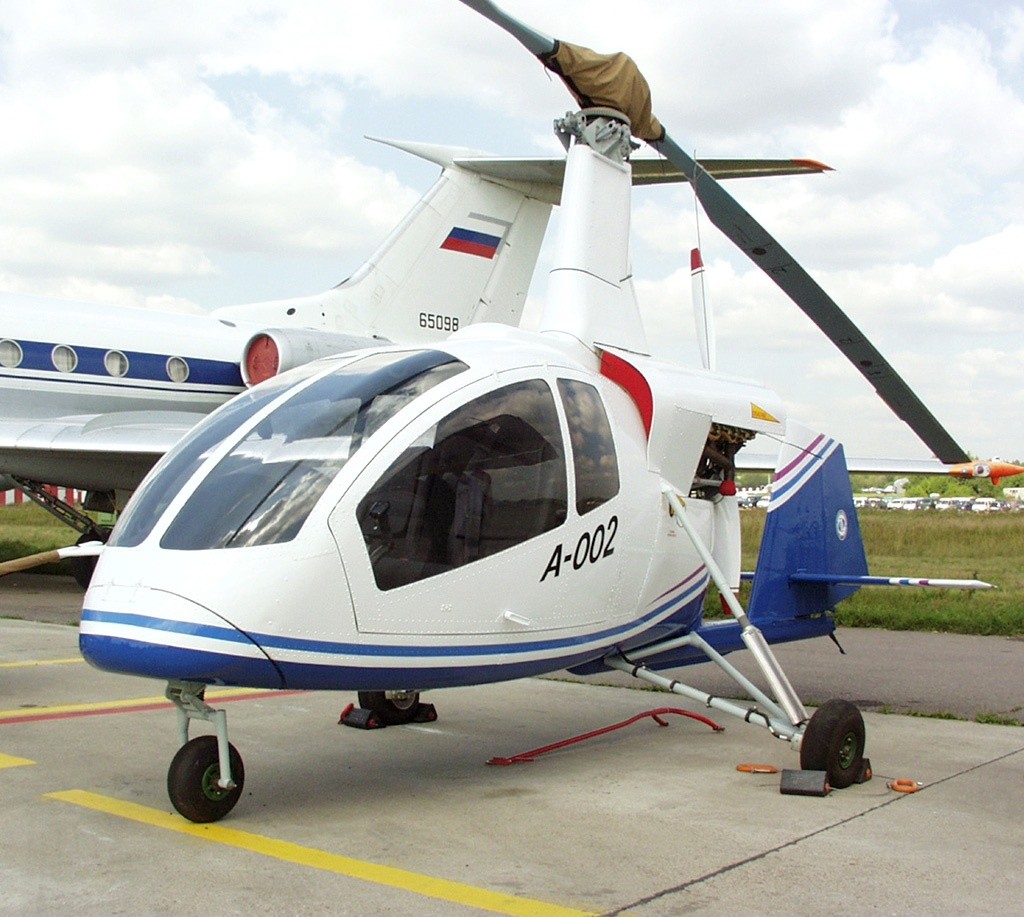
Development and Design
The A-002 project commenced on February 15, 1999, representing an ambitious venture by the United Constructor Bureau for Light Aircraft team into the emerging autogyro market. Development proceeded rapidly, with the prototype completed within a year by 2000. After extensive ground testing, the aircraft achieved its maiden flight on July 6, 2002, marking the beginning of production that same year.
The autogyro's pusher configuration distinguished it from conventional helicopters and fixed-wing aircraft. Unlike traditional rotorcraft that rely on powered rotor systems for both lift and propulsion, the A-002 utilized an unpowered rotor for lift generation while employing a rear-mounted pusher propeller for forward thrust. This configuration offered several advantages including reduced vibration, improved forward visibility for the pilot, and potentially lower operating costs compared to conventional helicopters.
The Manufacturer's Legacy
The Irkutsk Aviation Plant, founded on March 28, 1932, brought nearly seven decades of aviation expertise to the A-002 project. Originally commissioned as GAZ-125 on August 24, 1934, the facility was redesignated GAZ-39 in 1941 as it transitioned to wartime production. Throughout its distinguished history, the plant manufactured approximately 6,500 aircraft representing 16 different types from Russia's premier design bureaus, including Antonov, Ilyushin, MiG, Petlyakov, Sukhoi, Tupolev, and Yakovlev.
During World War II, the Irkutsk facility played a crucial role in Soviet aircraft production, delivering 730 Petlyakov Pe-2 dive bombers and 919 Ilyushin Il-4 heavy bombers to front-line units. The plant's strategic importance continued through the Cold War era, producing advanced fighters including the MiG-23 variable-geometry interceptor, the MiG-27 ground-attack variant, and later the sophisticated Su-30 multirole fighter. The facility's aircraft reached global markets, with exports supplied to 21 countries across multiple continents.
Market Position and Classification
The A-002 represented a strategic diversification for Irkutsk Aviation Plant, moving away from military contracts into the civilian light aircraft sector. The autogyro market of the early 2000s offered opportunities for manufacturers seeking alternatives to traditional helicopters and fixed-wing aircraft. Autogyros appealed to recreational pilots and commercial operators requiring vertical takeoff capabilities without the complexity and maintenance requirements of conventional helicopters.
The three-seat configuration positioned the A-002 for training operations, recreational flying, and light utility missions. The pusher propeller arrangement provided improved ground handling characteristics and reduced the risk of propeller strikes compared to tractor-configured aircraft. This design philosophy aligned with growing safety consciousness in the general aviation community.
Technical Innovation
While specific performance parameters remain limited in available documentation, the A-002's design incorporated several notable features typical of modern autogyro development. The pusher configuration eliminated the torque effects common in conventional helicopters, potentially simplifying pilot training requirements. The unpowered rotor system reduced mechanical complexity compared to powered rotorcraft while maintaining the ability to operate from confined areas.
The aircraft's 2002 production launch coincided with advances in composite materials and avionics that enabled lighter, more efficient rotorcraft designs. Modern autogyros of this era typically offered cruise speeds comparable to light fixed-wing aircraft while retaining short-field capabilities that made them attractive for specialized missions.
Production and Legacy
Production of the A-002 commenced in 2002, though specific manufacturing numbers and delivery schedules remain undocumented in available sources. The aircraft's introduction occurred during a period of significant transition for the Russian aviation industry, as manufacturers adapted to post-Soviet market conditions and sought new civilian applications for their engineering expertise.
The A-002 project demonstrated the adaptability of established military aircraft manufacturers in pursuing emerging market segments. While the Irkutsk Aviation Plant continued its primary focus on military contracts, including ongoing Su-30 production, the autogyro project illustrated the facility's technical versatility and willingness to explore innovative aircraft configurations.
The limited available documentation suggests the A-002 remained a niche product within the broader autogyro market. Unlike the plant's historically significant military aircraft that achieved international recognition and large production runs, the A-002 appears to have targeted specialized civilian applications with correspondingly limited production volumes. The aircraft's current operational status and any ongoing support programs remain unclear from available sources.