
Design and Development
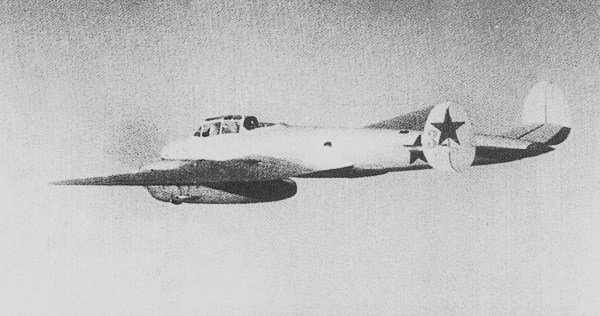
The Petlyakov Pe-3 was conceived in July 1941 as a direct response to German night bombing raids over Moscow during Operation Barbarossa. The Soviet People's Commissariat for Defense (NKO) required a heavily armed night fighter with long endurance, utilizing an aircraft already in production. Under the leadership of chief designer Vladimir Mikhailovich Petlyakov, the design team adapted the Pe-2 dive bomber by removing the ventral gunner's position and adding 700 liters of extra fuel. The prototype first flew on August 7, 1941, and passed manufacturer trials the following day. Following an NKO order on August 14, five pre-production aircraft were completed by August 25, 1941.
Production History
Manufacturing began at Moscow Aviation Plant № 39, which produced 196 aircraft between August and October 1941. Due to the wartime evacuation in October 1941, Plant № 39 merged with Plant № 125 to become the Irkutsk Aviation Plant. Production resumed in Irkutsk in April 1942 under GKO Decree No. 1385, resulting in 132 aircraft in 1942 and 13 more in 1943. A final batch of 19 more lightly armed aircraft was produced by Plant № 22 (Kazan Aircraft Production Association) in early 1944. In total, approximately 360 aircraft were built, including 207 standard Pe-3s and 152 Pe-3bis variants.
Technical Specifications
The Pe-3 was powered by two liquid-cooled V-12 Klimov M-105R engines (or M-105RA for the Pe-3bis), each producing 1,100 hp (820 kW). The Pe-3bis variant introduced significant improvements, including 148 kg of frontal steel armor, a 20 mm ShVAK cannon in the nose, and a belt-fed dorsal UBT machine gun. The aircraft reached a maximum speed of 530 km/h at an altitude of 5,050 meters and had a service ceiling of 9,100 meters. While the prototype claimed a range of 2,150 km, the serial Pe-3bis typically achieved 1,500 km.
Military Service
Operated primarily by the Soviet VVS and PVO, the Pe-3 served in various roles, including heavy fighter, long-range reconnaissance, and navigation leader. The 95th High-Speed Bomber Regiment (later 95th IAP) was the first operational unit, while the 9th Bomber Aviation Regiment used the aircraft to lead over 2,000 planes to front-line airfields. The aircraft also saw naval service with the Northern Fleet's 65th Aviation Regiment. Notably, the Finnish Air Force operated one captured Pe-3 (PE-301) from November 1942 until it was destroyed by Soviet bombing on July 2, 1944.
Legacy
The Pe-3 represents a pivotal example of rapid wartime industrial adaptation and the evacuation of Soviet manufacturing to the east. Although it filled a critical gap in heavy fighter capabilities, it suffered high initial losses, with roughly 25% of early production lost within three months. No intact museum examples are known to exist, though wreckage believed to be a Pe-3 has been reported in the Finnish wilderness near Lake Inari.