
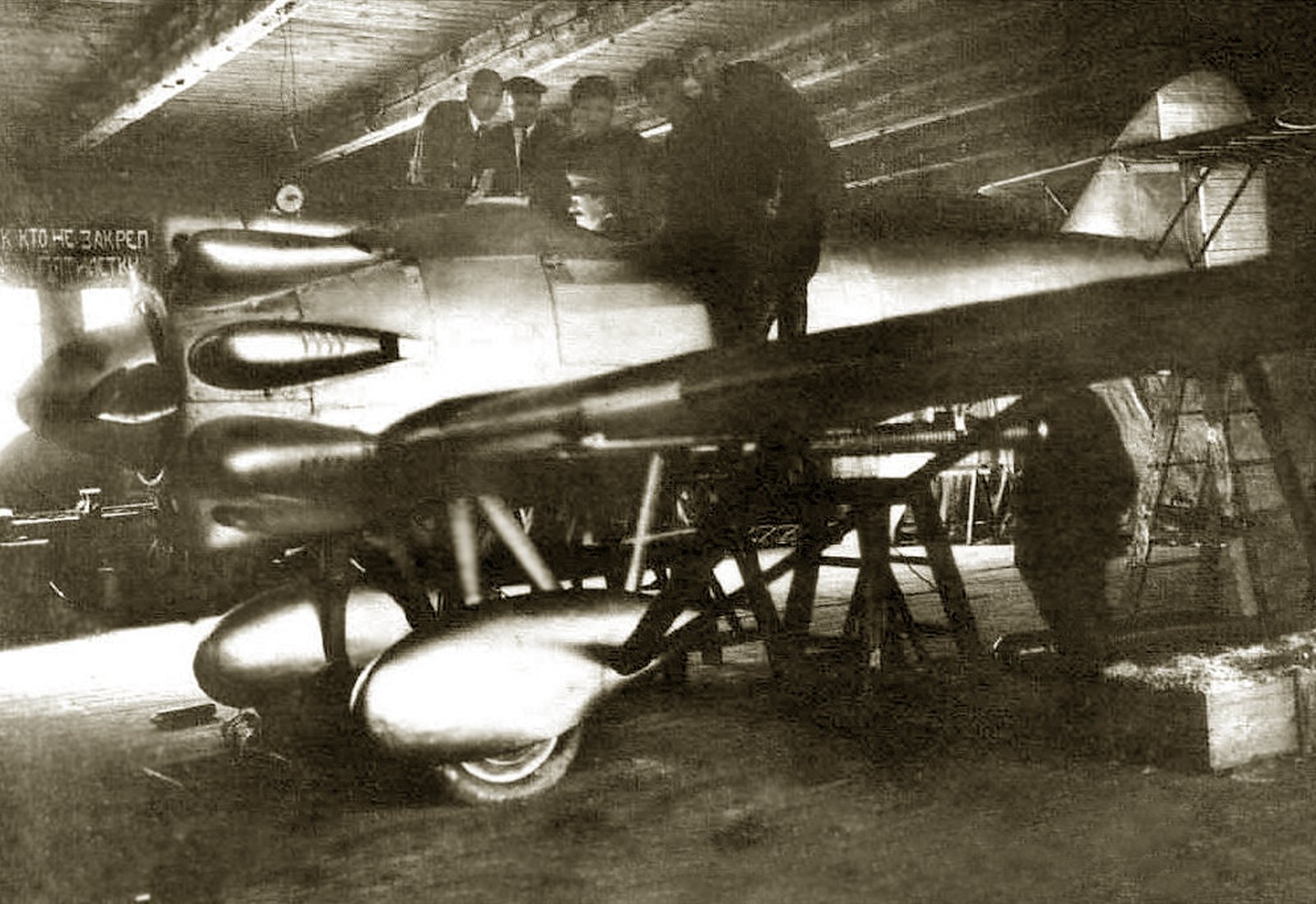
The Grigorovich I-Z was an experimental single-seat interceptor fighter developed in the Soviet Union during the early 1930s. Designed by Dmitri Pavlovich Grigorovich and his design bureau (OKB), the aircraft was conceived as a dedicated "anti-bomber" platform. Its most notable feature was the integration of large-calibre recoilless "Kurchevski" cannons, which served as the primary armament. This approach represented a radical departure from the standard machine-gun arrays of the era, aiming to destroy enemy bombers at longer ranges through heavy artillery fire.
Structurally, the I-Z was a landplane featuring a single-bay, strut-braced monoplane layout with fixed landing gear. This design marked a transitional phase in Soviet aviation, moving away from traditional biplane configurations toward cleaner monoplane shapes, although it retained conservative structural elements common to the period. The aircraft was powered by a single liquid-cooled inline piston engine, though specific model designations and power ratings were not consistently documented in available records.
Production of the I-Z took place at Moscow Aviation Plant № 39, an entity established in 1921 that later became known as the Aviation Plant No. 39 named after V.R. Menzhinsky. The plant, which had roots in the pre-revolutionary "Dux" production, served as a primary site for experimental and small-series fighter development. The I-Z did not enter large-scale serial production; instead, it was produced in a small batch consisting of a few prototypes and a short pre-series. Flight testing of these aircraft occurred between 1931 and 1932, with the prototype completing its initial flights around 1931.
Operationally, the I-Z was used exclusively by the Soviet Air Forces (VVS) for evaluation and testing. It never saw combat service in any armed conflict, as its operational life was limited to assessing the viability of the recoilless-cannon concept. Ultimately, the project was judged unsatisfactory due to the practical difficulties of integrating large recoilless guns onto small fighter airframes, including issues with reliability and ballistic performance. Consequently, the I-Z was not adopted for wide use, and all examples were likely scrapped. Despite its lack of operational success, the I-Z remains historically significant as a precursor to later heavy-armament fighter doctrines. The legacy of its manufacturer, Plant № 39, continued through various reorganizations and mergers, eventually contributing to the formation of the Moscow Aircraft Production Association (MAPO) and RAC "MiG."