
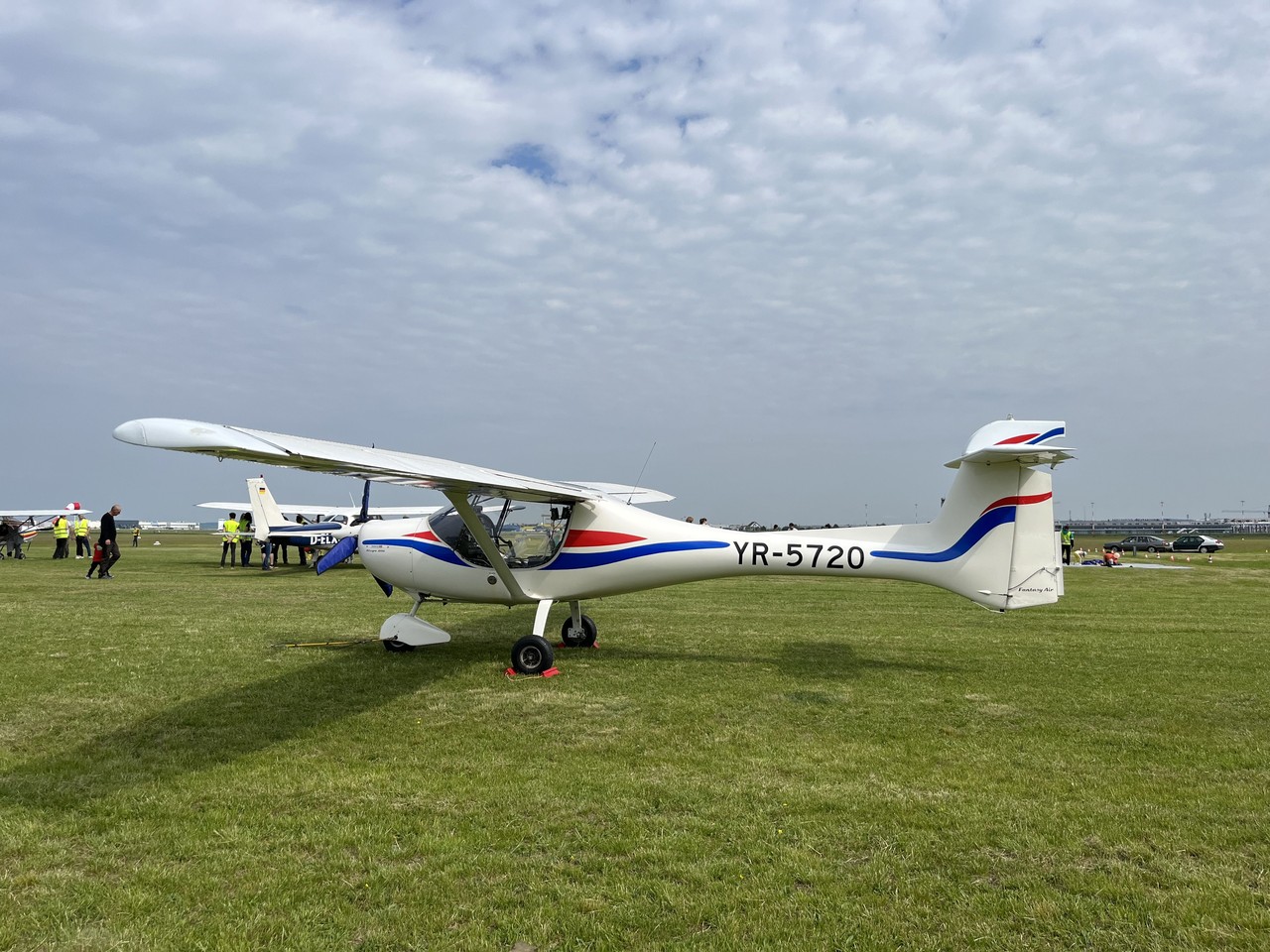
Design Innovation and Development
The Allegro emerged from designer Oldrich Olsansky's vision to create a light sport aircraft that combined aesthetic appeal with practical performance characteristics. The aircraft featured several innovative design elements for its class, including a strut-braced aluminum wing with fiberglass wingtips, a Kevlar-reinforced fiberglass fuselage strengthened with steel tube cockpit reinforcement, and a distinctive T-tail configuration that provided excellent elevator authority and ground clearance.
The original Cora variant, which first flew in 1995, established the basic design philosophy that would carry through all subsequent versions. Olsansky prioritized wide cockpit visibility, light control forces, and operating economics while maintaining structural integrity suitable for both recreational flying and utility operations including glider towing.
Manufacturing Success and International Expansion
Fantasy Air, established in the Czech Republic during the 1990s aviation boom following the country's democratic transition, quickly gained recognition in the European ultralight market. The company's focus on the Allegro design proved prescient, as demand for light sport aircraft grew throughout Europe and North America during the late 1990s and early 2000s.
Production expanded beyond the Czech Republic when American entrepreneurs recognized the aircraft's potential in the U.S. light sport aircraft market. Allegro LSA of Sanford, North Carolina, established manufacturing operations to serve the North American market, taking advantage of the region's rich aviation manufacturing heritage. This transatlantic production arrangement allowed Fantasy Air to reach customers who preferred domestically-manufactured aircraft while maintaining the original Czech design integrity.
Technical Evolution and Variants
The Allegro family expanded through systematic development of specialized variants addressing different market needs. The Allegro 2000 introduced tapered wings with a 10:1 aspect ratio, improving both performance and aesthetic appeal while maintaining the type's forgiving handling characteristics. This variant established the 1,148-pound gross weight that became standard for European microlight operations.
Floatplane enthusiasts gained options through the Allegro 2000F, equipped with provisions for Full Lotus inflatable floats, and the later Allegro F variant manufactured in the United States by B-Bar-D Aviation. These amphibious configurations extended the aircraft's operational envelope while preserving its fundamental design characteristics.
The Allegro 2007 represented the design's maturation, incorporating three inches of additional headroom, redesigned doors, increased wing dihedral for improved stability, and gross weight increased to 1,320 pounds—the maximum permitted under U.S. Light Sport Aircraft regulations. This variant featured three-position electrically-actuated flaps with settings of -4.5, 15, and 48 degrees, providing pilots with precise control over approach and landing characteristics.
Powerplant Evolution
The Allegro's success stemmed partly from its adaptability to Rotax's evolving four-stroke engine line. Early examples utilized the 64-horsepower Rotax 582, adequate for basic recreational flying but limiting payload and performance. The introduction of Rotax's 912 series transformed the aircraft's capabilities, with the 80-horsepower 912UL becoming the standard powerplant and the 100-horsepower 912ULS available for operators requiring maximum performance.
This engine flexibility allowed operators to match powerplant selection to mission requirements and budget constraints. The Austrian-manufactured Rotax engines provided reliable operation with relatively low maintenance requirements, crucial factors for the cost-conscious light sport aircraft market.
Operational Characteristics and Pilot Experience
Pilots consistently praised the Allegro's wide speed range, from a 40-mph stall speed to a 136-mph never-exceed speed, providing operational flexibility rare in the light sport category. The aircraft's 985-feet-per-minute climb rate and 14,800-foot service ceiling enabled operations from high-altitude airfields and effective terrain clearance.
The side-by-side seating configuration with dual controls made the aircraft popular for flight training operations, while the 63-liter standard fuel capacity (103 liters in long-range variants) provided impressive endurance for cross-country flying. The aircraft's glider-towing capability, certified for gliders up to 1,102 pounds gross weight, opened additional revenue opportunities for commercial operators.
Criticism focused on ergonomic limitations for taller pilots and control harmony issues, with significantly different control forces between elevator, aileron, and rudder inputs requiring pilot adaptation. These characteristics, while not affecting safety, prevented the Allegro from achieving universal pilot acceptance.
Production Legacy and Current Status
With more than 300 aircraft delivered since 1995, the Allegro established Fantasy Air as a significant player in the European light sport aircraft market. The design's 28-year production run demonstrates remarkable longevity in an industry where many manufacturers struggle to maintain consistent output beyond initial enthusiasm.
The aircraft's dual-continent manufacturing approach proved successful in serving diverse regulatory environments, with European variants meeting microlight requirements while American-built examples satisfied Light Sport Aircraft certification standards. This flexibility helped sustain production through changing market conditions and regulatory evolution in both regions.