
Market Dominance
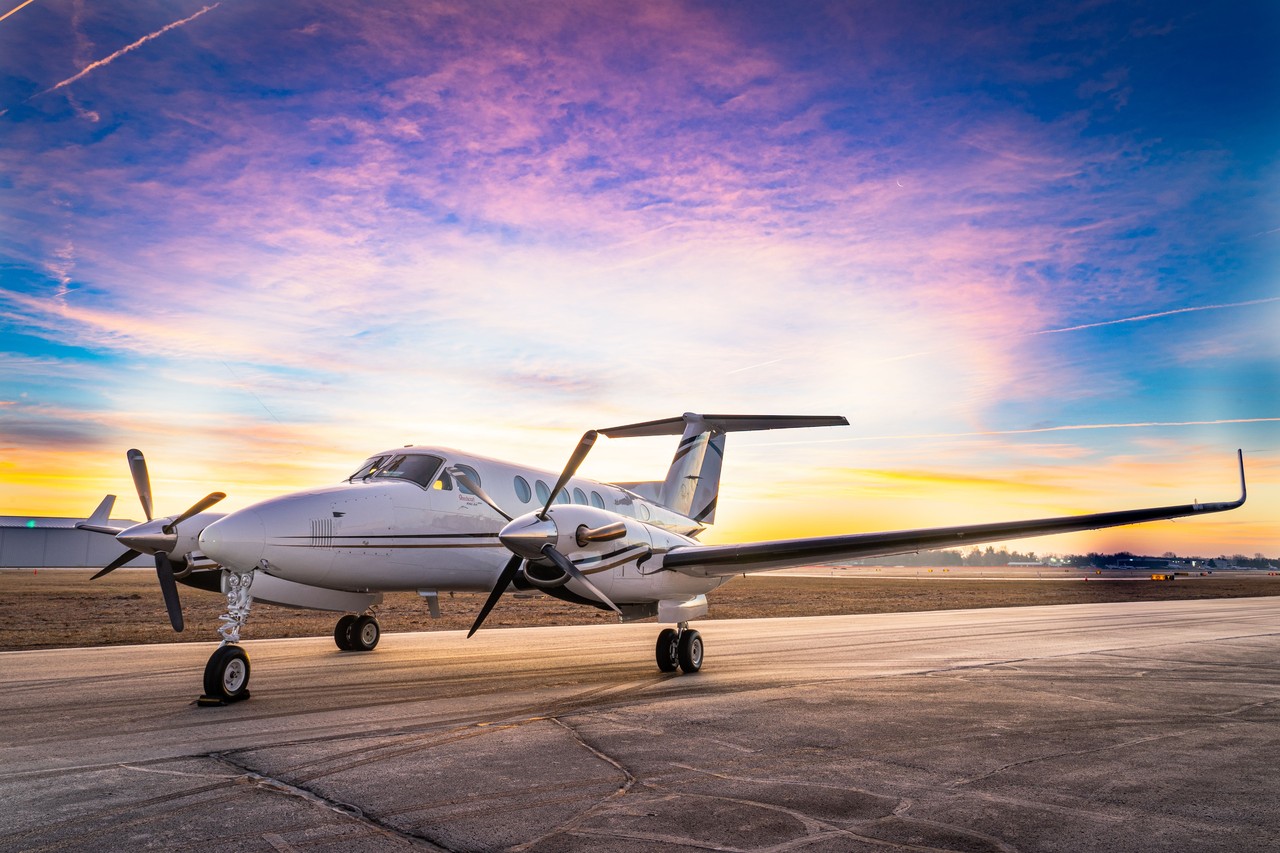
The King Air 200 series achieved unprecedented success in twin-turboprop aviation, capturing such a commanding market position that it outsold all competing turboprops combined since entering service in 1974. More than 1,800 aircraft were delivered across all variants through 2020, representing the longest continuous production run of any pressurized twin-turboprop in aviation history. Charter operators, corporations, air ambulance services, and government agencies worldwide adopted the aircraft as their primary workhorse.
Military Service
While designed for civilian use, the King Air 200 series found significant military applications. The first three production Model 200s were delivered to the U.S. Army in 1972 as A100-1 evaluation aircraft. The military variant A200 saw 75 aircraft built specifically for U.S. Army and Air Force utility and transport missions. The cargo-door equipped B200C variant included aircraft designated C-12F for the United States Air Force, with 112 total B200C models produced. These military variants served exclusively in transport and utility roles, with no combat armament or weapons systems.
Beechcraft Legacy
Walter H. Beech and Olive Ann Beech founded Beechcraft in 1932, establishing the company as a leader in business and utility aircraft manufacturing. The company operated independently until Raytheon acquired it in 1980, creating Raytheon Aircraft. Following a complex series of corporate changes, including the formation of Hawker Beechcraft in 2006 and a bankruptcy in 2008, Textron Aviation emerged as the current manufacturer and continues King Air production today from facilities in Wichita, Kansas.
Engineering Innovation
Beechcraft engineers developed the King Air 200 internally as the Model 101 in 1969, building upon the successful Model 100 King Air foundation. The design team made crucial improvements including adopting a distinctive T-tail configuration replacing the conventional tail, stretching the fuselage by 3 feet 10 inches, and increasing the wingspan by 4 feet 3 inches to 54 feet 6 inches. These modifications created the first aircraft in the pressurized twin-turboprop class, establishing performance benchmarks that competitors struggled to match.
Powerplant Excellence
Twin Pratt & Whitney Canada PT6A turboprop engines power all King Air 200 variants, with the original Model 200 equipped with PT6A-41 engines producing 850 shaft horsepower each, compared to 680 shaft horsepower on the earlier Model 100. Later variants including the B200GT and King Air 250 received upgraded PT6A-52 engines offering superior high-altitude performance. The PT6A engine family, in continuous production since 1963 with over 50,000 units manufactured, provided exceptional reliability and reverse thrust capability that became synonymous with King Air operations.
Commercial Applications
Commercial operators embraced the King Air 200 series for diverse missions ranging from scheduled airline service to specialized medical transport. Mesa Airlines operated 14 B200s configured as high-density 13-seat Model 1300s with belly cargo pods from 1989 to 1990. The Royal Flying Doctor Service of Australia received two B200C aircraft in January 2009 for remote area medical operations. Air ambulance operators worldwide adopted the Model 200C and subsequent cargo-door variants for medical evacuation missions, capitalizing on the aircraft's reliability and cabin space.
Production Variants
Production encompassed multiple specialized variants over 46 years. The original Model 200 totaled 858 aircraft including prototypes, while the improved B200 reached 1,157 units by 2009. The cargo-capable B200C produced 112 aircraft, and the enhanced B200GT delivered 97 units by 2009 following certification on November 16, 2007. The final variant, designated King Air 250, entered production in 2010 and continued until the series conclusion in 2020.
Enduring Value
Used King Air 250 aircraft maintained strong market values, with 2011 models valued at $3 million and 2015-2016 aircraft commanding $5 million in 2017. The aircraft's combination of reliability, performance, and cabin comfort ensured continued demand throughout its production life. Many examples remain in active service worldwide, testament to the fundamental soundness of the original 1972 design and the aircraft's adaptability to evolving mission requirements.