
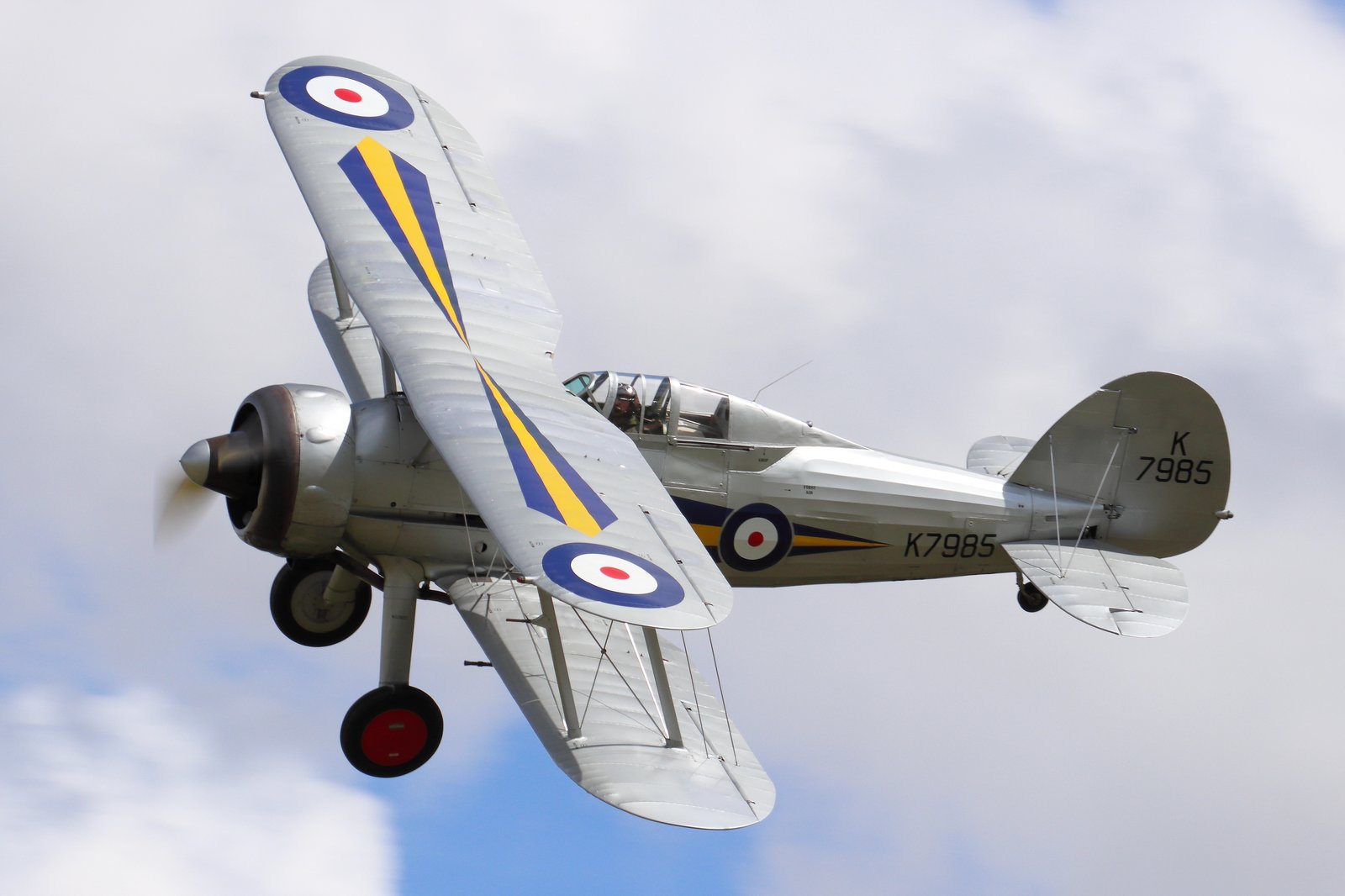
The Gloster Gladiator was a pivotal transitional aircraft, representing the final refinement of the biplane fighter before the adoption of all-metal monoplanes. Designed by Henry Philip Folland, the aircraft evolved from the Gloster Gauntlet. The prototype, designated the Gloster G.37, first flew on September 12, 1934, with Hawker test pilot Flying Officer Phillip Edward Gerald Sayer at the controls. The design was notable for introducing an enclosed cockpit to the RAF, which improved aerodynamics and pilot comfort, while maintaining a traditional single-bay biplane layout with a fixed undercarriage.
Production took place entirely at Gloster’s Hucclecote factory in Gloucestershire, England. The first production aircraft, K6129, was accepted into RAF service on February 16, 1937. Total production across all marks, including the Mk I, Mk II, and the navalized Sea Gladiator, reached 737 aircraft. The manufacturing company, Gloster Aircraft Company, had roots as the Gloucestershire Aircraft Company founded in 1917. Over time, Gloster became part of the Hawker Siddeley Group and was eventually absorbed into British Aerospace (BAe), now BAE Systems plc.
Technically, the Gladiator was powered by air-cooled, supercharged radial piston engines from the Bristol Aeroplane Company. The Mk I typically utilized the Bristol Mercury IX, while the Mk II and Sea Gladiator used the Bristol Mercury VIIIA, producing approximately 840 hp. The Sea Gladiator Mark I specification listed a maximum speed of 244 mph at 14,500 ft, a range of 423 miles, and a service ceiling of 33,000 ft. The aircraft was armed with four .303-calibre Browning machine guns, a significant increase in firepower over the G.37 prototype's mixed Vickers and Lewis gun armament.
Militarily, the Gladiator saw extensive global service. In the Royal Air Force, units such as No. 72 Squadron were early adopters, and No. 247 Squadron operated the type during the Battle of Britain. The Fleet Air Arm utilized the Sea Gladiator, including No. 804 Squadron. Beyond the UK, the aircraft served in 15 foreign air forces, including China, where it fought Japanese Mitsubishi A5M fighters starting in 1938, and Finland during the Winter War. During the 1940 Norwegian campaign, No. 263 Squadron operated Gladiators in extreme conditions. In France, two RAF squadrons were deployed in 1939, though all their Gladiators were lost within ten days of the German assault on May 10, 1940. The aircraft also played a critical role in the defense of Malta and operations in North Africa and Greece up to 1942. Today, the Gladiator's legacy is preserved in collections such as the RAF Museum.