
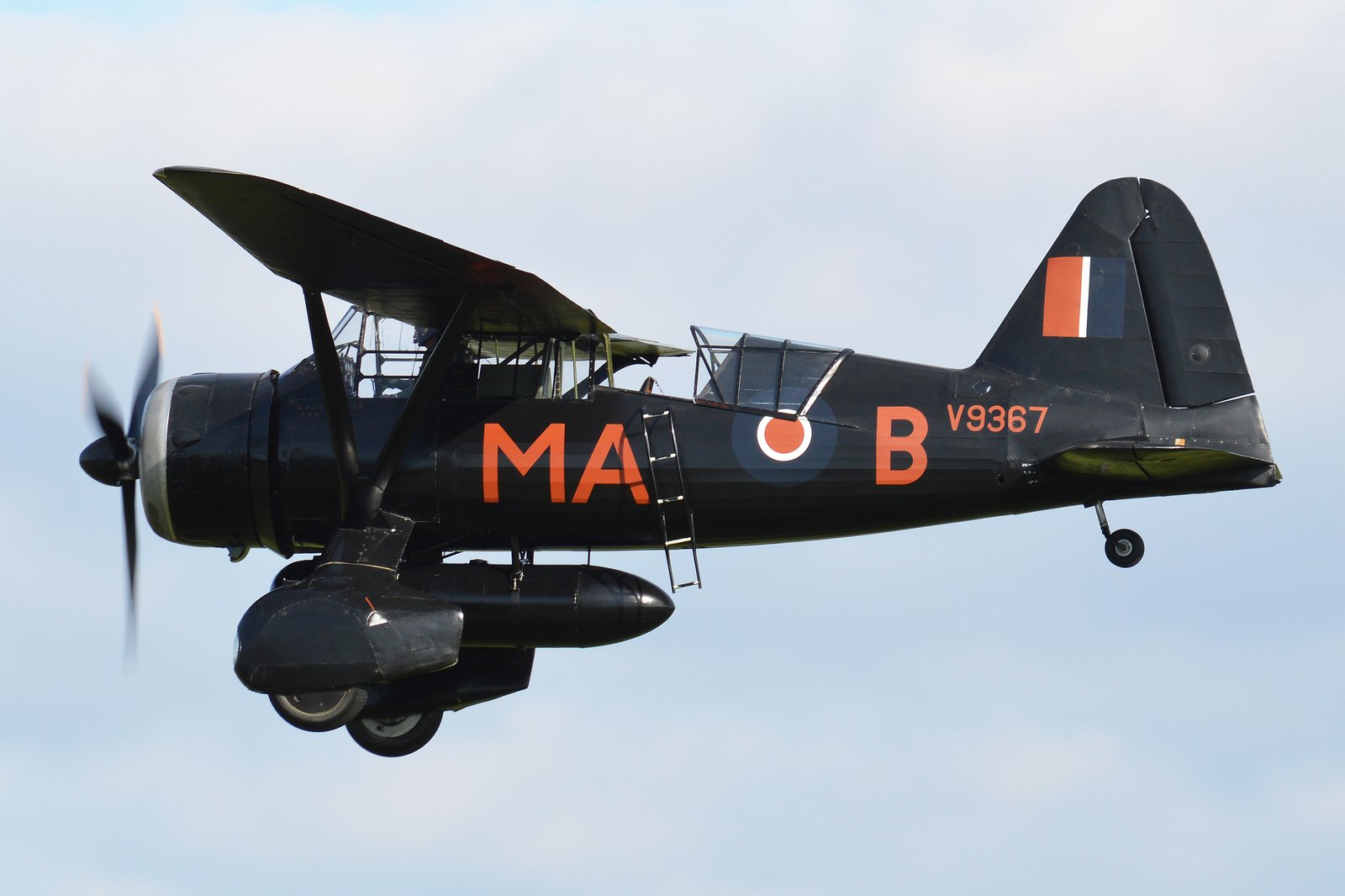
The Hawker Hector was developed in the mid-1930s as a specialized army-co-operation and liaison aircraft intended to replace the Hawker Audax. Derived from the Hawker Hart and Hind lineage, the Hector utilized a Hind-type fuselage, tail unit, and landing gear. The prototype first flew on 14 February 1936. While Hawker Aircraft was the nominal manufacturer and builder of the prototype, the production of the subsequent 178 aircraft was subcontracted to Westland Aircraft, as Hawker was prioritizing the production of the Hurricane fighter.
Technically, the Hector was powered by the Napier Dagger, an air-cooled, supercharged piston engine. Depending on the specific variant, such as the Dagger III or Dagger IIIMS, the engine produced approximately 805 hp (600 kW). Despite its power, the Napier Dagger was noted for being heavy and unreliable. The aircraft's performance included a maximum speed of 187 mph (301 km/h) at altitudes between 6,500 and 6,600 feet, a service ceiling of 24,000 feet, and a range of 300 miles. It could climb to 10,000 feet in 5 minutes and 40 seconds. For armament, the Hector carried one forward-firing .303 in Vickers machine gun and one rear-mounted .303 in Lewis gun, with equipment for flares, a camera, and two 112 lb bombs or containers.
In military service, the Hector entered Royal Air Force (RAF) operations in February 1937, equipping seven army-co-operation squadrons, including Nos. 2, 4, 13, 26, 53, 59, 296, 602, 612, 613, 614, and 615. By July 1938, it began to be displaced by the Westland Lysander. During the Battle of France, No. 613 Squadron utilized the Hector for dive-bombing missions against German positions near Calais on 26 May 1940. The following day, while attempting supply drops after the garrison's surrender, two Hectors were lost. Following their frontline retirement, the aircraft served as target tugs and as tow planes for General Aircraft Hotspur training gliders. Additionally, the Irish Air Corps acquired 13 Hectors between 1941 and 1942 via a British War Office sale, though these aircraft were reported to be in poor condition.
Ultimately, the Hector represents one of the final biplane designs used by the RAF for army-co-operation. Its legacy is that of a functional but short-lived stopgap that bridged the gap between the Audax and the more modern monoplane liaison aircraft.