
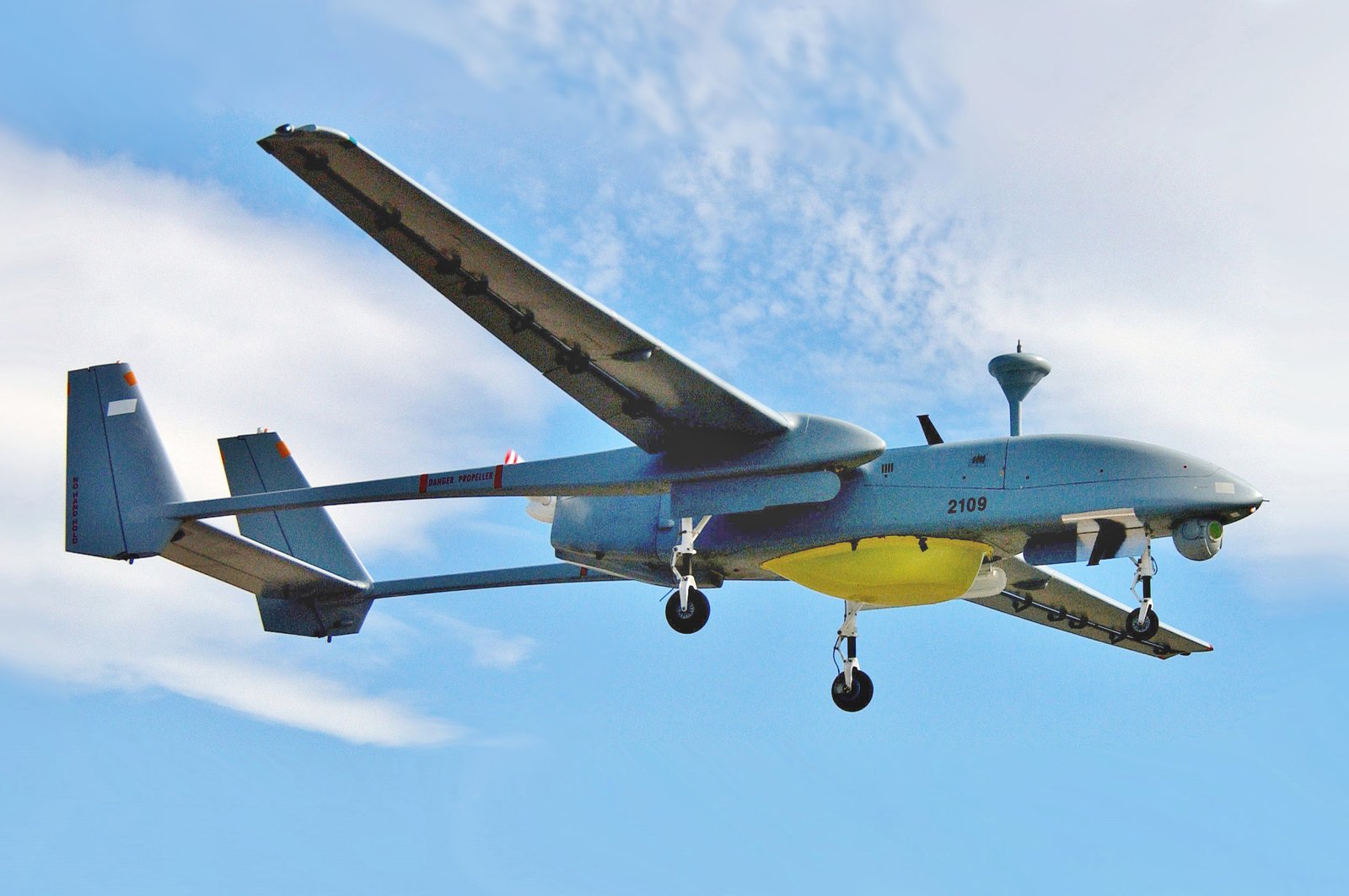
The IAI Heron-1 is a medium-altitude long-endurance (MALE) unmanned aerial vehicle (UAV) developed by the Malat UAV division of Israel Aerospace Industries (IAI). First flown in 1994 and introduced to service in 2005, the Heron-1 has become one of the most widely exported MALE platforms, serving over 22 customers worldwide. IAI, the manufacturer, evolved from the Bedek Aviation Company established in 1953, growing from a maintenance and overhaul institute into Israel's largest government-owned defense and aerospace firm.
Designed for strategic intelligence, surveillance, target acquisition, and reconnaissance (ISTAR), the Heron-1 is characterized by its high-aspect-ratio wings and a single piston engine driving a rear-mounted pusher propeller. While specific engine model details are not provided in official documentation, the aircraft is capable of reaching a service ceiling of up to 35,000 feet and a maximum speed of 207 km/h. One of its most significant technical achievements is its endurance, which ranges from 45 to 52 hours, and the integration of a fully automated take-off and landing (ATOL) system that allows operations in adverse weather. The platform supports beyond line-of-sight (BLOS) operations via satellite communications and can carry modular multi-sensor payloads, including SAR radar, SIGINT, and electro-optical/infrared (EO/IR) cameras.
In military service, the Heron-1 (known as the Machatz-1 or Shoval in Israel) played a pivotal role during Operation Cast Lead in 2008–2009. During this conflict, the Israeli Defense Forces integrated UAV squadrons directly at the brigade combat team level, a doctrinal shift that allowed ground forces to utilize UAVs, helicopters, and jets without requiring central air force authorization for every sortie. Other significant operators include India, which purchased 12 units in 2002 following the Kargil Review Committee's recommendations and later expanded its fleet to include 68 Heron Mk1 aircraft across the Army, Navy, and Air Force. The Heron-1 has also been deployed by the Royal Australian Air Force in Afghanistan under Project Nankeen, and by Germany in Afghanistan and Mali via lease arrangements.
Beyond combat, the Heron-1 has served in humanitarian and security roles, such as search and rescue missions following the 2004 Indian Ocean tsunami and maritime surveillance for the Hellenic Coast Guard. While the platform has influenced derivatives like the French Eagle (Harfang), all exported Heron-1 units are explicitly unarmed. The aircraft remains in active production and served as the operational foundation for subsequent models, including the Heron Mk II and Heron TP.