
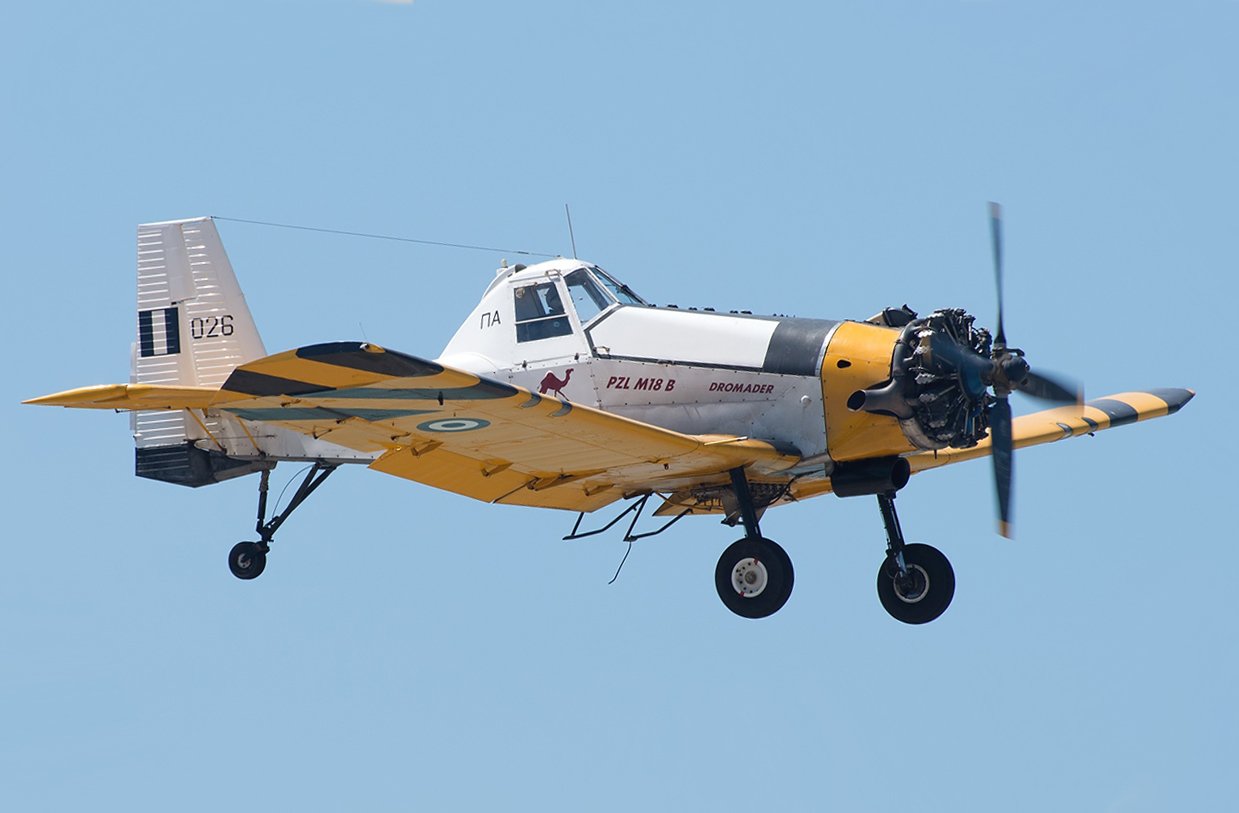
Service History
The Dromader established itself as a dominant force in specialized aviation roles, with more than 200 aircraft operating in the United States alone. By 2008, China had acquired 15 units, while countries spanning five continents adopted the type for agricultural spraying and aerial firefighting missions. The Polish fire service began purchasing M-18 Dromaders in 1980 as specialist aircraft, recognizing their effectiveness in combating wildfires with specialized tank systems.
The Manufacturer
PZL-Mielec developed the Dromader during the first half of the 1970s as part of Poland's ambitious aviation export program. The company collaborated with Rockwell International of the United States to ensure the design met international standards and market requirements. In 1996, PZL-Mielec expanded operations by finalizing a contract to establish a Dromader assembly plant in Brazil, demonstrating the aircraft's global appeal. As of 2017, while new production had ceased, PZL-Mielec continued supporting the worldwide fleet through comprehensive refurbishment programs, with new engines supplied by WSK "PZL-Kalisz."
Engine & Technical Details
The standard Dromader utilized a PZL Kalisz ASz-621R nine-cylinder air-cooled radial engine producing 731 kilowatts (980 horsepower), driving a four-bladed PZL Warszawa AW-2-30 constant-speed aluminum propeller measuring 3.3 meters in diameter. This powerplant configuration provided the substantial thrust necessary for operations with heavy chemical loads. The aircraft typically operated with a single pilot, though two-seat variants accommodated mechanics or chemical loaders as passengers. An alternative turboprop variant, the M-18T, entered service in 1986 through MELEX USA, offering enhanced performance characteristics for specialized applications.
Pilot Perspective
Pilots appreciated the Dromader's robust construction and reliable handling characteristics during low-altitude agricultural operations. The aircraft's maximum fuel capacity of 510 kilograms (1,120 pounds) provided sufficient range for extended spraying missions, while its low-wing configuration ensured stable flight characteristics when carrying chemical payloads approaching maximum gross weight. The M-18's design prioritized operational efficiency over speed, focusing on precise chemical application and firefighting effectiveness rather than transportation velocity.
Production & Variants
Production commenced in 1978 following Polish certification in September of that year, continuing with interruptions until 2017. The manufacturing program produced several distinct variants to meet diverse operational requirements. The original M-18 single-seat version established the baseline configuration, while the M-18A two-seater, available from 1984, could transport up to 2,200 kilograms of payload plus a mechanic. The M-18AS featured dual cockpits for training purposes, and the M-18B incorporated a more powerful K-9 engine for enhanced performance.
The M-18BS training variant replaced the chemical tank with a student pilot cabin while maintaining 700 kilograms of payload capacity. During the 1980s, PZL-Mielec envisioned an expanded family including the M-21 Dromader Mini (first flight June 18, 1982), M-24 Dromader Super (first flight July 14, 1987), and M-25 Dromader Mikro, though none of these derivatives achieved production status.
Global Distribution and Legacy
The Dromader's international success stemmed from its versatility in both agricultural and firefighting roles across diverse geographical conditions. Aircraft were delivered to Argentina, Australia, Brazil, Bulgaria, Canada, China, Croatia, Cuba, Czech Republic, France, Germany, Greece, Hungary, Iran, Italy, Nicaragua, Portugal, Spain, Turkey, the United States, Venezuela, and Yugoslavia. This widespread distribution established the M-18 as one of the most internationally recognized Polish aircraft designs.
The type's longevity from 1976 to present operations demonstrates its effectiveness in specialized aviation roles. Many Dromaders continue operating worldwide, supported by ongoing refurbishment programs that install modern engines while maintaining the proven airframe design. Plans for renewed production at WZL-2 in Bydgoszcz indicate continued confidence in the Dromader's market relevance, ensuring this Polish aviation success story will continue serving agricultural and firefighting communities globally.