
Service History
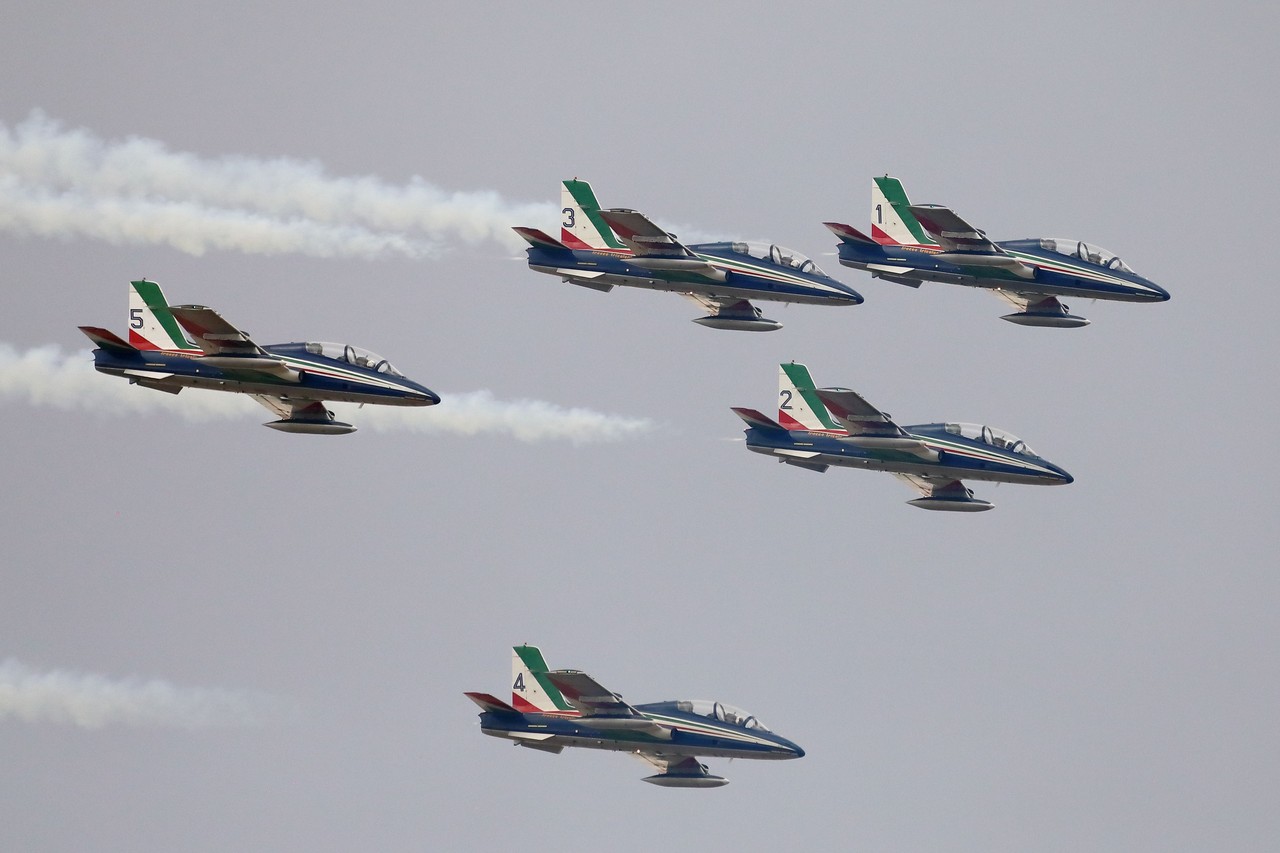
The MB-339 entered Italian Air Force service in August 1979, quickly establishing itself as the backbone of advanced pilot training. The aircraft gained international prominence when the Frecce Tricolori aerobatic demonstration team adopted the MB-339PAN variant on April 27, 1982, replacing their aging Fiat G-91s. Twenty-five specially configured MB-339PAN aircraft were built or converted for aerobatic duties, showcasing Italian aviation excellence at air shows worldwide.
Beyond Italy's borders, the MB-339 found success in diverse international markets. The Royal New Zealand Air Force ordered 18 MB-339CB variants equipped with laser rangefinders and capable of carrying AIM-9L Sidewinder missiles and AGM-65 Maverick air-to-ground missiles. The United States Navy employed the type as an adversary trainer, while other operators included Malaysia, Argentina, Peru, Nigeria, Ghana, and the United Arab Emirates.
Combat Operations
The MB-339 saw its only significant combat action during the 1982 Falklands War, when Argentina's Air Force deployed the aircraft in ground attack missions against British forces. This operational deployment demonstrated the aircraft's light attack capabilities, utilizing underwing pylons to carry bombs and other ordnance.
The Manufacturer
Aermacchi, formally known as Aeronautica Macchi, originated as a pioneering Italian aviation company founded in 1912. The MB-339 represented the culmination of designer Ermanno Bazzocchi's trainer aircraft lineage, which included the successful MB-326 that saw over 800 examples built starting in 1954. The MB-339 became the final aircraft in the "Macchi Bazzocchi" series before the company's integration into larger aerospace conglomerates.
During the 1990s and 2000s, Aermacchi was acquired by Finmeccanica, later renamed Leonardo. Under Leonardo's ownership, MB-339 production and support continues today, with the company developing the M-345 as the MB-339's eventual successor.
Design and Development
Emanno Bazzocchi's design team developed the MB-339 as an evolutionary improvement of the proven MB-326, incorporating a new engine, redesigned nose section, updated cabin, and modified wings and tailplanes. The Italian Air Force selected the MB-339 over Fiat's competing G-91YT design on February 11, 1975, launching the development program.
The prototype MM588 completed its maiden flight on August 12, 1976, followed by a second prototype (MM589) on May 20, 1977. The first production aircraft (MM54438) flew on July 20, 1978, with initial deliveries of MM54439 and MM54440 occurring on August 8, 1979. The aircraft was engineered to meet MIL-A-8860A standards for a 10,000-hour service life with remarkably low maintenance requirements of just 5.95 maintenance man-hours per flight hour.
Engine and Performance
Early MB-339A models utilized the Rolls-Royce Viper 632-43 turbojet producing 4,000 pounds of thrust. Later variants, beginning with the MB-339C that first flew on June 9, 1983, adopted the more powerful Viper 680 engine generating 4,300 pounds of thrust. The production MB-339C made its debut flight on December 17, 1985.
The reliable Viper engine, manufactured by Rolls-Royce from the 1950s through the 1990s, enabled the MB-339 to achieve a maximum speed of 558 mph with a range exceeding 1,200 miles. The aircraft's tandem stepped cockpit configuration accommodates two crew members, with the instructor positioned in the elevated rear seat for optimal forward visibility.
Production Legacy
Full-scale production commenced in 1979 at Aermacchi's Varese facility and continues today, representing over 44 years of continuous manufacturing. More than 230 examples have been completed across multiple variants, including the MB-339A baseline model, the C-series with improved engines, the CD variant featuring digital avionics, and specialized versions like the CE model delivered to Eritrea.
Significant production milestones include the rollout of the first MB-339CD on April 12, 1996, its first flight on April 24, 1996, and delivery of the 200th aircraft on April 14, 1997. By late 2002, the global MB-339 fleet had accumulated over 500,000 flight hours.
Current Operations
Italy implemented a mid-life upgrade program beginning in 1999, extending aircraft service life from 10,000 to 15,000 hours and operational lifespan to 30 years. The upgraded prototype CSX54453 flew on December 20, 1999. Today, MB-339CD variants continue serving with the Italian Air Force's 61° Stormo at Galatina, while the iconic Frecce Tricolori maintains its fleet of MB-339PAN aircraft.
Museum preservation includes RNZAF aircraft NZ6460, a MB-339CB variant displayed at the Air Force Museum of New Zealand's Thérèse Angelo Wing, ensuring this successful Italian trainer's legacy endures for future generations.