
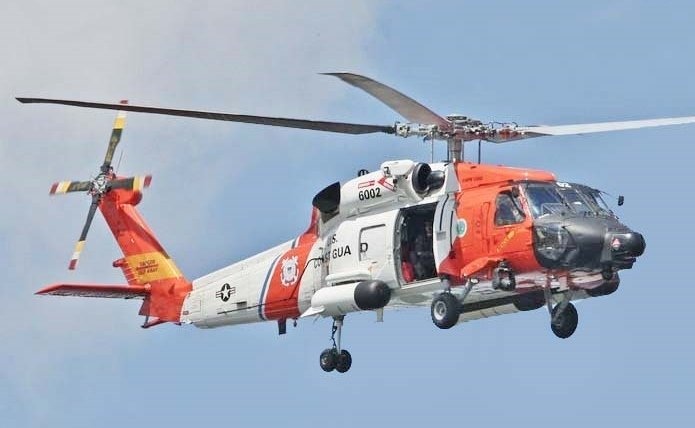
The Sikorsky MH-60 Jayhawk is a specialized medium-range recovery (MRR) helicopter utilized by the U.S. Coast Guard for search and rescue (SAR), law enforcement, marine environmental protection, and military readiness. Developed as a derivative of the U.S. Navy's H-60 family—specifically the HH-60H Strike Rescue and Special Warfare Support Helicopter—the Jayhawk was designed to replace the aging HH-3F Pelican fleet. The aircraft's name was selected in 1989 through a Coast Guard contest won by Marine Science Technician Second Class Janice Silves, who chose the name to reference both the "J" in the original HH-60J designation and the Navy's Seahawk.
Production of the HH-60J began in the late 1980s at Sikorsky's main facility in Stratford, Connecticut. The first airframe was delivered to NAS Patuxent River, Maryland, in March 1990 for developmental testing, though some records indicate the prototype's maiden flight occurred as early as August 8, 1989. While the Coast Guard originally purchased 42 HH-60J airframes, the fleet has since grown to 51 MH-60T Jayhawks through the conversion of other H-60 airframes, such as former Navy SH-60F models. To maintain operational readiness, the Coast Guard implemented a Service Life Extension Program (SLEP) to upgrade avionics and mission systems, as 90% of the fleet would have reached the end of its service life by 2028 without these modifications.
Technically, the Jayhawk is powered by two General Electric T700-GE-401C turboshaft engines, each producing approximately 1,980 shaft horsepower. This power plant allows for a maximum gross weight of 21,884 lb and a rescue hoist capacity of 600 lb. The aircraft is optimized for over-water endurance, featuring a range of 700 nautical miles and an endurance of 6.5 to 7 hours. In a typical SAR profile, the Jayhawk can operate within a 300-NM radius of action, allowing for a 15-minute search and a 30-minute hover to recover up to six survivors. Its performance includes a cruise speed of 140 to 170 knots and a service ceiling of 13,000 ft for the MH-60T variant.
Since entering service in 1990, the Jayhawk has become the workhorse of U.S. maritime safety, credited with saving over 13,000 lives. It is operated from various air stations, including those in Astoria, Cape Cod, Clearwater, Elizabeth City, Kodiak, San Diego, and Sitka, as well as the Aviation Training Center in Mobile, Alabama. The aircraft's legacy is preserved through its continued front-line service and its planned inclusion as a major exhibit at the National Coast Guard Museum.