
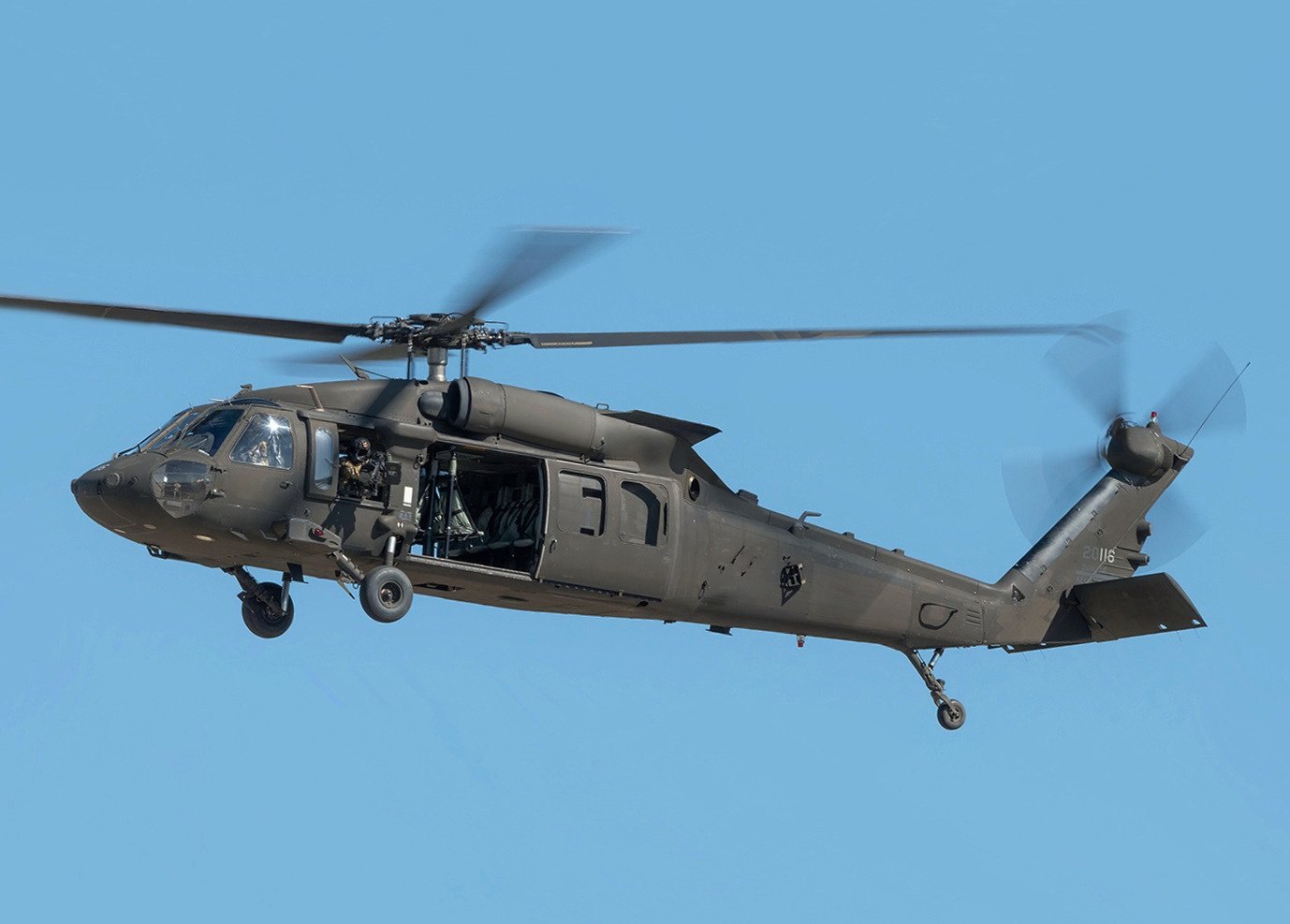
Developed in the early 1970s, the Sikorsky UH-60 Black Hawk was created to satisfy the U.S. Army's Utility Tactical Transport Aircraft System (UTTAS) requirement. The program sought a robust and reliable utility helicopter to replace the single-engine UH-1 Huey. Sikorsky submitted the S-70 design in 1972, and after eight months of testing, the YUH-60A was selected over the Boeing Vertol YUH-61A. The prototype first flew on October 17, 1974, and the first production UH-60A was accepted by the U.S. Army in 1978. The aircraft officially entered service in 1979, initially deploying with the 82nd Airborne Division and the 101st Airborne Division.
Designed for battlefield survivability, the Black Hawk features a four-blade main rotor system utilizing titanium-cored blades capable of resisting anti-aircraft artillery fire up to 23 mm. These blades are equipped with pressurized sensors to alert crews to damage. The aircraft is powered by twin turboshaft engines and is configured to carry a crew of three—a pilot, co-pilot, and crew chief—alongside an 11-man rifle squad. Over time, the airframe has evolved through several iterations, including the UH-60L and the current production model, the UH-60M, which features updated avionics and systems.
Since its introduction, the Black Hawk has been utilized in every major U.S. Army contingency operation. This includes the 1983 invasion of Grenada (Operation Urgent Fury), the 1989 invasion of Panama (Operation Just Cause), and the 1991 Gulf War, which featured the largest air assault in U.S. Army history. The aircraft gained significant notoriety during the 1993 Battle of Mogadishu in Somalia. More recently, it has seen extensive use in the Iraq War and Operation Enduring Freedom in Afghanistan. Specialized variants include the MH-60 for special operations, the HH-60 for search and rescue, and the VH-60N "White Hawk," which serves as "Marine One" when transporting the U.S. President.
Beyond military combat, the Black Hawk has adapted to civil and humanitarian roles. The "Firehawk" variant is specifically equipped with a 1,000-gallon belly water tank for wildfire suppression. To date, more than 5,000 aircraft have been built for at least 36 nations. The fleet has accumulated over 15 million flight hours, with more than 5 million of those occurring in combat. Original production took place at Sikorsky's facilities in Stratford, Connecticut. While originally built by Sikorsky Aircraft, the company was acquired by Lockheed Martin in 2015 and now operates as Sikorsky, a Lockheed Martin company.