
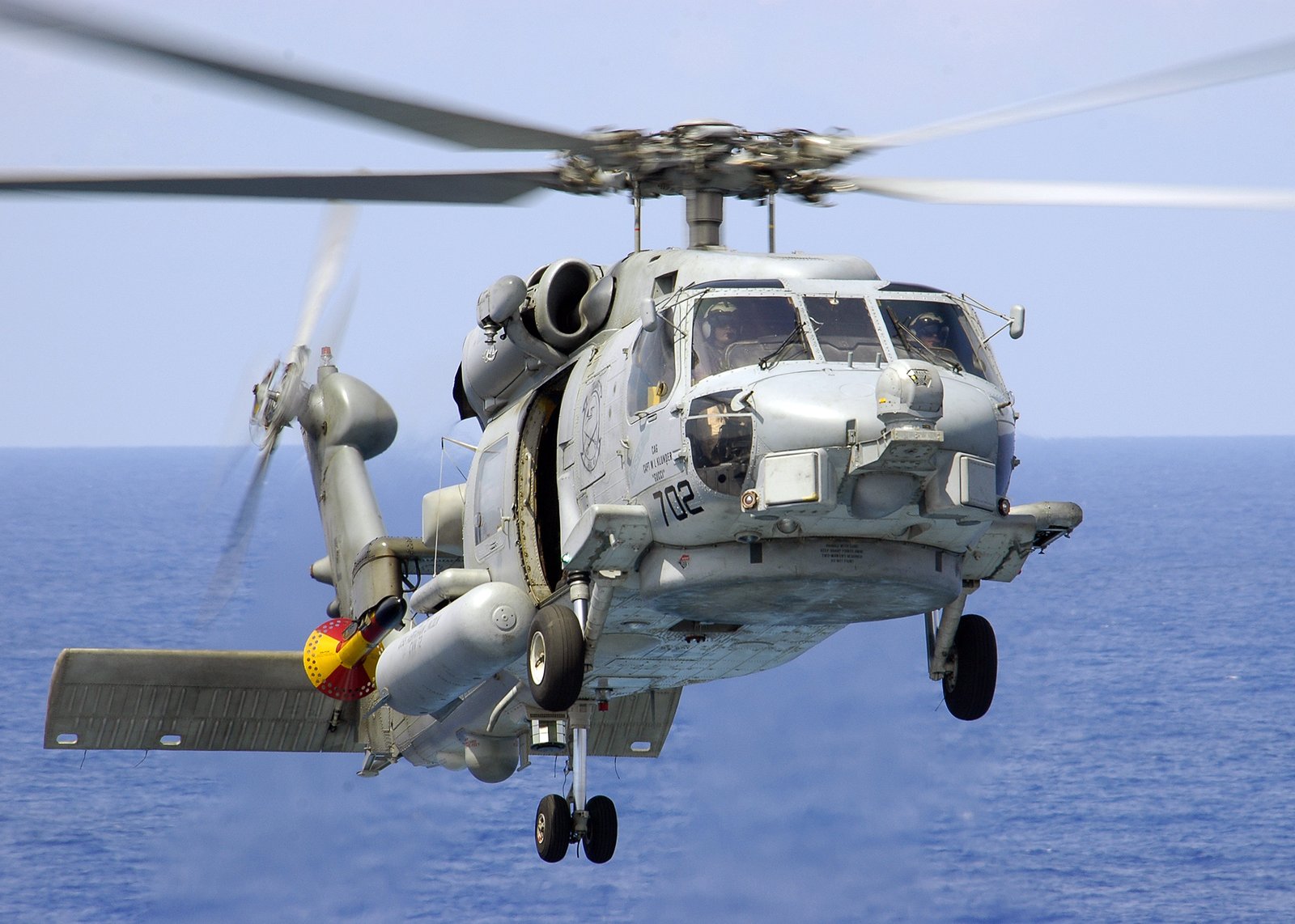
The Sikorsky SH-60 Seahawk is a twin-turboshaft, shipborne multi-mission helicopter developed for the U.S. Navy in the late 1970s. Derived from the UH-60 Black Hawk, the Seahawk was designed to provide a versatile platform capable of anti-submarine warfare (ASW), anti-surface warfare (ASuW), search and rescue (SAR), and vertical replenishment (VERTREP). The U.S. Navy selected Sikorsky's S-70B design in 1978 to replace the Kaman SH-2 Seasprite within the Light Airborne Multi-Purpose System (LAMPS) III role. The prototype YSH-60B first flew on December 12, 1979, followed by the first production SH-60B on February 11, 1983. The aircraft officially entered operational service in 1984.
Designed for the rigors of maritime environments, the SH-60 features corrosion-resistant materials and coatings. To facilitate storage on cruisers, destroyers, frigates, and aircraft carriers, the aircraft incorporates a folding main rotor and a folding tail. Other naval modifications include a relocated tail wheel positioned in the mid-fuselage and strengthened landing gear. The SH-60B variant specifically integrated the LAMPS III mission suite, which included electronic support measures (ESM), a surface-search radar, and a data-link to host ships, allowing the helicopter to act as a remote sensor for the battle group.
Power is provided by two General Electric T700 turboshaft engines. Representative modern variants, such as the MH-60R and MH-60S, utilize the T700-GE-401C model, which produces 1,890 shp (1,410 kW) per engine at takeoff. In terms of performance, the aircraft can reach a maximum speed of 146 knots and has a range of 450 nautical miles at cruise speed, with a service ceiling of 12,000 feet. For combat, it can be armed with up to three Mk 46 or Mk 54 lightweight torpedoes, AGM-114 Hellfire missiles, and door-mounted machine guns such as the M60.
Production of the Seahawk family has continued from 1979 to the present at Sikorsky's facilities in Stratford, Connecticut. A total of 938 airframes have been built across the various naval S-70 variants. While the original SH-60B was retired from U.S. Navy service in April 2015 after 32 years, the lineage continues through the MH-60R and MH-60S. These aircraft are operated by the U.S. Navy and several international partners, including the Royal Australian Navy, Indian Navy, and the Hellenic Navy. The Seahawk's combat record includes service during Operation Desert Storm in 1991, where HH-60H variants were used for combat search and rescue and special warfare support.
Sikorsky Aircraft, the original manufacturer, was part of United Technologies Corporation (UTC) for several decades before being acquired by Lockheed Martin on November 6, 2015. Today, the company operates as Sikorsky, a Lockheed Martin company. The legacy of the Seahawk is cemented by its role as the de facto standard for modern ASW helicopters, with the global MH-60R fleet surpassing one million flight hours by early 2023.