
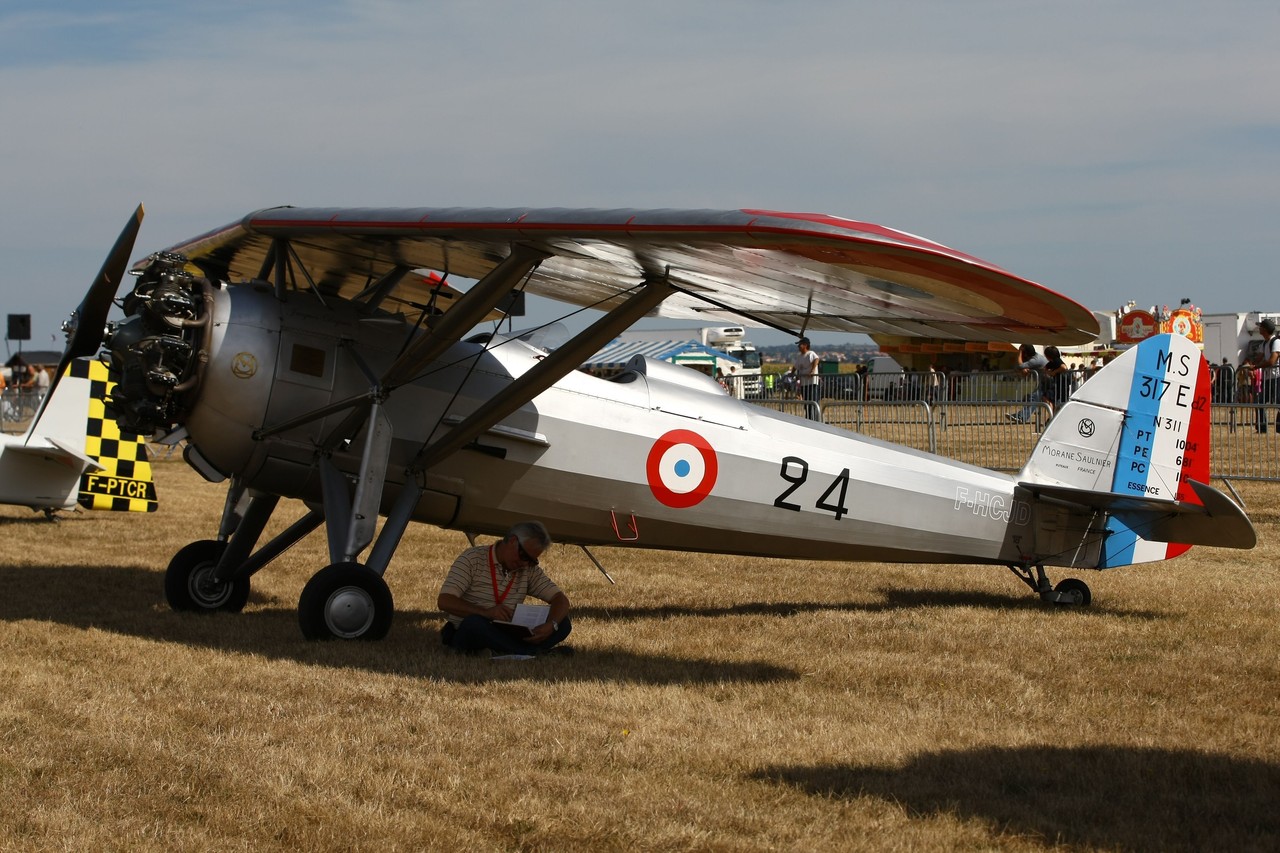
Service History
The MS.315 became the backbone of French aviation training, serving with both the Armée de l'Air and Aeronavale from 1932 through World War II. More than 240 copies were operational before the French Armistice of June 1940, making it the primary aircraft used to train an entire generation of French military pilots. Beyond military service, the MS.315 equipped numerous civil flying schools throughout France and became a fixture at pre-war airshows, where it was flown by notable demonstration pilots including Thoret, Fleurquin, and Detroyat.
Development and Design Evolution
The MS.315's success came only after a challenging development process that began with the MS.300 prototype in February 1930. The French military's Ed2 program demanded a primary trainer capable of taking off within 120 meters, a requirement that proved elusive for early variants. The MS.301, which first flew in July 1930, also failed to meet these stringent performance standards. Engineers finally achieved the necessary specifications with the MS.315 by installing the more powerful 135-horsepower Salmson 9Nc engine and reducing the vertical stabilizer area compared to earlier prototypes.
Production Success
French state contracts drove steady production increases throughout the 1930s. Initial orders included 4 aircraft in August 1932 and 30 in October 1932, followed by larger contracts of 80 aircraft in 1934, 75 in 1935, 20 in 1937, and 30 in 1938. This systematic procurement reflected the aircraft's proven reliability and effectiveness as a training platform. Post-war production added another 33 aircraft, bringing total manufacturing to 355 units including prototypes.
Technical Innovation
The MS.315's parasol wing configuration provided excellent stability characteristics essential for primary training while maintaining good visibility for both instructor and student. The mixed construction technique combined strength with manageable weight, while the divided main landing gear offered stability during ground operations. The two-bladed metal propeller driven by the nine-cylinder Salmson 9Nc represented modern technology for its era.
Variants and Modifications
The MS.316 variant substituted a 120-horsepower Lorraine 5Pc engine and found export success with Peru, which purchased six aircraft. These Peruvian machines were later re-engined with American Kinner B5 five-cylinder engines during their service life. Five enhanced MS.315/2 aircraft were manufactured specifically for civil operators with increased power output.
Between 1960 and 1962, 40 MS.315s underwent major modifications for glider towing operations, receiving 164-kilowatt Continental W-670K radial engines and the new designation MS.317. This conversion extended the aircraft's operational life well into the jet age.
Wartime Operations
As Germany invaded France in 1940, the MS.315 fleet represented a critical training asset that had prepared hundreds of military pilots. While not designed for combat, these trainers continued operating under Vichy control and later with Free French forces, maintaining pilot proficiency throughout the war years. The aircraft's robust construction and reliable powerplant made it ideal for the demanding environment of wartime flight training.
Legacy and Preservation
The MS.315's commercial success established Morane-Saulnier as a major force in trainer aircraft manufacturing and demonstrated French aviation industry capabilities during the challenging interwar period. Its nearly two-decade production run proved the soundness of the basic design concept.
At least one MS.315 remains airworthy today. Aircraft G-BZNK, serial number 354 manufactured in 1932, continues flying with a modern Rotec R3600 nine-cylinder engine replacement, though it experienced a forced landing near Sidmouth Beach, Devon, on May 5, 2018. This surviving example represents one of the oldest continuously operated training aircraft in the world, testament to the MS.315's enduring design qualities that made it France's most successful interwar trainer.