
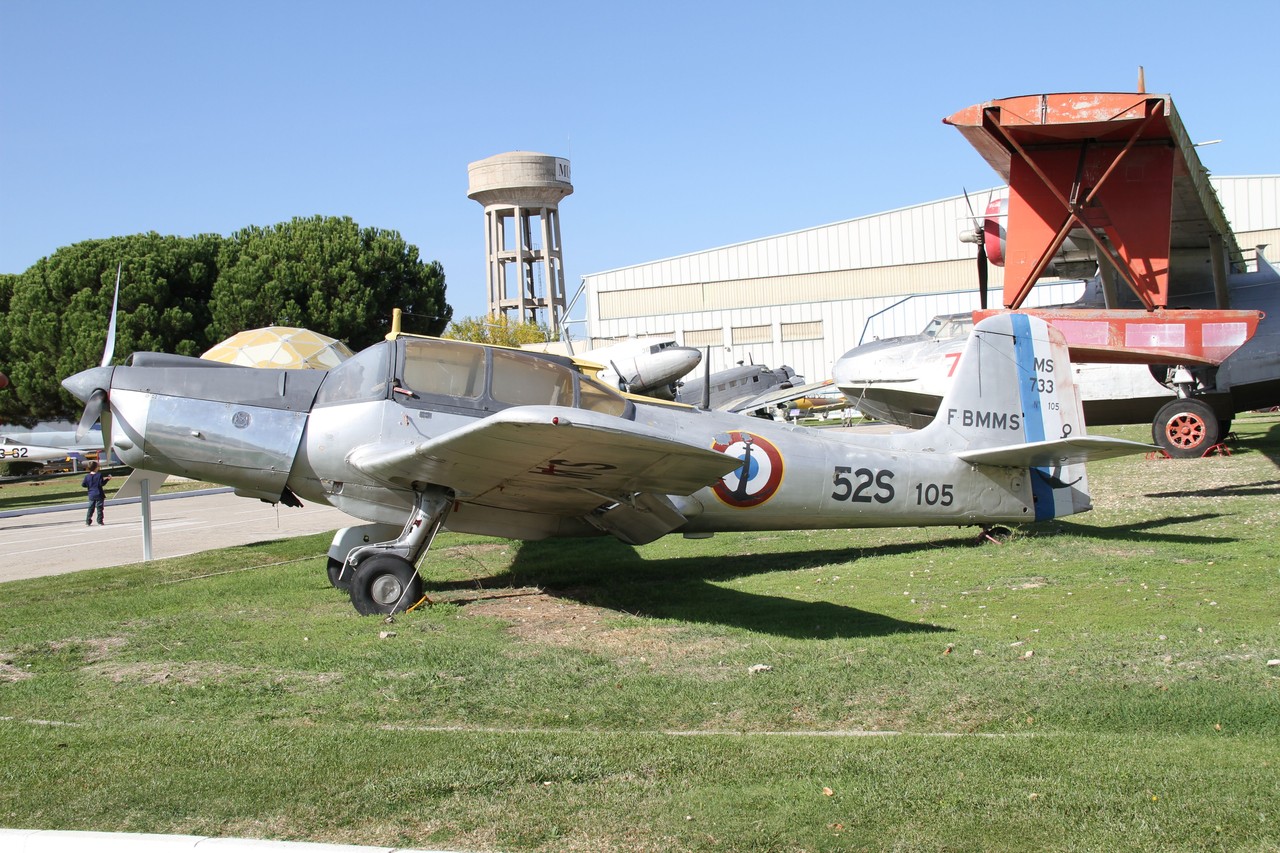
Development History
The Alcyon's development began in the late 1940s when the French military sought a modern replacement for their obsolete training fleet. The initial prototype MS.730 took to the air on August 11, 1949, powered by a 180-horsepower Mathis 8G.20 inverted V8 engine. However, engine availability issues forced designers to adapt a German war-surplus 240-horsepower Argus As 10 powerplant, leading to the redesignated MS.731 that flew in November 1949.
Two MS.732 prototypes followed in 1951, introducing the crucial retractable landing gear system and a Potez 6D.02 engine. The definitive MS.733 configuration emerged on April 16, 1951, featuring the reliable Potez 6D.30 inverted inline piston engine that would power all production aircraft. This evolutionary development process, spanning nearly three years, reflected Morane-Saulnier's methodical approach to creating a trainer that would serve France's military aviation needs for decades.
Production and Service Entry
Production commenced in 1955, with Morane-Saulnier ultimately delivering 208 aircraft through the late 1950s. The French Air Force received the largest allocation of 145 aircraft, with the first operational squadron, 51.S "Escadrille d'Entrainement au Pilotage," achieving full operational status in October 1957. The French Navy's Aeronavale took delivery of 40 Alcyons beginning in January 1957, using them for pilot training and liaison duties until early 1958.
Cambodia became the aircraft's primary export customer, receiving 15 armed variants equipped with dual 7.5mm machine guns. The first seven Cambodian Alcyons arrived in January 1955, followed by four additional aircraft and eight more in 1957. These armed variants served dual roles as advanced trainers and counter-insurgency platforms until their replacement by Gardan GY-80 Horizons in 1969.
Combat and Military Operations
The Alcyon proved its versatility beyond basic training when French forces adapted 70 aircraft with armament for advanced gunnery instruction. Each armed variant carried two MAC 34/39 7.5mm machine guns mounted in the wings, with 500 rounds per gun and an SFOM 83 reflector sight for accurate targeting. Some of these armed trainers were further modified for counter-insurgency operations during the Algerian conflict, receiving the designation MS.733A.
The aircraft's combat adaptation demonstrated the sound design philosophy underlying the Alcyon program. Its stable handling characteristics and robust construction made it equally suitable for teaching basic flying skills and conducting operational missions in challenging environments.
The Manufacturer Legacy
Morane-Saulnier brought significant aviation heritage to the Alcyon project, having previously designed the MS.406, France's standard fighter at the outbreak of World War II. This experience in military aircraft development proved invaluable in creating a trainer that met the exacting standards of postwar French aviation. The company's understanding of pilot training requirements, gained through decades of military aircraft production, influenced every aspect of the Alcyon's design.
The Alcyon represented one of Morane-Saulnier's final independent aircraft programs before the company's absorption into larger French aerospace conglomerates, marking the end of an era in French aviation manufacturing.
Technical Innovation
The Potez 6D.30 powerplant provided the Alcyon with exceptional reliability and performance characteristics. This air-cooled, six-cylinder inverted inline engine delivered 240 horsepower while maintaining the simplicity essential for training operations. The engine's inverted configuration lowered the aircraft's center of gravity and provided excellent forward visibility for both instructor and student.
The Alcyon's retractable landing gear system represented a significant advancement over fixed-gear trainers, allowing students to master the complexities of modern aircraft systems while maintaining manageable operating costs. The cantilever low-wing design provided superior aerodynamic efficiency compared to earlier biplane trainers, enabling all basic aerobatic maneuvers essential for military pilot development.
Operational Characteristics
Pilots praised the Alcyon's predictable handling and forgiving flight characteristics, making it ideal for ab initio military training. The aircraft's 160 mph maximum speed provided sufficient performance for advanced training scenarios while remaining manageable for novice pilots. Its 560-mile range allowed extended cross-country training flights without frequent fuel stops.
The spacious cockpit accommodated various training configurations, from basic dual instruction to advanced multi-crew cooperation exercises. The aircraft's structural strength supported the demanding training environment, including repeated takeoffs, landings, and aerobatic sequences that characterized military pilot instruction.
Legacy and Preservation
The Alcyon successfully bridged the transition from biplane to modern monoplane training, serving French military aviation through the crucial post-World War II reconstruction period. Several examples remain in private ownership today, testament to the aircraft's enduring appeal and robust construction. One notable survivor, originally built in 1956 as French Air Force serial 125, transitioned to civilian registration F-BMQJ in 1965, later becoming G-SHOW in the United Kingdom in 1980.
The MS-733 Alcyon stands as a symbol of French aviation's postwar renaissance, representing the successful marriage of practical training requirements with innovative aeronautical engineering that characterized the industry's recovery and modernization.