
Military Service Dominance
The MS-760 Paris found its greatest success in military service rather than the civilian market it was designed to penetrate. The French Air Force ordered 50 aircraft on July 18, 1956, with deliveries split between 36 for the Air Force and 14 for the French Navy. The Navy employed their Paris aircraft for specialized training of Super Étendard and F-8 Crusader pilots in instrument flight rules and all-weather flying procedures, as well as advanced training for new pilots and proficiency training for senior naval officers.
Internationally, the Paris attracted significant military interest. The Argentine Air Force acquired 48 aircraft, with 36 built under license by Fábrica Militar de Aviones, making it one of the few French jets manufactured in South America. Some Argentine examples were equipped with military armament including machine guns, 20mm cannon, and provisions for light ordnance. The Brazilian Air Force operated 30 Paris jets, while the Netherlands ordered seven Paris II variants in 1962 for the Rijksluchtvaartschool at Groningen Airport Eelde, operating them until 1974 when they were replaced by Cessna 500 Citations.
The Manufacturer's Struggle
Morane-Saulnier, founded in 1911 by brothers Léon and Robert Morane, faced significant financial challenges during the Paris production period. The company had originally achieved success with military aircraft in both world wars, but the transition to jet-age aircraft proved economically difficult. In 1961, Morane-Saulnier declared bankruptcy and was acquired by fellow French manufacturer Potez, which continued Paris production until 1964. This acquisition effectively ended Morane-Saulnier's independent operations, making the MS-760 one of the company's final original designs.
Design Evolution and Innovation
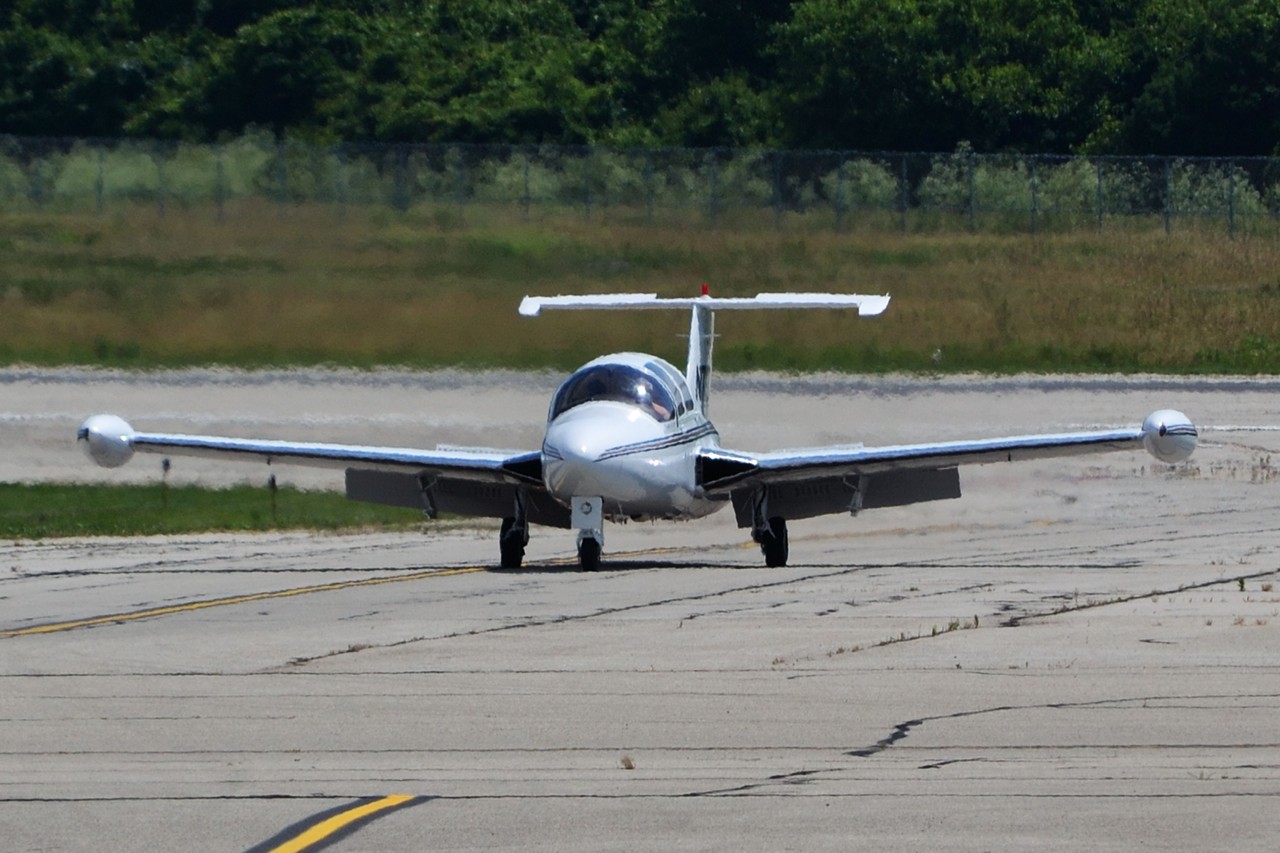
Chief engineer René Gauthier and his design team created the Paris from the earlier MS.755 Fleuret, originally a two-seat jet trainer proposed for French Air Force competition. When the Fouga Magister won the military trainer contract, Gauthier's team redesigned the Fleuret into a four-seat liaison aircraft, creating an innovative configuration for its era. The distinctive T-shaped vertical stabilizer and side-by-side engine mounting in the aft fuselage provided inherent stability while allowing easy maintenance access through a detachable tail unit.
Test pilot Jean Cliquet performed the maiden flight on July 29, 1954, in prototype F-WGVO. The aircraft retained excellent flying characteristics from its trainer heritage, with pilots praising its stability and predictable handling. The pressurized cockpit featured a single-piece canopy, while the retractable tricycle landing gear provided modern ground handling characteristics.
Engine Performance and Variants
The Paris utilized French Turbomeca Marboré turbojet engines, with specifications varying by variant. The initial Paris I employed two Marboré 400 kg turbines, while the improved Paris II featured more powerful Marboré IV engines producing 480 kg thrust each. The Paris II also incorporated wingtip fuel tanks, air conditioning, and enlarged luggage capacity, representing the most refined production version.
Fuel capacity totaled 220 gallons in the main tank, with an additional 55 gallons in each wingtip tank when fitted. Emergency fuel jettison valves provided safety options during critical situations. The aircraft could reach its service ceiling of 22,900 feet in just 18 minutes, with a maximum range of 800 to 930 nautical miles depending on configuration.
Commercial Market Disappointment
Despite its technical merit, the MS-760 failed to capture the civilian business jet market. Morane-Saulnier conducted approximately 700 demonstration flights in cooperation with Beech Aircraft in the United States between 1954 and 1958, attempting to establish the Paris as an executive aircraft. However, the emergence of the Learjet Model 23 and other American competitors quickly overshadowed the French design.
Only about 25 Paris II aircraft were produced for civilian operators, representing a small fraction of the 219 total aircraft manufactured. The Paris suffered from limited cabin space compared to emerging American business jets and lacked the marketing resources of established U.S. manufacturers entering the market.
Production Legacy
Total production reached 219 aircraft between 1958 and 1964, comprising 109 MS-760A Paris I, 10 MS-760B Paris II, and one MS-760C Paris III prototype designed for five to six passengers. The relatively short production run reflected both the company's financial difficulties and limited market success outside military applications.
The MS-760 Paris holds historical significance as the first certified very light jet, establishing design principles later adopted by successful business aircraft. While it never achieved commercial success, the Paris demonstrated that jet propulsion could be successfully applied to light aircraft operations, paving the way for the modern very light jet category that emerged decades later.