
Design Philosophy and Development
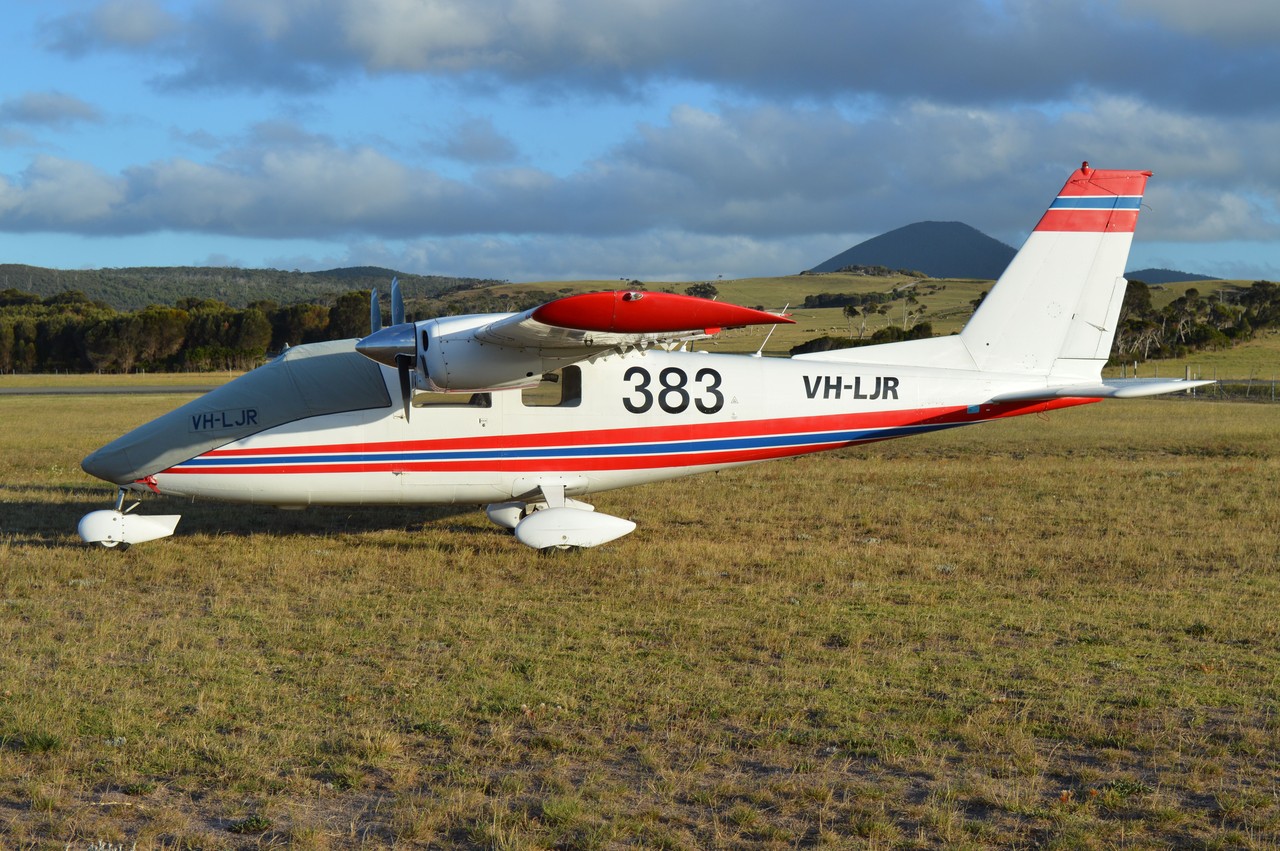
Professor Luigi Pascale conceived the P-68 Victor with a clear mission: create an Italian aircraft capable of competing against established American light twins in utility transport roles. His design philosophy emphasized simplicity of construction, ease of maintenance, and robust performance from challenging airstrips. The high-wing configuration with single-spar torsion-box aluminum construction and fiberglass leading edge provided the structural integrity needed for demanding operations while keeping manufacturing costs reasonable.
The prototype, registered I-TWIN, validated Pascale's design approach during its maiden flight on May 25, 1970. Ten pre-production aircraft followed, allowing Partenavia to refine the design before receiving type certification on November 17, 1971.
Production and Manufacturing
Partenavia, established in the 1950s by brothers Luigi "Gino" Pascale and Giovanni "Nino" Pascale, manufactured the P-68 at their Costozioni Aeronautiche facility in Naples. Production of the improved P-68B variant commenced in 1974, with delivery numbers climbing from nine aircraft that year to 20 in 1975 and 34 in 1976, demonstrating growing market acceptance.
The company's financial struggles eventually led to liquidation, but the P-68's value was recognized when Samanta acquired Partenavia's assets. Samanta later evolved into Vulcanair in 1997, returning the P-68 series to production and ensuring continued parts support for existing aircraft. This transition preserved decades of Italian aerospace engineering expertise.
Engine Options and Performance
The P-68B utilized twin Lycoming IO-360-A1B four-cylinder horizontally-opposed engines, each delivering 149 kilowatts (200 horsepower). Partenavia offered flexibility with both 134-kilowatt (180-horsepower) and 149-kilowatt options to suit different operational requirements and budgets.
Recognizing altitude performance limitations, Partenavia introduced the P-68C-TC variant in 1980, equipped with Lycoming TIO-360-C1A6D turbocharged engines providing 150 kilowatts (200 horsepower) each. This configuration maintained power output at higher altitudes, expanding the aircraft's operational envelope.
The most ambitious powerplant variant was the AP-68TP/300 Sparticus, featuring twin Allison 250-B17C turboprops each flat-rated at 246 kilowatts (330 shaft horsepower). The Sparticus prototype I-PAIT first flew in September 1978, achieving a maximum cruising speed of 386 kilometers per hour (240 miles per hour) at 4,570 meters (15,000 feet). However, only 13 AP-68TP-300s were manufactured before production ceased.
Operational Versatility
The P-68's design flexibility enabled diverse applications beyond basic transport. The aircraft accommodated private and business aviation, flight training, and specialized missions. Its fixed tricycle landing gear and high-wing configuration simplified ground handling and provided excellent ground clearance for rough-field operations.
One notable specialized variant was the P-68 Observer, affectionately nicknamed the "Nosy" Partenavia. This configuration featured a transparent nose section for police surveillance and observation duties. The prototype D-GERD was converted from a standard P-68B by German company Sportavia-Putzer, demonstrating the aircraft's adaptability.
Optional equipment included wing and tail pneumatic de-icing boots, electrothermal propeller de-icing, and alcohol windshield de-icing systems, enabling all-weather operations in challenging climates.
Global Market Penetration
The P-68's international success was evident in markets like Australia, where the first P-68B (VH-FSH, construction number 18) arrived in mid-1974 for distributor Forrestair of Essendon, Victoria. Over 60 examples were eventually registered throughout the Australasian region, proving the aircraft's suitability for diverse geographic and operational conditions.
Legacy and Continued Production
With at least 114 P-68Cs manufactured, the Victor achieved respectable production numbers for a specialized aircraft from a relatively small manufacturer. The P-68R variant with retractable landing gear and the stretched AP-68TP-600 Viator (accommodating nine passengers plus two crew) represented Partenavia's attempts to expand the design's market appeal, though financial constraints limited their production.
Vulcanair's stewardship has ensured the P-68's continued relevance, with refined variants entering service as recently as 2004. The arrival of VH-VMV in Australia that year as a demonstrator proved that Pascale's 1970s design concepts remained viable in modern aviation markets, testament to the aircraft's fundamental engineering soundness and enduring utility in specialized transport roles.