
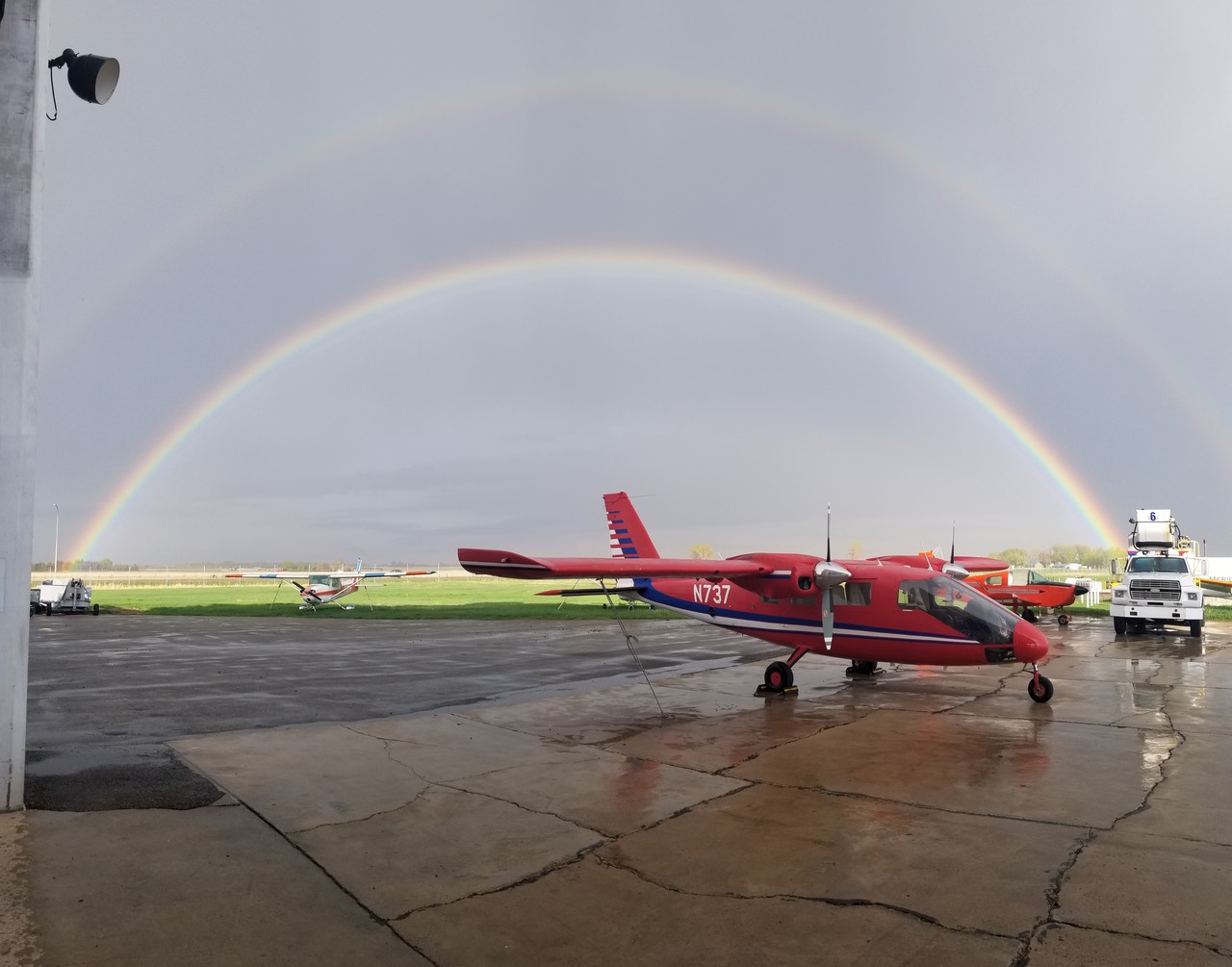
Development and Design Philosophy
The AP-68TP-300 Spartacus emerged from Professor Luigi Pascale's ambitious vision to transform his successful P.68 piston twin into a turboprop-powered business aircraft. Pascale, who had founded Partenavia and first flew the original P.68 prototype on May 25, 1970, recognized that turboprop engines could dramatically improve the aircraft's performance and appeal to business operators seeking greater speed and reliability.
The turboprop conversion program began in earnest during the late 1970s, with Aeritalia providing development assistance after acquiring Partenavia in 1981. The original AP-68TP prototype took to the skies on September 11, 1978, powered by twin Allison 250 turboprops. This initial success led to the refined AP-68TP-100 prototype, which first flew on November 20, 1981, before the final production configuration emerged as the AP-68TP-300.
The Manufacturer's Journey
Partenavia's story began in 1957 under the leadership of Professor Luigi Pascale, becoming a formal limited company in 1959. Operating from Italy, the company built a reputation for practical, well-engineered aircraft designs. During the 1980s, Partenavia employed approximately 150 workers and focused production on two primary models: the P.68 twin-engine transport family and the P.66C Charlie trainer.
The 1981 acquisition by Aeritalia, Italy's state-owned aerospace firm, provided the resources necessary to pursue the complex turboprop conversion program. However, this partnership could not prevent Partenavia's eventual closure in 1998, though the P.68 type certification found new life under Vulcanair ownership, ensuring continued support for operators.
Technical Innovation
The AP-68TP-300's powerplant selection proved crucial to its performance characteristics. Each Allison 250-B17C turboprop engine delivered 328 horsepower, representing a significant increase over the original piston engines while offering the reliability and altitude performance that turboprops provided. The Allison 250 series had already established itself as one of aviation's most successful small turboprop engines, powering everything from helicopters to light aircraft across military and civilian applications.
The aircraft maintained the P.68's proven high-wing configuration and fixed tricycle landing gear, keeping complexity and costs manageable while maximizing cabin space. The 177-gallon fuel capacity supported extended range operations, while the 4,594-pound maximum takeoff weight reflected the increased power and capability over piston variants.
Market Performance and Operations
Partenavia targeted the North American business aviation market as the primary destination for Spartacus sales, where the aircraft reportedly generated roughly half of the company's annual revenue during the 1980s. The nine-seat configuration, including pilot positions, positioned the Spartacus to compete against established turboprop twins in the growing corporate aviation sector.
Notable aircraft included I-SPRV, the initial Italian-registered example from 1984, and several that found homes in the United States under registrations such as N313LC and N75CY. One aircraft even reached South America, with an example exported to Bolivia by February 2011, demonstrating the type's international appeal despite limited production numbers.
Operational Challenges
The Spartacus faced significant challenges during its development and operational phases, with several serious accidents affecting both prototypes and production aircraft. The loss of prototype I-RAIP on July 30, 1982, at Via Ogliaro, Naples, resulted in four fatalities and highlighted the risks inherent in flight testing complex new aircraft systems.
These incidents, combined with the limited production run of approximately 13 aircraft, prevented the Spartacus from achieving the market penetration that Partenavia had hoped for. The January 9, 1996, accident involving N3116C in El Segundo, California, demonstrated that operational risks continued throughout the type's service life.
Evolution and Legacy
Partenavia's experience with the AP-68TP-300 directly influenced development of the more advanced AP-68TP-600 Viator, which featured a stretched fuselage and retractable landing gear. This evolution represented the company's attempt to address market demands for higher performance and greater passenger capacity, though production remained limited with only six examples completed.
The Spartacus proved that converting proven piston aircraft to turboprop power could yield significant performance improvements, but also demonstrated the challenges facing smaller manufacturers in competing against established players in the business aviation market. While Partenavia's ambitious turboprop program ultimately fell short of commercial success, it contributed valuable experience to the broader industry understanding of light twin-turboprop design and operation.
Today, the surviving AP-68TP-300 aircraft represent rare examples of 1980s Italian aerospace engineering, embodying both the innovative spirit of Professor Pascale's design philosophy and the practical challenges facing European manufacturers in the competitive business aviation marketplace.