
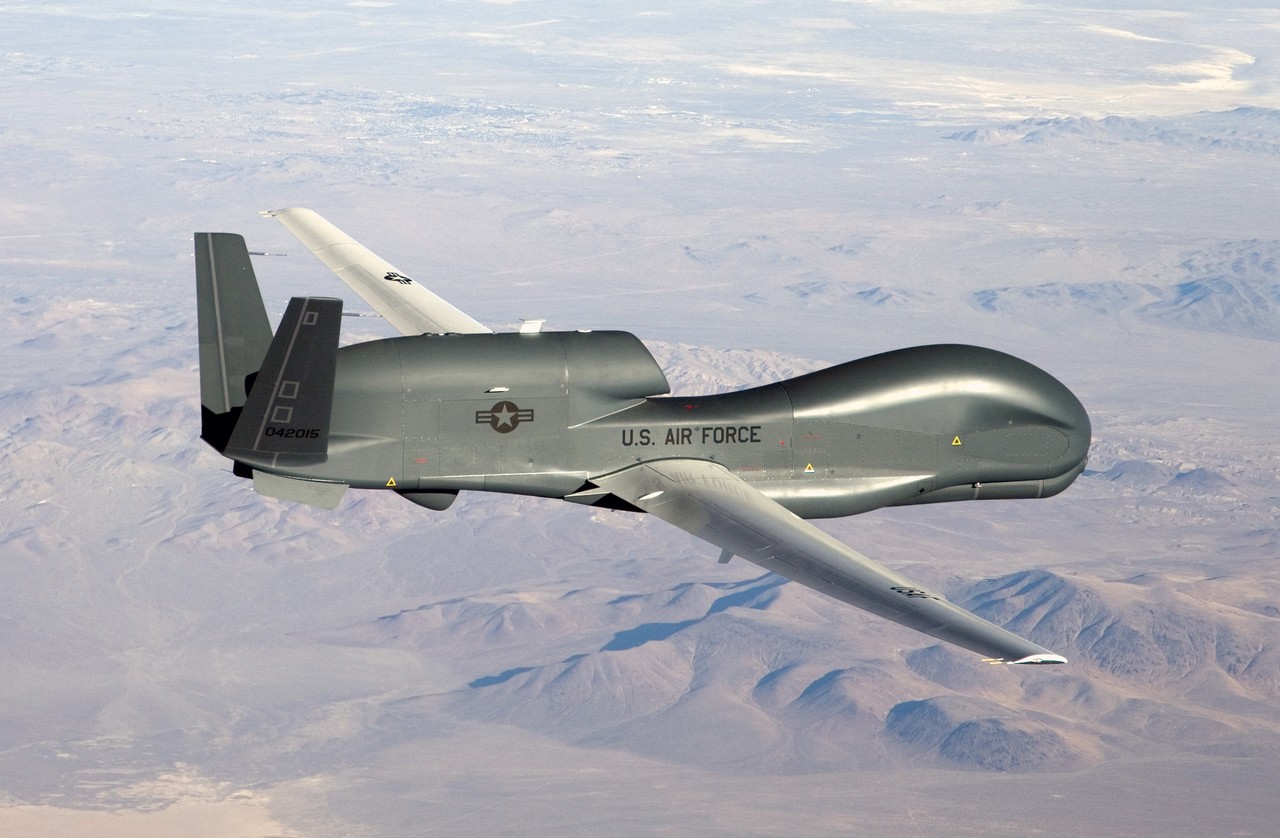
Revolutionary Intelligence Platform
The Global Hawk emerged from DARPA's Tier II+ program in 1994, designed to complement and eventually replace the venerable U-2 spy plane. Unlike its manned predecessor, the RQ-4 could loiter over target areas for more than a day without crew fatigue or life support constraints. By September 2013, the Global Hawk fleet had accumulated over 100,000 flight hours, with 75 percent of those hours flown in combat zones.
Immediate Combat Deployment
Following the September 11 attacks, prototype Global Hawks were rushed into service over Afghanistan in November 2001, bypassing normal acquisition procedures. This unprecedented deployment of developmental aircraft demonstrated the urgent need for persistent surveillance capabilities. The aircraft provided real-time imagery and signals intelligence to ground commanders, proving invaluable for tracking high-value targets across Afghanistan's rugged terrain.
During the Iraq War beginning in 2003, Global Hawks conducted round-the-clock surveillance missions, with some aircraft achieving flight durations exceeding 33 hours. The longest recorded mission lasted 33.1 hours on March 22, 2008. By 2015, the EQ-4 communications relay variant had completed 1,000 combat sorties with an impressive 5-hour turnaround time between missions.
International Operations
Beyond American operations, the Global Hawk achieved international significance when it became the first unmanned aircraft to cross the Pacific Ocean autonomously. On April 24, 2001, a prototype flew from Edwards Air Force Base, California, to RAAF Base Edinburgh, Australia, demonstrating unprecedented long-range capability for unmanned systems.
South Korea became the first international customer, receiving four RQ-4B Block 30 aircraft between December 2019 and September 2020. Japan followed with three aircraft delivered by September 2022, while Germany's Euro Hawk program was ultimately cancelled despite initial procurement efforts.
Northrop Grumman Heritage
Northrop Grumman traces its unmanned aircraft expertise to the 1994 merger between Northrop Corporation and Grumman Aerospace. The company's involvement with the Global Hawk actually began through its acquisition of Teledyne Ryan, the original contractor that won the DARPA competition in March 1995. Jack Northrop's original company, founded in 1939, had pioneered flying wing designs, while Grumman brought decades of naval aviation experience.
This merged entity continues operating today as a major defense contractor, with the Global Hawk representing one of its most successful unmanned programs. Manufacturing occurs at Air Force Plant 42 in Palmdale, California, the same facility that produces other classified aircraft.
Advanced Propulsion System
The RQ-4's single Rolls-Royce F137-RR-100 turbofan engine, derived from the commercial AE 3007H, produces 7,600 pounds of thrust. This powerplant enables the aircraft to reach altitudes of 65,000 feet while carrying sensor payloads weighing thousands of pounds. The engine's exceptional reliability contributed to the Global Hawk fleet's 88 percent mission success rate through 2013.
Unlike fighter aircraft engines designed for high performance, the F137 emphasizes fuel efficiency and longevity. A single engine can power missions lasting more than 30 hours, covering distances exceeding 11,000 nautical miles without refueling.
Operational Characteristics
Global Hawks operate from conventional runways despite their massive 130.9-foot wingspan, larger than a Boeing 737. The aircraft's 47.7-foot length houses sophisticated radar, electro-optical sensors, and communication equipment. Ground control stations manage multiple aircraft simultaneously, with pilots and sensor operators working in shifts during extended missions.
The aircraft's high-altitude capability places it above most weather and air traffic, while its endurance allows persistent surveillance of areas covering 40,000 square miles per mission. This combination proved particularly valuable during humanitarian crises, including earthquake response in Haiti and tsunami aftermath monitoring in Japan.
Production and Variants
Northrop Grumman built approximately 50 Global Hawks across multiple variants. Production included seven Block 0 prototypes, 16 RQ-4A Block 10 aircraft, six Block 20 units, and successively improved Block 30 and 40 variants. The RQ-4B introduced the enlarged wingspan and enhanced payload capacity that became standard.
Block 30 aircraft achieved initial operational capability in August 2011, followed by Block 40 systems in August 2016. Each variant incorporated improved sensors and communication systems, with Block 40 featuring the most advanced signals intelligence equipment.
Museum Legacy
The fourth production Global Hawk, serial number 02-2011, is preserved at the Museum of Aviation in Warner Robins, Georgia. This RQ-4A first flew in August 2004 and represents the early operational configuration that proved the concept's viability. One Block 0 prototype also serves as a museum display, commemorating the program's experimental origins.
The Global Hawk's legacy extends beyond military reconnaissance, having demonstrated that unmanned aircraft could perform complex, long-duration missions previously requiring human crews. This pioneering achievement paved the way for numerous subsequent unmanned aircraft programs across multiple nations.