
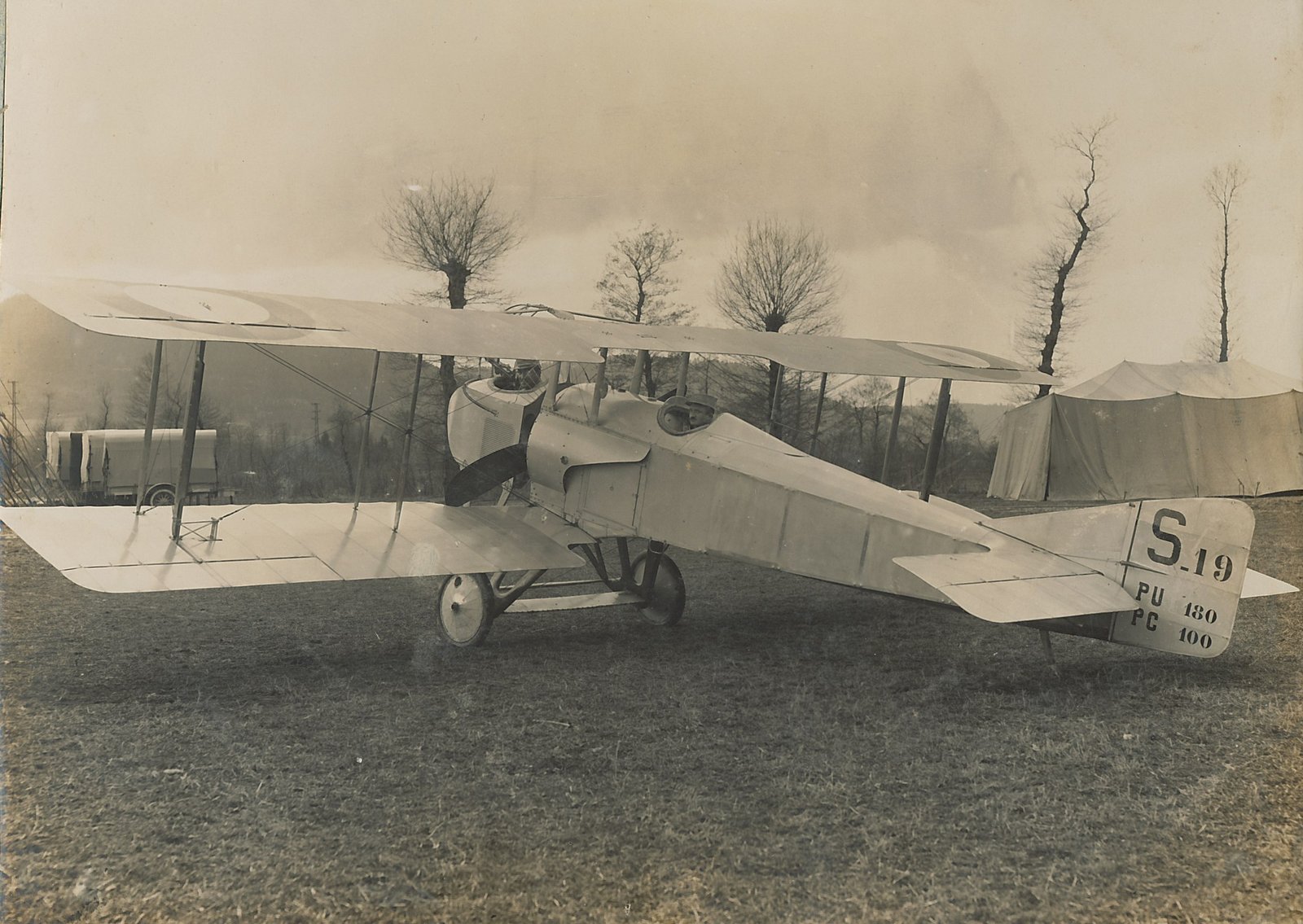
The SPAD S.A.2 (also referred to as the SPAD A.2 or SA.2) was a two-seat tractor biplane designed by Louis Béchereau, the chief designer for Société Pour L'Aviation et ses Dérivés (SPAD). First flown on May 21, 1915, the aircraft was developed during a period of rapid tactical evolution in World War I, specifically addressing the challenge of mounting a forward-firing machine gun without the use of synchronization gear.
To solve this problem, Béchereau implemented a highly unconventional crew arrangement. While the pilot sat in the main fuselage behind the engine and propeller, the observer/gunner was positioned in a separate nacelle, or "pulpit," mounted ahead of the propeller on the fuselage's upper longerons. This configuration allowed the gunner to operate a flexible .303 Lewis machine gun (or a French equivalent) directly forward without the risk of shooting through the propeller disk. However, this layout proved problematic in practice; crews frequently reported communication difficulties between the pilot and observer, and the pulpit was considered extremely dangerous for the gunner in the event of a crash.
Production took place in France between 1915 and 1916, with a total of 99 aircraft built. Of these, 42 were delivered to France's Aviation Militaire and 57 to the Imperial Russian Air Service. The aircraft served in fighter and fighter-reconnaissance roles, performing armed reconnaissance and escort missions. In French service, the S.A.2 had a short and unpopular career, as it was quickly rendered obsolete by the introduction of operational synchronization gear. Conversely, the Imperial Russian Air Service utilized the type for a longer duration due to a severe shortage of modern aircraft on the Russian-German front. One documented combat success occurred on November 25, 1916, when a Russian crew consisting of pilot Karpov and observer Bratolyubov shot down a German aircraft near the village of Vulka.
Société Pour L'Aviation et ses Dérivés, which had evolved from the Deperdussin concern and was active from 1911 to 1921, eventually saw the SPAD brand retired in 1921 following its acquisition by Blériot Aéronautique. The S.A.2 is now remembered as a technological dead end that illustrated the experimental nature of early fighter design, marking the transition toward the more successful single-seat fighters like the SPAD S.VII and S.XIII.