
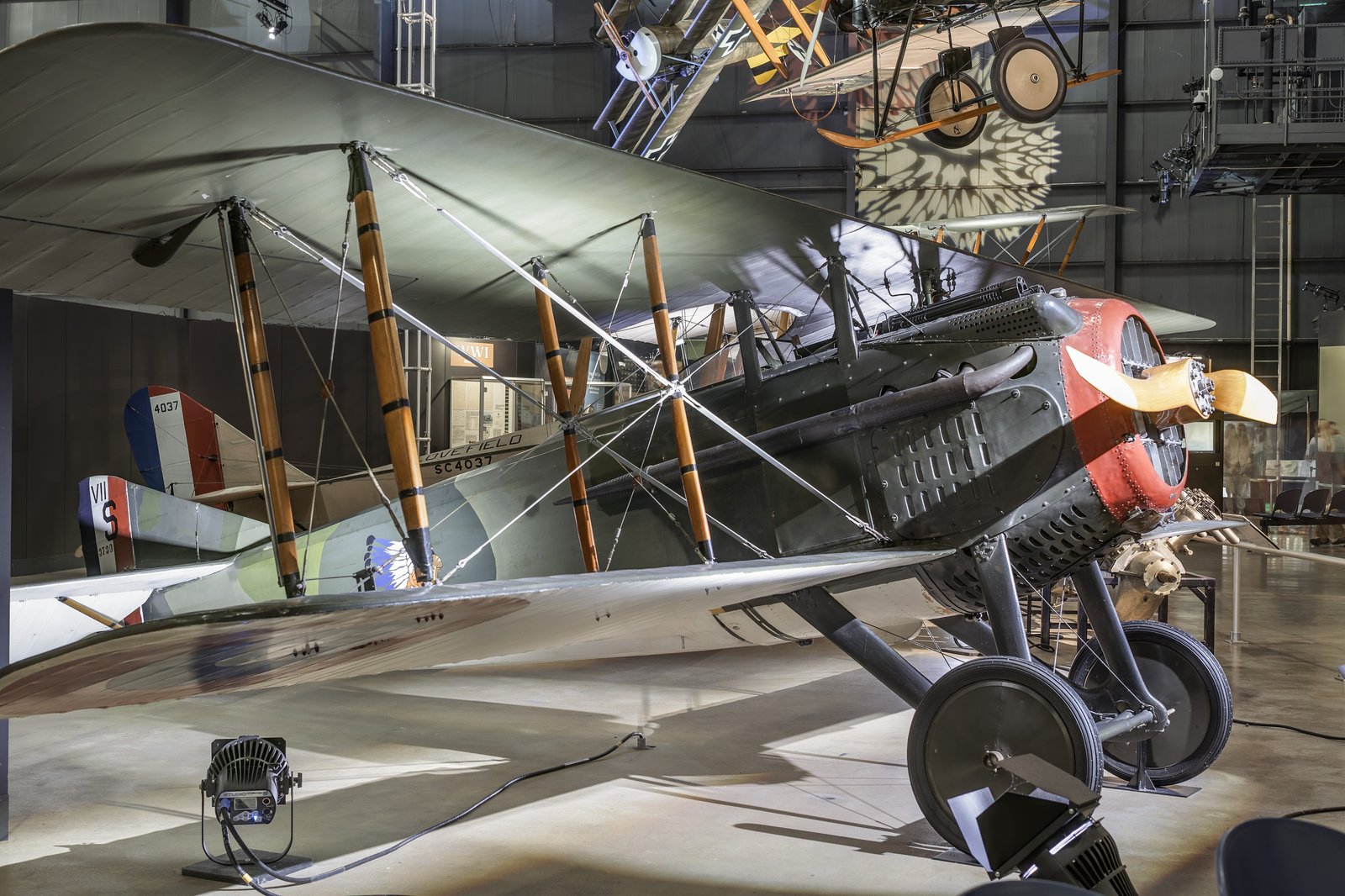
Design and Development
The SPAD S.VII was designed by Louis Béchereau, the chief designer at Société Pour L'Aviation et ses Dérivés (SPAD). The aircraft was developed specifically to utilize the new Hispano-Suiza V-8 water-cooled engine. Internally designated as the Type H or SH.1, the prototype first took flight in April 1916, piloted by Becquet. The design was characterized by a strong wooden structure and a wire-braced biplane configuration, which provided exceptional structural integrity. This robustness allowed pilots to perform high-speed dives without speed restrictions, a tactical advantage that distinguished the S.VII from many of its contemporaries.
Production and Manufacturer History
Société Pour L'Aviation et ses Dérivés was the successor to the Société de production des aéroplanes Deperdussin, which had been founded by Armand Deperdussin in January 1911. Following a financial scandal and bankruptcy in 1913, the firm was acquired in 1914 by a group of industrialists led by Louis Blériot and renamed SPAD.
Production of the S.VII was extensive, with approximately 5,500 to 6,000 units built. While 5,500 were produced in France by SPAD and various subcontractors—including Kellner, Regy, Gremont, S.E.A., De Marçay, and Blériot Aéronautique—production also occurred abroad. In the United Kingdom, Mann Egerton built 120 aircraft and L. Blériot (Aeronautics) produced 100 for the Royal Flying Corps. Additionally, the Dux company in Russia manufactured slightly more than 100 examples. The SPAD brand remained active until it was retired in 1921.
Technical Specifications and Powerplant
The S.VII was initially powered by the 150 hp Hispano-Suiza 8Aa V-8 engine, developed by Marc Birkigt. By the spring of 1917, many aircraft were uprated to the 180 hp Hispano-Suiza 8Ab. A standard SPAD S.VII C1 featured a wingspan of 7.82 meters, a length of 6.08 meters, and a wing area of 18 square meters. With a loaded weight of 705 kg, the 180 hp variant could reach a maximum speed of 212 km/h and a practical ceiling of 6,200 meters, with a range of 300 km. For armament, the aircraft carried a single 7.7 mm synchronized Vickers machine gun utilizing Birkigt synchronization gear.
Military Service and Legacy
Entering front-line service in late 1916, the S.VII became a staple of the French Aviation Militaire, equipping most French fighter escadrilles. It was widely adopted by other Allied nations, including the United Kingdom, Italy, Belgium, Russia, Greece, Serbia, and the United States. Notable aces associated with the type include France's Georges Guynemer—who flew the famous "Vieux Charles" (S.254)—as well as René Fonck, Charles Nungesser, Italy's Francesco Baracca, and the American Eddie Rickenbacker.
Following World War I, surplus S.VII aircraft were operated by several nations, including Brazil, Czechoslovakia, Estonia, Finland, Greece, Peru, Poland, Portugal, Romania, Siam, and Yugoslavia. Today, the Musée de l’Air et de l’Espace in France preserves Guynemer's original S.VII. While original survivors are rare, the company FOX-Aviation Historique continues to produce faithful reproductions of the S.VII C1 using original plans and techniques.