
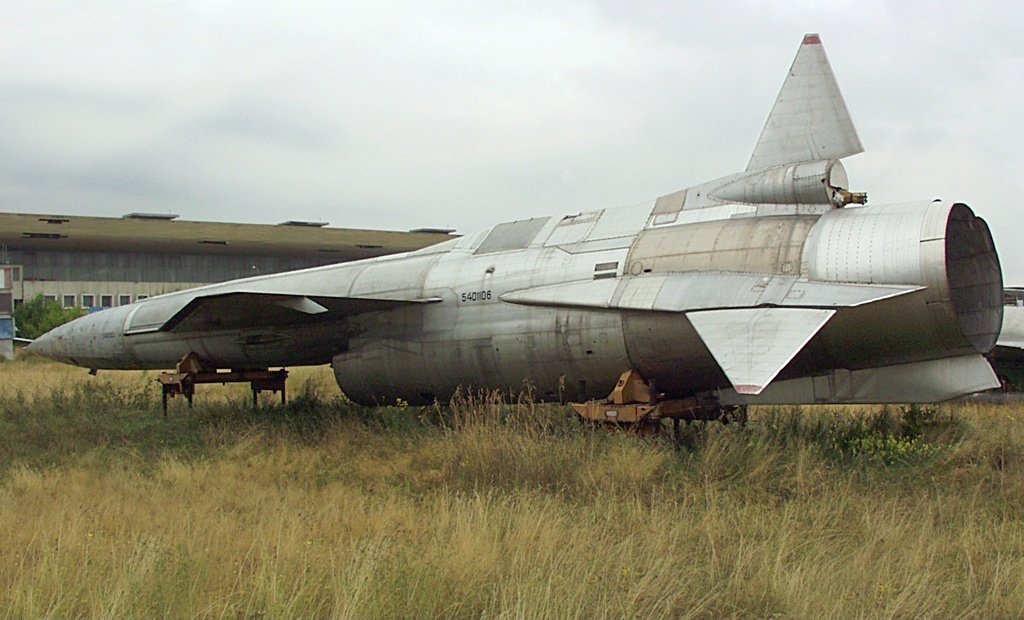
The Tupolev Tu-123, designated "Yastreb" (Hawk), was a specialized high-altitude photo-reconnaissance drone developed by the Soviet Union during the Cold War. Designed by the Tupolev Experimental Design Bureau (OKB-156) under the leadership of Andrei Nikolaevich Tupolev, the aircraft was conceptually derived from the Tu-121 strategic cruise-missile program. It was intended to operate as an expendable system; while the main airframe was not reused, the nose section and high-resolution camera payload were recovered via parachute after completing a reconnaissance mission.
Series production of the Tu-123 was carried out by the Voronezh Aircraft Production Association (VASO), also known as the Voronezh aircraft plant. The manufacturing facility, located at 27 Tsiolkovskogo Street in Voronezh, has a history dating back to 1916 and was formally established as an aircraft factory in 1932. Historically focused on heavy and long-range bombers, VASO produced the Tu-123 in limited numbers. Although exact production totals remain unpublished, specialist literature suggests a few dozen airframes were built. The aircraft entered operational service around 1964–1965 and remained in use into the 1970s, when it was eventually replaced by follow-on systems such as the Tu-141 and Tu-143.
Technically, the Tu-123 was a land-based unmanned aircraft powered by a single large turbojet engine. It was designed for extreme performance to penetrate defended airspace, capable of reaching speeds on the order of Mach 2 and operating at service ceilings between 20,000 and 22,000 meters. Its operational range was approximately 3,000 kilometers. The aircraft was operated by the Soviet Air Forces, specifically within the Long-Range Aviation branch, to conduct strategic intelligence gathering.
Today, the original manufacturer, VASO, continues to operate as a subsidiary of the United Aircraft Corporation (UAC) and the PJSC Ilyushin Aviation Complex, producing aircraft such as the Il-96. While the Tu-123 is no longer in service, a small number of airframes are believed to survive as museum exhibits across the former Soviet Union, marking its legacy as a critical technological bridge between early cruise missiles and modern strategic unmanned aerial vehicles.