
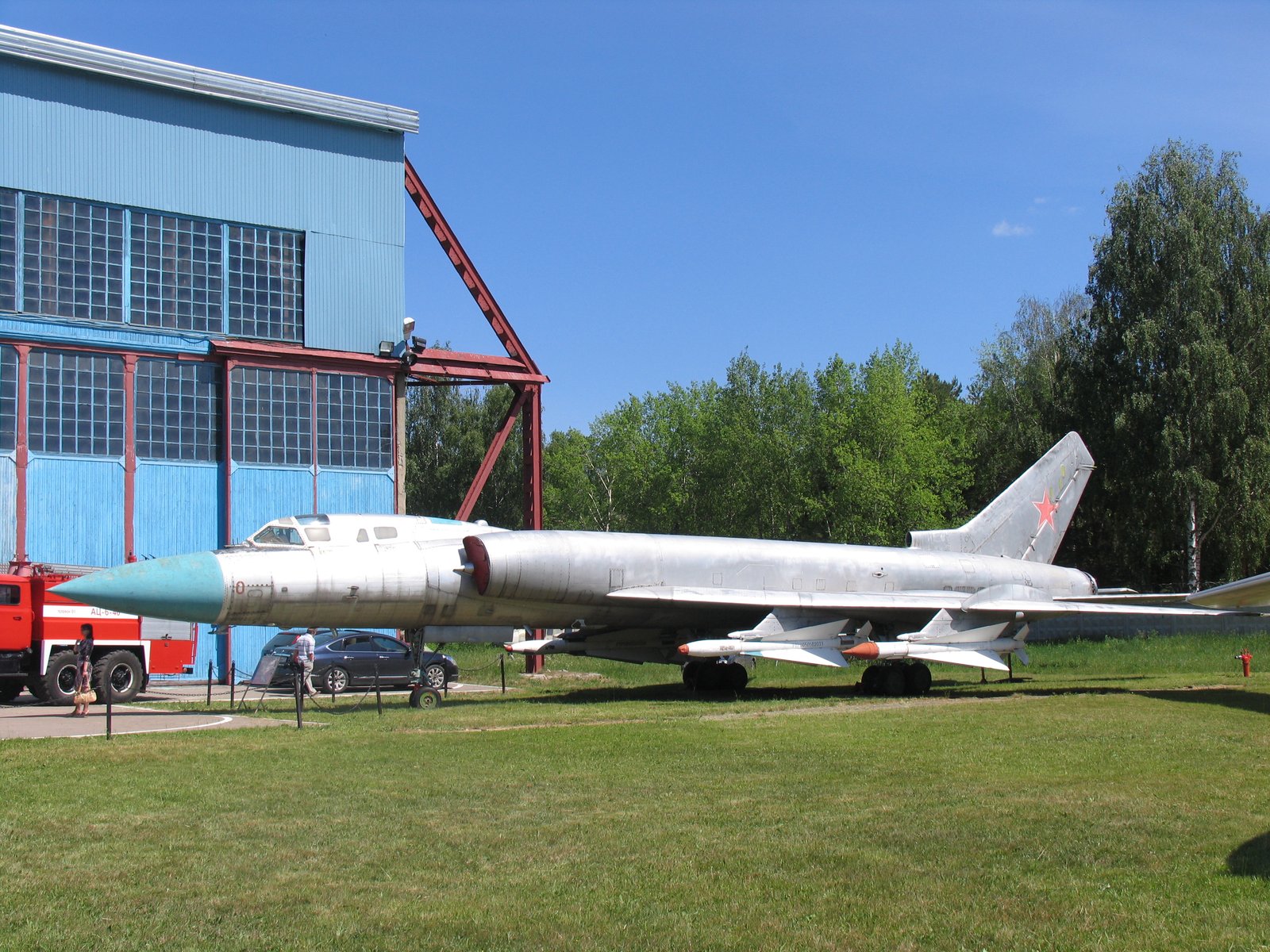
The Tupolev Tu-128, known by the NATO reporting name "Fiddler," was a specialized long-range interceptor developed by the Tupolev Design Bureau (OKB-156) in Moscow. Designed to provide air defense coverage over the Arctic and remote northern regions of the Soviet Union, the aircraft was essentially a bomber-sized airframe adapted for the interceptor role. The prototype, initially designated as the I-128 or Tu-28, made its first flight on March 18, 1961, at Zhukovsky.
Production was carried out exclusively by the Voronezh Aircraft Production Association (VASO), located at 27 Tsiolkovsky Street in Voronezh, Russia. The plant, which had roots dating back to 1916 and was formally established as an aircraft factory in 1932, specialized in heavy and long-range aircraft. Full-scale series production of the Tu-128 ran from 1965 to 1970, resulting in approximately 198 aircraft, a figure that includes prototypes and the modernized Tu-128M variant.
Technically, the Tu-128 was notable for its immense scale, weighing over 40 tonnes at takeoff. It was powered by two Lyulka AL-7F-2 afterburning turbojets, developed by the OKB of Arkhip Lyulka (now NPO Saturn). These engines provided a dry thrust of approximately 6,800–7,100 kgf and afterburning thrust of 10,000–10,200 kgf each. The aircraft featured a swept-wing, podded-engine layout and was crewed by a pilot and a weapons-systems operator. Its primary armament consisted of four R-4 (K-80) long-range air-to-air missiles, utilizing a mix of radar and infrared homing; notably, the aircraft carried no internal cannon.
Operational service began in 1966 with the Soviet Air Defence Forces (PVO). The Tu-128 served as a cornerstone of the northern air-defense network during the Cold War, tasked with intercepting Western strategic bombers such as the B-52. Variants included the Tu-128S-4, the upgraded Tu-128M with the RP-S-M "Smerch-M" radar, and the Tu-128UT dual-control trainer. The type remained in frontline service into the late 1970s before being replaced by the MiG-31. Today, only a small number of static museum exhibits remain, including a well-known example at the Central Air Force Museum at Monino.