
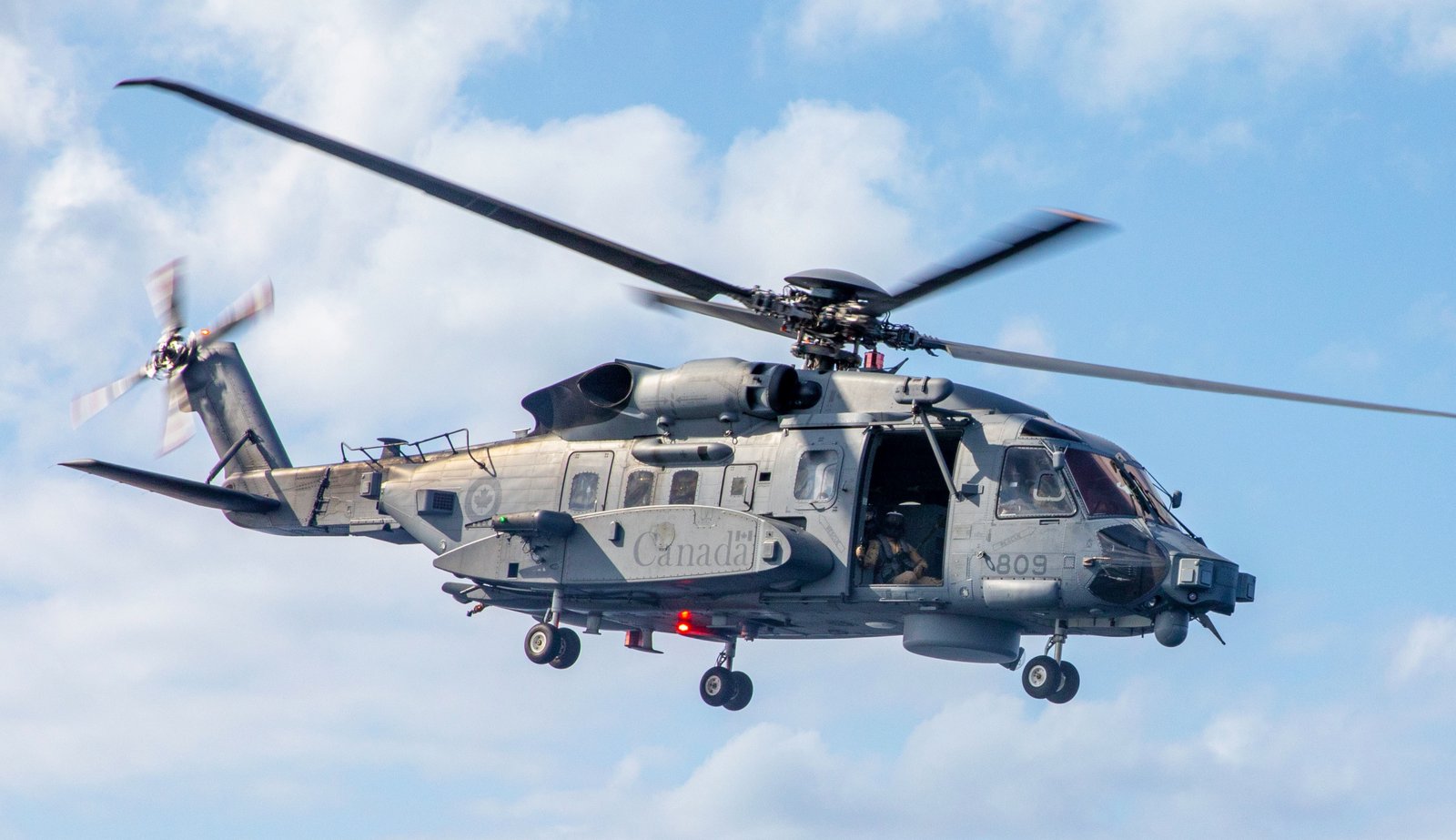
The Sikorsky CH-148 Cyclone is a twin-engine, shipborne maritime helicopter developed by the Sikorsky Aircraft Corporation specifically for the Canadian Armed Forces. Designed to replace the long-serving CH-124 Sea King, which operated from 1963 to 2018, the Cyclone serves as a multi-role platform capable of anti-submarine warfare (ASW), anti-surface warfare (ASuW), intelligence, surveillance and reconnaissance (ISR), and search and rescue (SAR) operations.
Based on the civil Sikorsky S-92 airframe, the CH-148 incorporates significant military enhancements. Most notable is its full-authority fly-by-wire flight control system, which provides enhanced handling and allows the aircraft to operate aboard Halifax-class frigates in Sea State 6 conditions. The aircraft is powered by two General Electric CT7-8A7 turboshaft engines. In terms of armament, the Cyclone is equipped to carry two Mk 46 anti-submarine torpedoes on BRU-14 folding weapons pylons, as well as general-purpose machine guns mounted in the door and ramp.
Canada ordered 28 helicopters in November 2004 for C$1.8 billion. The first production aircraft, serial number 801 (registration N4901C), flew on November 15, 2008, in Florida, USA. Deliveries to Canada commenced in June 2015, and the fleet is expected to be fully delivered by fall 2025. The Royal Canadian Air Force (RCAF) officially entered the aircraft into operational service in 2018, with the 406 Maritime Operational Training Squadron adopting the type in summer 2016, followed by the 423 and 443 Maritime Helicopter Squadrons in 2018.
Despite its technical capabilities, the program is noted for a difficult procurement history characterized by significant cost growth and schedule delays. Operationally, the fleet suffered a tragedy in April 2020 when an aircraft, callsign STALKER-22, crashed into the sea near Greece while operating from HMCS Fredericton, resulting in the deaths of six personnel. Of the 28 aircraft procured, 27 remain in service. The aircraft's operational crew typically consists of four members: two pilots, a tactical coordinator (TACCO), and a sensor operator (SENSO).