
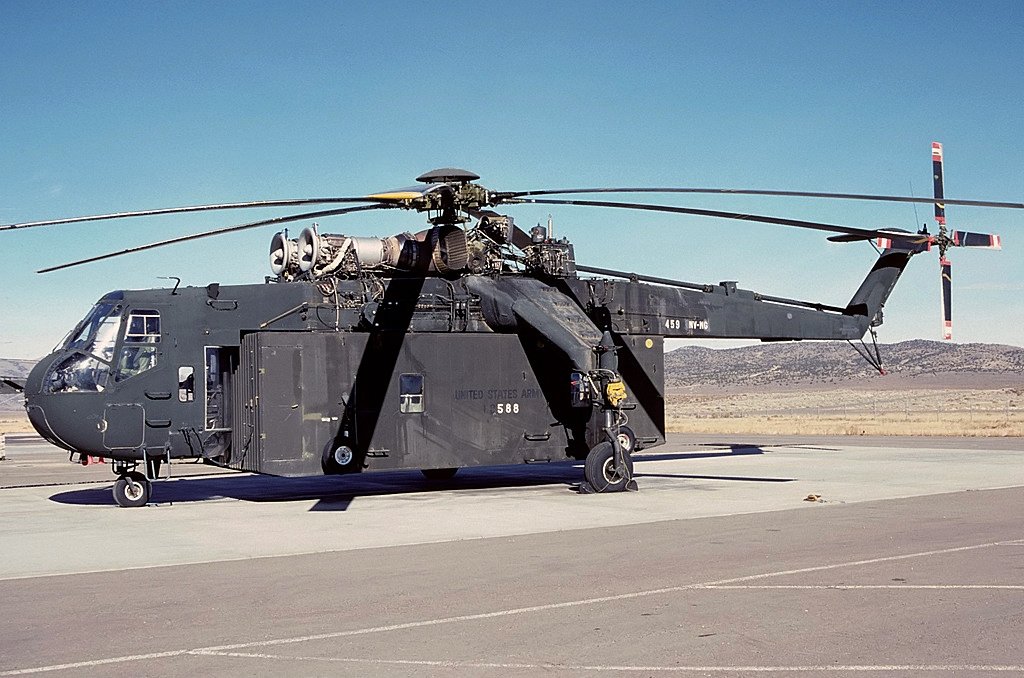
The Sikorsky CH-54 Tarhe was developed by Sikorsky Aircraft as a dedicated heavy-lift solution, characterized by a distinctive design featuring a large open central fuselage. This 'Skycrane' layout allowed the aircraft to carry outsized cargo externally beneath the fuselage, making it capable of transporting heavy equipment such as bulldozers, patrol boats, and M101 howitzers. The prototype first took flight on May 9, 1962, in Stratford, Connecticut.
Technical specifications for the CH-54A variant include two Pratt & Whitney T73-P-1 / JFTD12A-4A turboshaft engines. These powerplants provided a maximum continuous output of 4,000 shaft horsepower each, increasing to 4,500 shaft horsepower during takeoff or limited conditions. The aircraft's physical dimensions include a length of 70 feet 3 inches, a height of 18 feet 7 inches, and a rotor diameter of 72 feet. Performance figures vary by source, but reports indicate a maximum speed of between 115 knots (132 mph) and 126 mph, with a range extending from 230 miles to 217 nautical miles. Its service ceiling is cited between 9,000 and 13,000 feet, and it featured a single-point cargo hoist capable of handling a 20,000 lb payload.
Production began following the 1962 prototype flight, with the first production units arriving in Vietnam by 1965. A total of 105 military aircraft were built for the United States Army. During the Vietnam War, the CH-54 was utilized for critical logistical support, artillery relocation, and the recovery of large external loads. Notable operators included the 2nd Battalion, 291st Aviation Company, as well as the 273rd, 355th, and 478th Heavy Helicopter Companies. In military service, the crew typically consisted of five members: a pilot, co-pilot, third pilot, and two mechanics.
Beyond combat, the aircraft served with NASA and the Army National Guard, with the latter conducting its final flight on January 10, 1993. A civilian version, marketed as the S-64 Skycrane, found success in the United States, South Korea, and Italy. These commercial variants were employed in the timber industry, power-line construction, and aerial firefighting. Today, the CH-54's legacy persists in heavy-lift and firefighting operations, with surviving airframes preserved in institutions such as the Pima Air & Space Museum.