
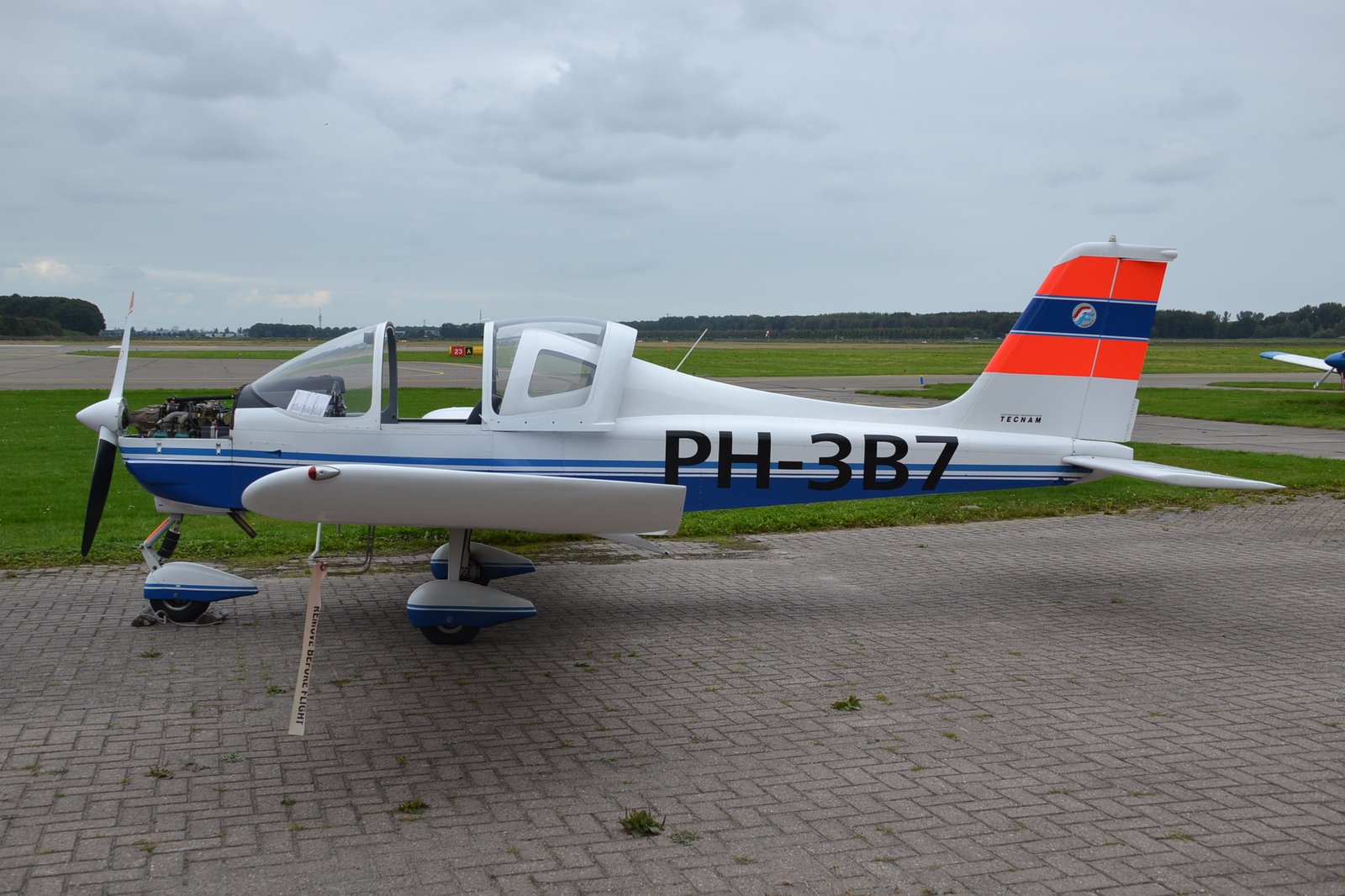
Development and Design Philosophy
The P.96 Golf emerged from Luigi Pascale's ambitious goal to create a low-wing ultralight that would significantly reduce drag compared to Tecnam's successful high-wing P92 Echo while keeping manufacturing costs reasonable. Prototype construction began in July 1996, leading to the first flight in March 1997. The design emphasized practical innovations including flush wing-fuselage integration with strakes to minimize interference drag, and maintained parts commonality with the P92 Echo to reduce production complexity.
The aircraft's low fuselage cross-section specifically accommodated tall occupants, addressing a common complaint about cramped ultralight cockpits. A composite fuselage spine extending to the tailfin provided structural efficiency while the fixed tricycle undercarriage featured hydraulic disc brakes operated by a single cockpit hand lever.
The Pascale Brothers' Legacy
Tecnam's history traces back to 1948 when brothers Giovanni and Paolo Pascale founded the company in a small workshop near Naples. The early years focused on aircraft like the P57 Fachiro for aero clubs and air races, where Tecnam consistently placed second until finally achieving victory in 1967. The company expanded in the 1970s with twin-engine aircraft like the P68 Victor, which first flew in 1970, necessitating construction of larger facilities at Naples.
After facing bankruptcy challenges linked to predecessor Partenavia, Tecnam restarted under second-generation leadership, with Luigi Pascale spearheading the ultralight revival that would include both the P92 series and the P.96 Golf. By 2023, Tecnam celebrated its 75th anniversary, having built over 2,600 P92 variants alone.
Powerplant and Performance
The P.96 Golf utilized the proven Rotax 912UL or 912A, a four-cylinder horizontally-opposed air-cooled engine producing 60 kilowatts in standard form. The Golf 100 variant introduced in 1999 featured an uprated version delivering 75 kilowatts (100 horsepower). Austrian manufacturer BRP-Rotax had introduced the 912 series in the 1990s, and it became renowned for low vibration and fuel efficiency in ultralight applications.
With a 70-liter fuel capacity, the Golf achieved an impressive 800-kilometer range. New Zealand operators reported cruise speeds of 115 knots, while the aircraft demonstrated a service ceiling of 13,120 feet and climb rate of 1,000 feet per minute. The stall speed with flaps deployed dropped to approximately 36 knots, contributing to the remarkably short takeoff and landing distance of just 90 meters.
International Success
Canada emerged as a particularly strong market for the P.96 Golf, with the 200th aircraft (registered C-ITEC) delivered in February 2002. By December of that year, 277 units had been registered across various countries, demonstrating solid international appeal for recreational flying and flight training.
Australian operations included aircraft like S100 24-4868, photographed at Hoxton Park in New South Wales during July 2008. New Zealand saw continued operation of examples such as ZK-SHL, typically equipped with the 100-horsepower Rotax variant. The aircraft served primarily private pilots, flight schools, and aero clubs seeking an affordable yet capable two-seat trainer.
Technical Innovation
The Golf's empty weight ranged from 273 to 281 kilograms depending on equipment, while maximum takeoff weight varied between 450 and 550 kilograms based on ultralight versus certified configurations. The 21-foot fuselage combined with the 27-foot 7-inch wingspan created an efficient platform that addressed the aerodynamic shortcomings Pascale identified in high-wing designs.
Side-by-side seating maximized instructional effectiveness while providing space for baggage, making the aircraft practical for both training and recreational cross-country flights. The hydraulic disc brake system represented a significant upgrade over the simpler brake arrangements common in ultralight aircraft of the era.
Production End and Successor
Tecnam discontinued P.96 Golf production in 2006, replacing it with the P2002 Sierra as the company's primary low-wing offering. The Golf had successfully bridged the gap between Tecnam's high-wing ultralights and more sophisticated general aviation aircraft, proving that aerodynamic efficiency could be achieved without prohibitive cost increases.
While exact total production figures remain unspecified, the documented 277 registrations by 2002 suggest final production likely exceeded 300 units. Some examples continued flying well into the 2000s, with Australian and New Zealand aircraft remaining active as late as 2008. The P.96 Golf's legacy lies in demonstrating that ultralight aircraft could achieve meaningful performance improvements through thoughtful aerodynamic design rather than simply adding power or complexity.