
Service History
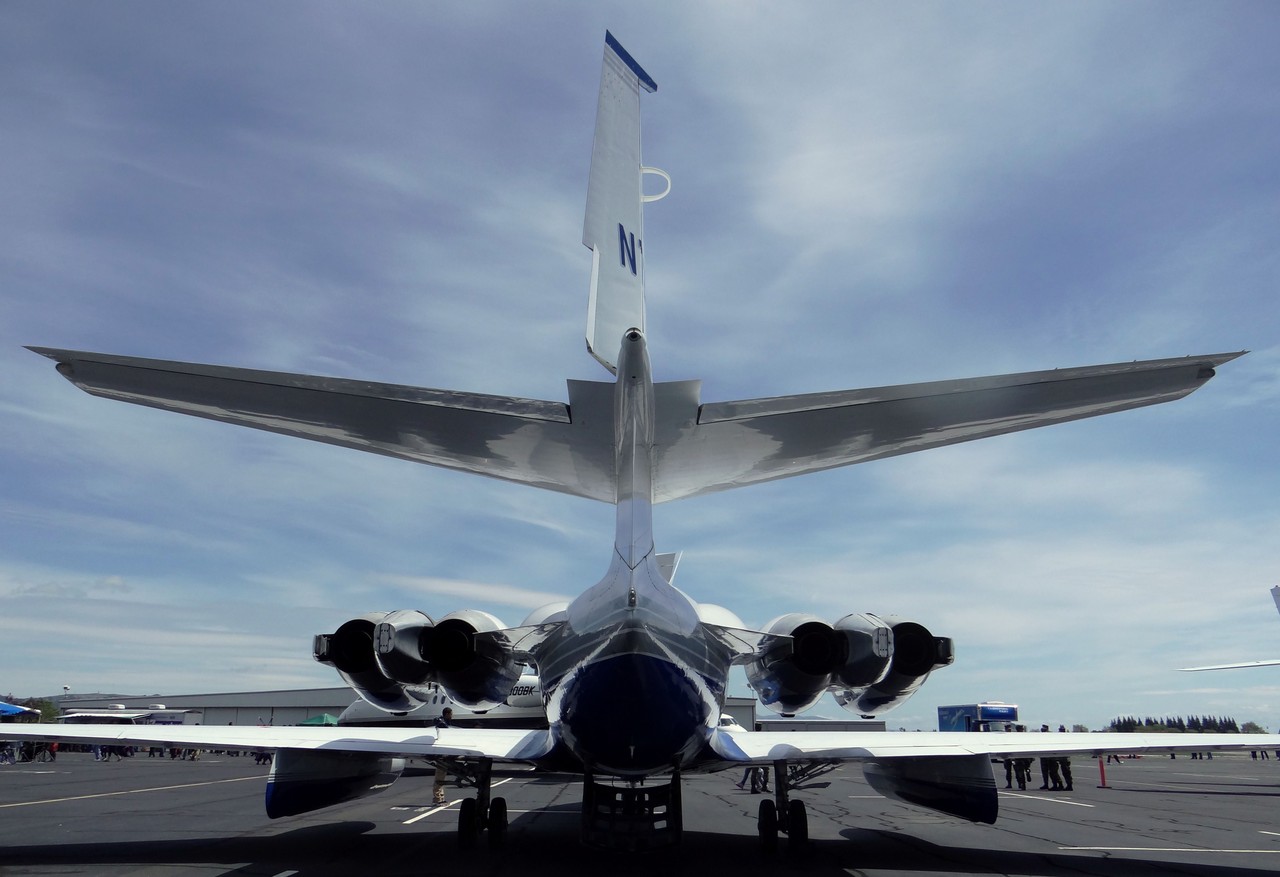
The JetStar II carved out a dominant position in the executive aviation market during its brief production run from 1976 to 1979. With only 40 aircraft built, it represented the pinnacle of Lockheed's business jet evolution, offering corporate operators unprecedented fuel efficiency and performance compared to its turbojet predecessors. The aircraft's rear-mounted quadjet configuration became a signature design that influenced executive transport development throughout the late 1970s.
The Manufacturer
Lockheed Corporation, established in 1926, manufactured the JetStar II at their Marietta, Georgia plant following initial prototype development at the legendary Skunk Works facility in Burbank, California. The company's aerospace legacy spanned nearly seven decades until its 1995 merger with Martin Marietta created Lockheed Martin, which continues operations today as one of the world's largest defense contractors. Beyond the JetStar family, Lockheed produced iconic aircraft including the P-38 Lightning, C-130 Hercules, and SR-71 Blackbird.
Design Origins
Kelly Johnson's design team at Lockheed's Skunk Works originally conceived the JetStar family to meet a U.S. Air Force requirement for a high-performance light transport. The prototype first took flight on September 4, 1957, but civilian business jet potential ultimately drove production decisions. The JetStar II incorporated substantial improvements over the original JetStar I, most notably the adoption of Garrett TFE731-3 turbofan engines and revised external fuel tanks that enhanced both range and runway performance.
Engine & Technical Innovation
The aircraft's four Garrett TFE731-3 turbofan engines, each producing 3,700 pounds of thrust, represented a quantum leap in business aviation technology. Manufactured by Garrett AiResearch (later Honeywell), these engines delivered superior fuel efficiency, reduced noise levels, and dramatically improved short-field performance compared to the Pratt & Whitney JT12 turbojets powering the earlier JetStar I. The engines featured 4,200-hour overhaul intervals, significantly reducing operating costs for corporate operators.
Performance Characteristics
The JetStar II's performance specifications established new benchmarks for business aviation. With a maximum cruise speed of 478 knots indicated airspeed and a service ceiling of 43,000 feet, it could climb at 4,400 feet per minute on all engines or maintain 2,600 feet per minute with one engine inoperative. The aircraft required 6,200 feet for takeoff and 4,487 feet for landing, while carrying a maximum payload of 2,000 pounds with 2,681 gallons of fuel capacity.
Military Applications
While the JetStar II itself saw no military service, the broader JetStar family supported various air forces in non-combat roles. The U.S. Air Force operated five C-140A variants based on the early JetStar I configuration for navigation aid calibration missions beginning in 1961. The Islamic Republic of Iran Air Force and Mexican Air Force also operated JetStar variants, with some aircraft remaining in service as of 2023.
Cultural Impact
The JetStar II gained cultural significance beyond its technical achievements, with notable ownership including Elvis Presley's JetStar, which sold at auction in 2023 for $260,000. This celebrity connection highlighted the aircraft's role in establishing business aviation as a symbol of success and luxury during the late 1970s.
Production Legacy
Despite its technological advantages, the JetStar II's production run proved remarkably brief, ending in 1979 or 1980 after just 40 aircraft. The limited production reflected market timing challenges and increasing competition in the business jet sector. The entire JetStar family totaled 202 aircraft built between 1961 and 1980, establishing Lockheed's credentials in the emerging corporate aviation market.
Preservation and Museums
Several JetStar examples survive today in museums and private collections. The prototype N329J (construction number 1001) underwent restoration at the Museum of Flight in Everett, Washington, while N711Z (construction number 1002) remains on display at Andrews Air Force Base in Maryland. The last recorded JetStar flight in the United States occurred on December 30, 2019, marking the end of an era for this pioneering business jet design.
The JetStar II's brief but influential career established crucial precedents for turbofan-powered business aviation, proving that corporate operators would embrace advanced engine technology for improved efficiency and reduced environmental impact.