
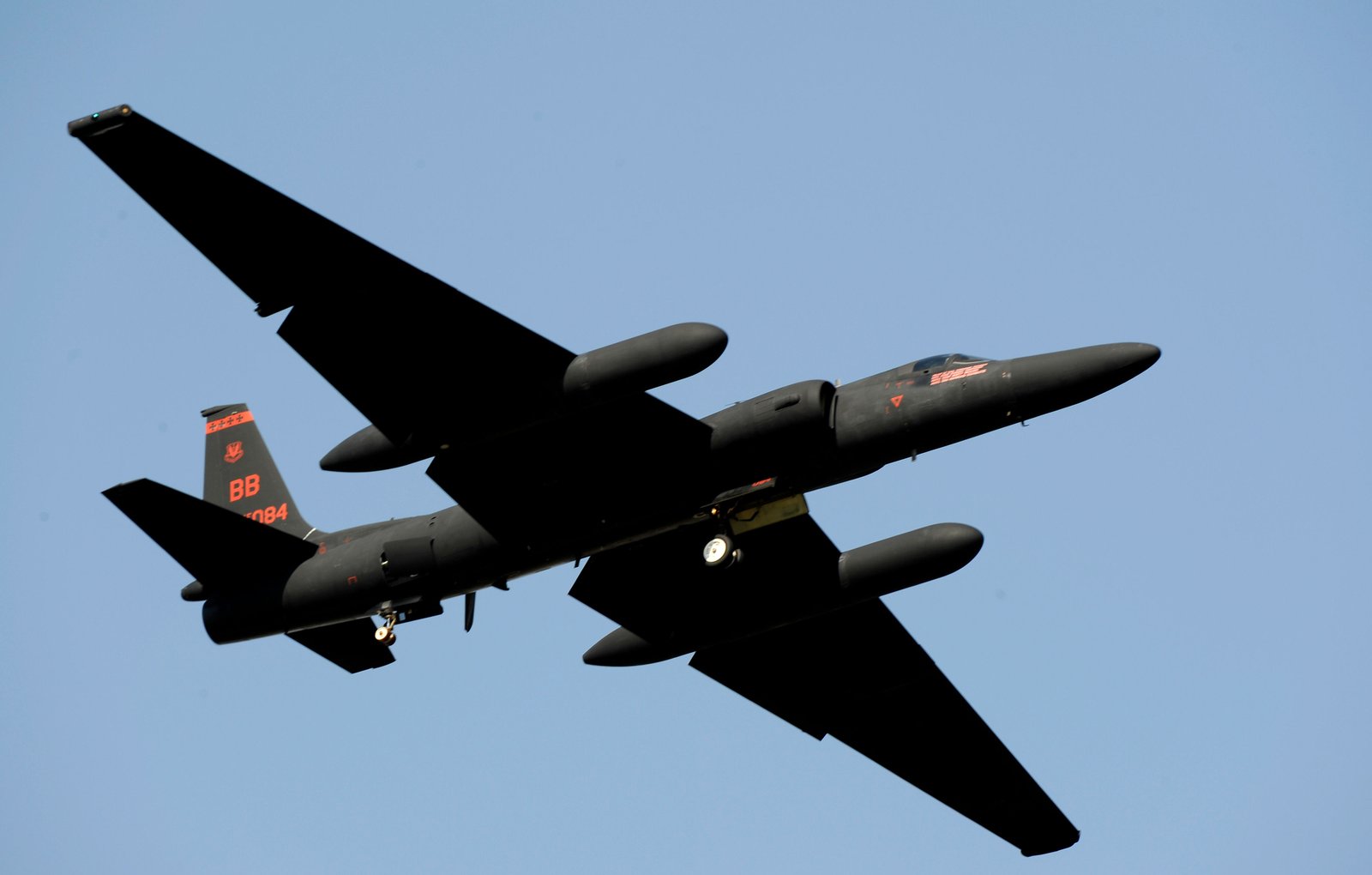
The Lockheed ER-2 is a high-altitude, Earth-resources research aircraft developed for NASA to serve as a manned, reconfigurable research platform. A variant of the Lockheed U-2R/TR-1 family, the ER-2 is designed to bridge the gap between satellite observations and balloon-borne research, providing a controlled environment for atmospheric sampling and remote sensing. Only two ER-2 aircraft were ever built; NASA acquired the first in 1981 and the second in 1989.
While the fundamental design of the U-2 lineage was led by Clarence “Kelly Johnson” at Lockheed’s Skunk Works, the specific ER-2 configuration was developed by Lockheed (later Lockheed Martin Corporation) to meet NASA's scientific requirements. The ER-2 is distinguished from the military U-2S by the absence of classified electronics and defensive systems. To support its role as a flying laboratory, it features entirely different electrical wiring and a unique paint scheme. Compared to earlier NASA U-2 aircraft, the ER-2 is 30% larger and possesses a wingspan that is 20 feet greater, allowing it to support a significantly larger payload.
Technically, the ER-2 is powered by a single Pratt & Whitney J75-P-13B turbojet engine. It is capable of operating at altitudes between 6,000 and 21,200 meters (20,000 to 70,000 feet). The aircraft is designed for rapid ascent, reaching a typical cruise altitude of approximately 20,000 meters (65,000 feet) within 20 minutes of takeoff. It has a cruise speed of roughly 750 km/h (470 mph) and can sustain missions lasting up to 8 hours, covering distances of up to 5,500 km (3,440 miles).
As a civilian research platform, the ER-2 has no military or combat history. It is operated by NASA's Airborne Science Program under the Science Mission Directorate, with aircraft based at the NASA Armstrong Flight Research Center in Palmdale, California. The aircraft can carry up to 1,180 kg (2,600 lb) of scientific instrumentation distributed across the nose, wing pods, and internal bays. These modular packages are used for atmospheric chemistry, cloud physics, oceanic and land remote sensing, and the calibration of satellite data. Together with its predecessors, the NASA U-2/ER-2 fleet has completed over 4,000 data missions and test flights, providing critical long-term datasets for environmental and climate science.