
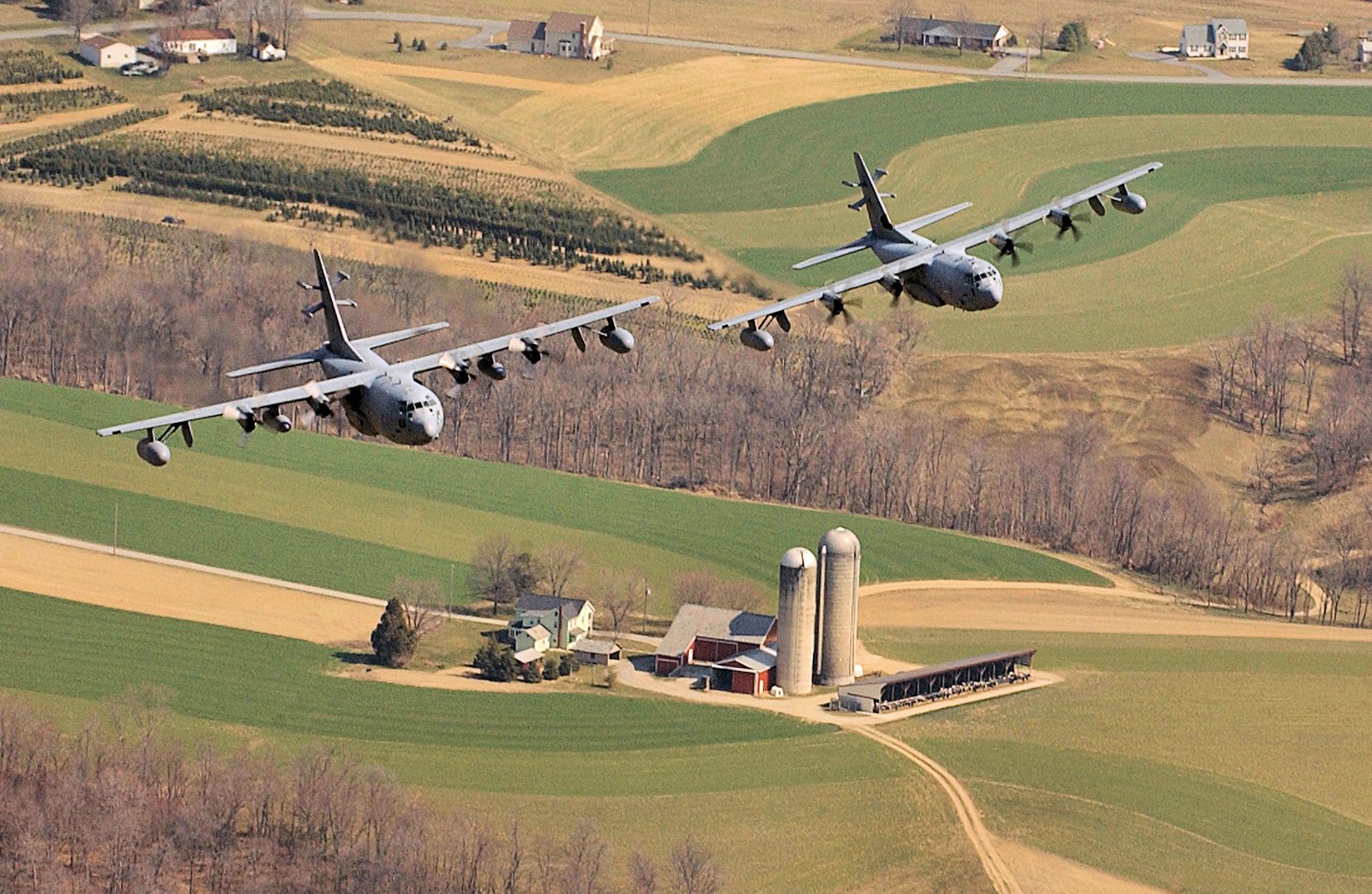
The Lockheed EC-130 is not a standalone aircraft model but a series of special-mission variants based on the C-130 Hercules. Designed to adapt the versatility of a tactical airlifter for electronic warfare, communications relay, and psychological operations, the EC-130 family has served the United States Air Force and United States Navy. The base C-130 airframe, which first flew on August 23, 1954, provided the necessary payload capacity and short-field performance to support these complex mission sets.
Production of the EC-130 series occurred through the conversion of existing C-130E, C-130H, and C-130J airframes at the Lockheed production plant in Marietta, Georgia. The EC-130Q TACAMO, utilized by the U.S. Navy for strategic communications with Fleet Ballistic Missile submarines, saw conversions begin between the late 1960s and early 1970s. The EC-130E ABCCC served as an airborne tactical command post during the Cold War, while the EC-130E Commando Solo—which utilized equipment from retired EC-121S Coronet Solo aircraft—focused on psychological operations (PSYOPS). Beginning in 2003, new-build EC-130J Commando Solo III aircraft were delivered to replace the aging EC-130E fleet.
Technically, the EC-130 variants utilize the propulsion systems of their parent airframes. The EC-130E and EC-130H models are powered by four Allison T56-series turboprops; specifically, the C-130H-based Compass Call uses the T56-A-15 engine, rated at approximately 4,590 shp each. The modern EC-130J employs the Rolls-Royce/Allison AE 2100D3 turboprop. These engines allow the aircraft to carry heavy electronic suites, such as the communications-jamming equipment found on the EC-130H Compass Call, which is operated by the 55th Electronic Combat Group at Davis-Monthan AFB.
In military service, the EC-130 has been integral to numerous U.S. operations. The Commando Solo and Compass Call variants were deployed during the Gulf War (1990–1991), Operation Uphold Democracy in Haiti (1994), Operation Enduring Freedom in Afghanistan, and Operation Iraqi Freedom. More recently, the EC-130H has supported Operation Inherent Resolve against the Islamic State starting in 2014. While the EC-130E was retired by 2006, the EC-130H and EC-130J remain active components of U.S. electronic attack and information operations capabilities.