
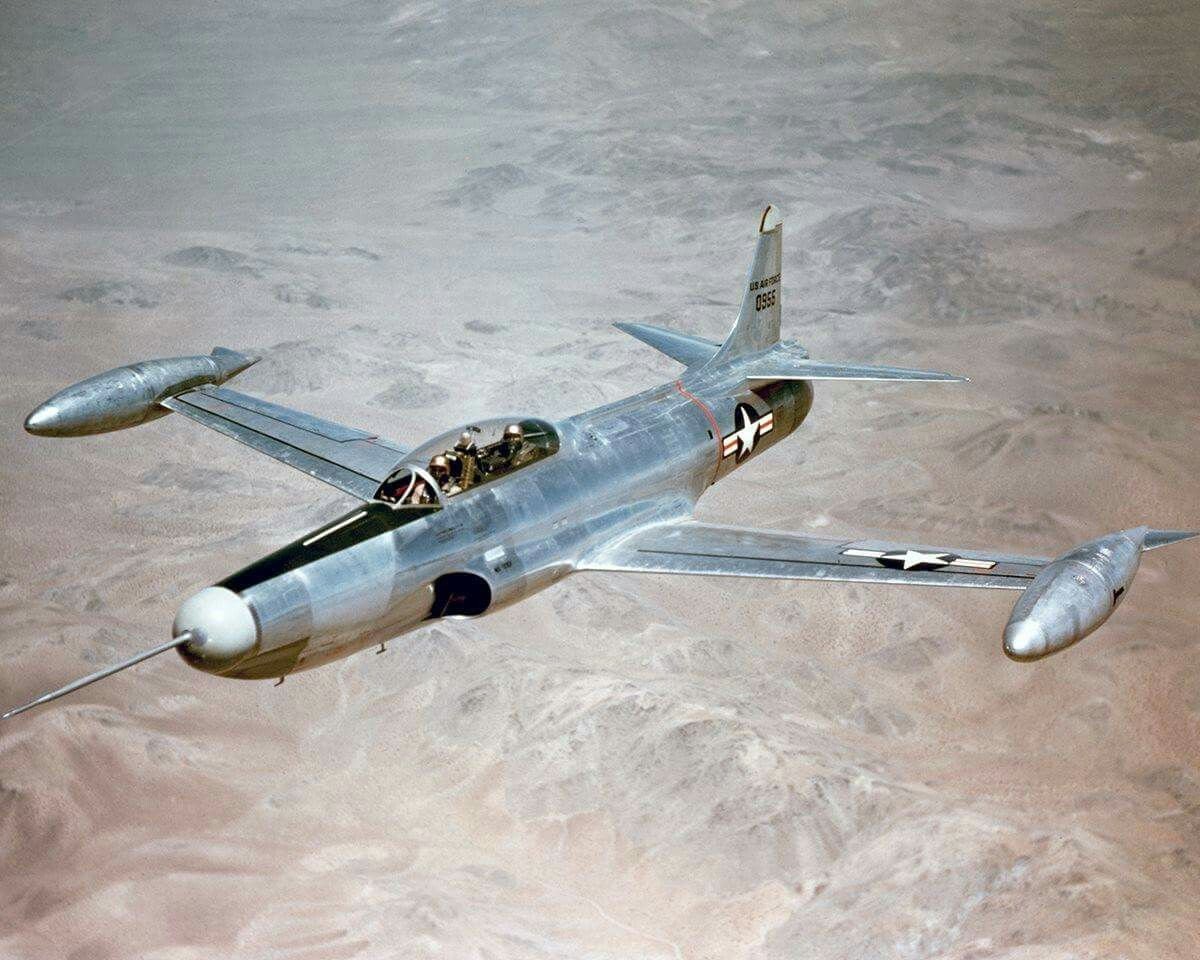
The Lockheed F-94 Starfire was developed to meet a 1948 United States Air Force specification for an all-weather interceptor capable of replacing piston-engined aircraft like the North American F-82 Twin Mustang and Northrop F-61 Black Widow. Designed and produced by the Lockheed Corporation at its Burbank, California plant, the F-94 was derived from the T-33 Shooting Star trainer, which itself evolved from the F-80. While the F-94 retained the wing, tail, and landing gear of its predecessors, Lockheed redesigned the fuselage and lengthened the nose to accommodate a large radar, an automatic fire-control system, and armament.
The prototype, designated the YF-94, first flew in 1949. The aircraft was powered by a single Allison J33 turbojet engine equipped with an afterburner, making it the first operational USAF fighter to utilize this technology. The engine provided approximately 6,000 lbf of thrust with the afterburner engaged. Another notable innovation was the inclusion of a drag chute for aerodynamic braking during landing, marking the first time such a system was used on a U.S. production fighter.
Production began in the late 1940s, with the F-94A entering operational service in May 1950. A total of 853 aircraft were produced, including 110 F-94A variants. The F-94A and B models were armed with four fuselage-mounted 0.50-caliber M3 Browning machine guns, while the later F-94C variant shifted its primary armament to rockets housed in the fuselage and wing-tip pods. Performance varied by model, but the Starfire could reach maximum speeds between 630 and 640 mph, with a service ceiling ranging from 42,750 to 51,800 feet.
During the Korean War, the F-94 became the first jet-powered all-weather fighter to see combat, beginning operations in January 1953. Prior to this, it patrolled Japanese airspace in 1951. In 1952, the aircraft flew night missions from Korean bases, providing air defense and escorting B-29 Superfortress bombers over the Yellow Sea and North Korea. In the continental United States, the F-94 played a vital role in defending against Soviet Tu-4 bombers. The aircraft remained in active USAF service until November 1957, when the 319th Fighter-Interceptor Squadron retired the last F-94C. The Air National Guard continued operating the type until the 179th Fighter-Interceptor Squadron retired the final examples in the summer of 1959.
Today, the F-94 is remembered as a pivotal evolutionary step in interceptor design. Only nine Starfires are known to have survived, all of which are static museum or gate-guard displays; none remain airworthy.